Ludwig Ahgren getting a Twitch logo tattoo while he was streaming on YouTube was already a pretty good joke. Adding his cat made it a much better tattoo. The finished piece pairs Coots with the familiar chat-shaped logo, turning a charity-stream dare into something softer, funnier, and much more personal than a plain company emblem.
The headline-only version misses a little of what appears in the finished picture. The cat isn’t sitting politely beside the logo. It’s hanging over it, with its paws and body wrapped around the shape. That small choice makes the gag legible before the donation, audience vote, or platform joke is explained.
The Coots and Twitch logo tattoo on his leg
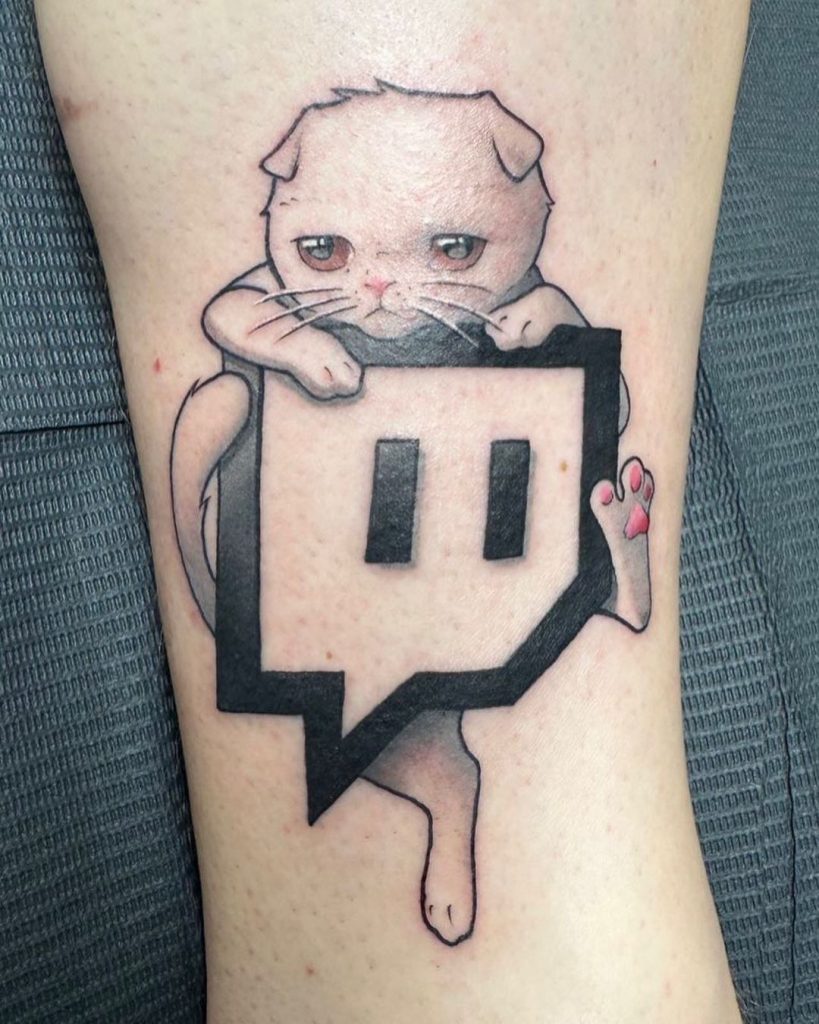
The clearest close-up shows a cartoon Coots draped over a large Twitch logo. The logo has a heavy black border, two dark vertical rectangles inside, and a pointed lower edge. It keeps the basic shape that viewers recognize, but it doesn’t dominate every part of the composition. The cat breaks up the top outline, hangs down beside it, and gives your eye something expressive to settle on.
Coots has a round head, folded-looking ears, a small pink nose, and large eyes with a slightly weary expression. Thin whiskers reach out across the face. The front paws rest over the upper edge of the logo, as though the cat has found somewhere to lean. On one side, you can see a raised paw with pink pads; a long, loosely drawn leg extends below the dark shape. It’s a deliberately cute pose without turning the whole piece into a sugary pet cartoon.
The contrast is what gives the piece its visual identity. The logo is straight, blocky, and dark. The animal is curved, lightly shaded, and a bit floppy. One element feels rigid; the other seems to be climbing over it. The composition keeps both forms readable without a pile of extra decorations. Even the small pink details stay fairly restrained. They give the cat warmth while leaving the black outline in charge.
The finished drawing keeps the joke readable
The tattoo is on his lower leg, rather than on the palm discussed during the earlier challenge. That’s an easy detail to miss if you read a report about the proposed tattoo and never see the finished one. A suggestion made on stream and the piece someone eventually wears aren’t always identical. Here, the completed photograph is the useful reference for the placement and finished appearance.
There’s also a difference between the stencil Ludwig shared during the process and the final ink. A stencil is an outline used for placement. The stencil does not capture the full shading, color, or weight of the finished work. If a picture looks like a simple purple outline, you’re looking at an earlier stage, not a different permanent version of the same piece. The completed close-up gives a much better sense of the cat’s face and the solid black areas.
The Coots detail matters because it changes the balance of the idea. A company logo on its own can look like an advertisement, a dare, or a declaration of loyalty. Put a beloved pet over it and the mood shifts. The platform reference is still obvious, but it shares the space with an animal that belongs to Ludwig’s life. That’s a design observation, rather than a claim that he chose every detail for some hidden symbolic reason.
And the expression is worth a second look. The kitten doesn’t seem triumphant or fierce. Those heavy-looking eyes make the pose feel a little resigned, which suits the comedy of someone following through on a promise he probably shouldn’t have handed over to other people. You don’t need to force a big emotional reading onto it. Sometimes a funny face on a well-drawn cat is enough.
The fresh photograph records the original arrangement without establishing anything about later changes. Lighting, skin redness, and the stage of healing affect a tattoo picture. What it shows clearly is the cat above and around the logo, bold black edges below, and small pink accents that stop the animal from disappearing into the heavier shape.
How a charity promise became a group decision
The setup came during Ludwig’s late-2022 charity subathon. He offered to get a tattoo based on donor suggestions, and Valkyrae’s $15,000 donation put her in a position to suggest something memorable. Her choice of Twitch was especially funny because Ludwig had already moved his livestreaming to YouTube. A straightforward platform logo became a very public bit of friendly troublemaking.
The audience got involved too. A poll included other suggestions, including Coots, and xQc encouraged people to vote for Twitch. Ludwig eventually brought the cat and the logo together. The finished piece combines the audience joke with a personal subject, which is a more interesting result than simply letting the winning option sit by itself on his skin.
The charity stream explains the setting
There’s a familiar tension in any audience-picked challenge: the spectators get to enjoy the choice, while the person making the promise has to live with it. That imbalance is the entertainment. With a tattoo, though, it also means that the final drawing matters after the broadcast ends. The joke might explain why someone booked the session, but it won’t do the visual work for the artist.
That’s why the cat is such a useful addition here. You can take away the chat messages and the vote totals and still have a coherent picture. Someone who knows nothing about the stream can see a little animal hanging over an angular shape. Someone who was there gets the extra layer. Both readings can coexist without a paragraph of explanation squeezed into the tattoo itself.
The platform joke became part of his streaming history
The tattoo also preserves a specific moment in Ludwig’s move from Twitch to YouTube. The platform reference is not presented as a complete career statement; it is the visual reminder of a public joke that continued after the broadcast and became part of his recorded streaming history.
The YouTube joke behind the reaction
When Ludwig shared the process in December 2022, he joked about getting the enemy tattooed on himself and addressed YouTube’s then-chief executive, Susan Wojcicki. She responded with an eyes emoji. His reply played along with the idea that someone had told on him, and he offered to get a matching YouTube tattoo with her. The exchange made the platform joke even easier to understand.
It would be a stretch to turn that into proof of an actual workplace dispute. The public exchange was playful. Likewise, an offer to get matching ink isn’t proof that a second appointment happened. A proposal on social media and a completed tattoo are different things. Keeping that distinction makes the story a lot less confusing.
The timing also matters. Ludwig had left Twitch for YouTube in late 2021, so the contrast had a specific meaning when he got the piece in 2022. You don’t have to treat the logo as a statement about every later career decision. A tattoo can belong to the circumstances in which it was made without becoming a running update on someone’s contracts.
For viewers, that is part of the appeal. The image can bring back a particular broadcast and the people who helped steer it. For everyone else, the cat gives the piece a way to stand on its own. The reference is specific, but the drawing doesn’t require an account on either streaming service to be readable.
Why the audience relationship matters
Ludwig has talked about letting his viewers influence his tattoos before. In his WIRED autocomplete interview, he described an earlier promise tied to reaching 1,000 Twitch subscribers. That account helps explain why another audience-driven tattoo challenge didn’t come out of nowhere. It fits a longer habit of making the viewers part of the stakes.
That doesn’t mean every suggestion from chat becomes permanent, or that every image circulating among fans is something he actually wears. Fan drawings, joke edits, and proposed designs can all look convincing when they’re separated from the conversation that produced them. A photograph of the finished piece does a different job from a clever concept posted in response to a challenge.
There’s something distinctive about that relationship between an entertainer and an audience. A conventional souvenir usually marks an experience you’ve already had. A live challenge can let the crowd help determine the souvenir while the experience is still happening. With Ludwig, the resulting picture becomes a reminder of both the broadcast and the decision to follow through.
The lasting part of the Coots piece is not only the drama of the poll. It is the actual picture left behind once the stream ends: a recognisable Twitch reference softened by a small, expressive drawing of Ludwig’s cat.
The Coots detail outlasts the original dare
The audience-selected origin is part of the tattoo’s history, but the completed image has its own visual logic. The Twitch logo supplies a rigid, immediately recognisable base while Coots supplies the curved outline, face, paws, and small pink accents that keep the piece from reading like a plain platform mark.
The cat changes the logo’s visual tone

The personal detail is the cat’s pose. Coots is not a decorative mark placed beside the logo; the body overlaps the shape and creates the impression of a small animal using it as a perch. That interaction is why the tattoo remains identifiable in a close photograph and still has a comic quality when the wider story is known.
The finished piece works as a funny, recognisable pairing with a clear silhouette and an expressive animal. The charity challenge explains how it happened, while the cat explains why the image remains distinctive after the punch line is familiar. Ludwig shows the finished result below.