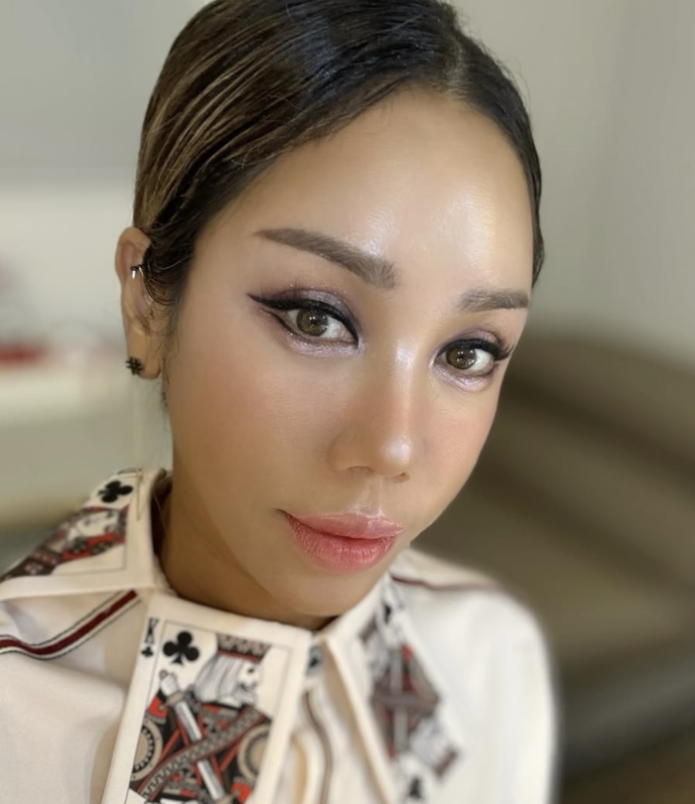
Kim Song’s tattoos cover her upper back, arms, calves and feet. Her photos show fine-line shapes, darker symbols, cartoon figures and text. She has explained two family pieces: a drawing her son made when he was six and his handwriting, copied onto her skin. News coverage describes the words as a message of love to his mother. Song has also said tattooing helps her release stress; most of the other designs are shown without a stated personal meaning.
Kim Song’s tattoos span her back, arms and legs
The collection is varied in size and style. A broad but delicate design crosses the upper back, smaller dark marks sit around the shoulders, and the arms and legs carry their own groups of drawings and symbols. The photos show separate pieces, not one motif repeated across every area.
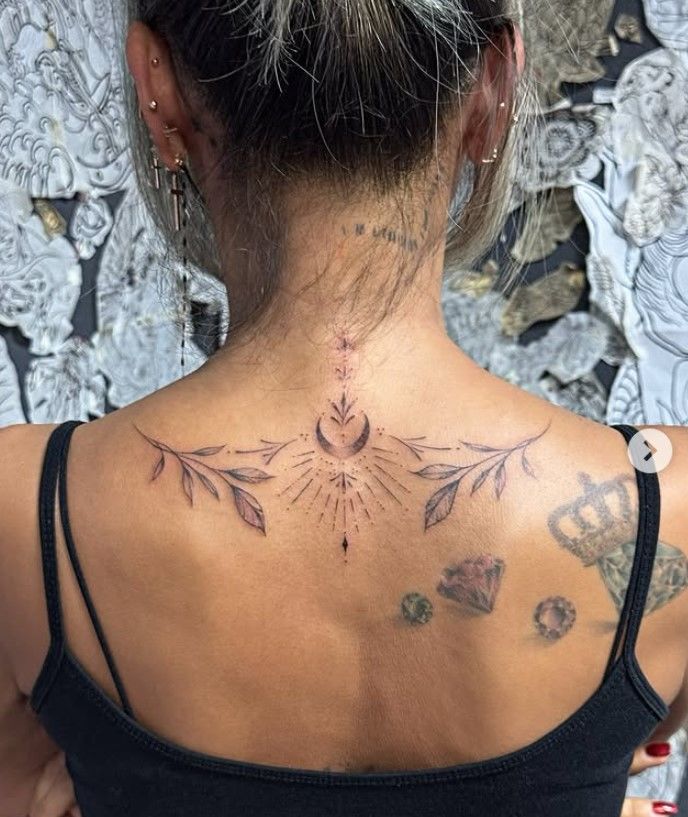
The back image gives a first look at the placement: a central crescent sits between the shoulders, with fine rays and leaf-like lines extending across the shoulder blades. Lower on the back are smaller circular and shaded motifs. The skin remains visible between the lines, so the design reads as separate details instead of a dark block.
Cartoon figures on the calves shift the tone, while the writing on her arm brings in a family story. The collection moves from fine lines to rounded drawings and text; not every mark belongs to the same style or subject.
Fine-line work across the upper back
The upper-back design spreads outward from the crescent in narrow lines and leaf shapes. The arrangement is close to symmetrical, though the branches and small marks don’t mirror each other exactly. They follow the slope of the shoulders rather than forming a rigid square.
Small vertical marks at the centre continue the line down the spine. A darker piece near the upper arm and several compact designs below the shoulder line add contrast to the fine central work. Subtle shading and open skin keep the narrow branches distinct from those darker marks.
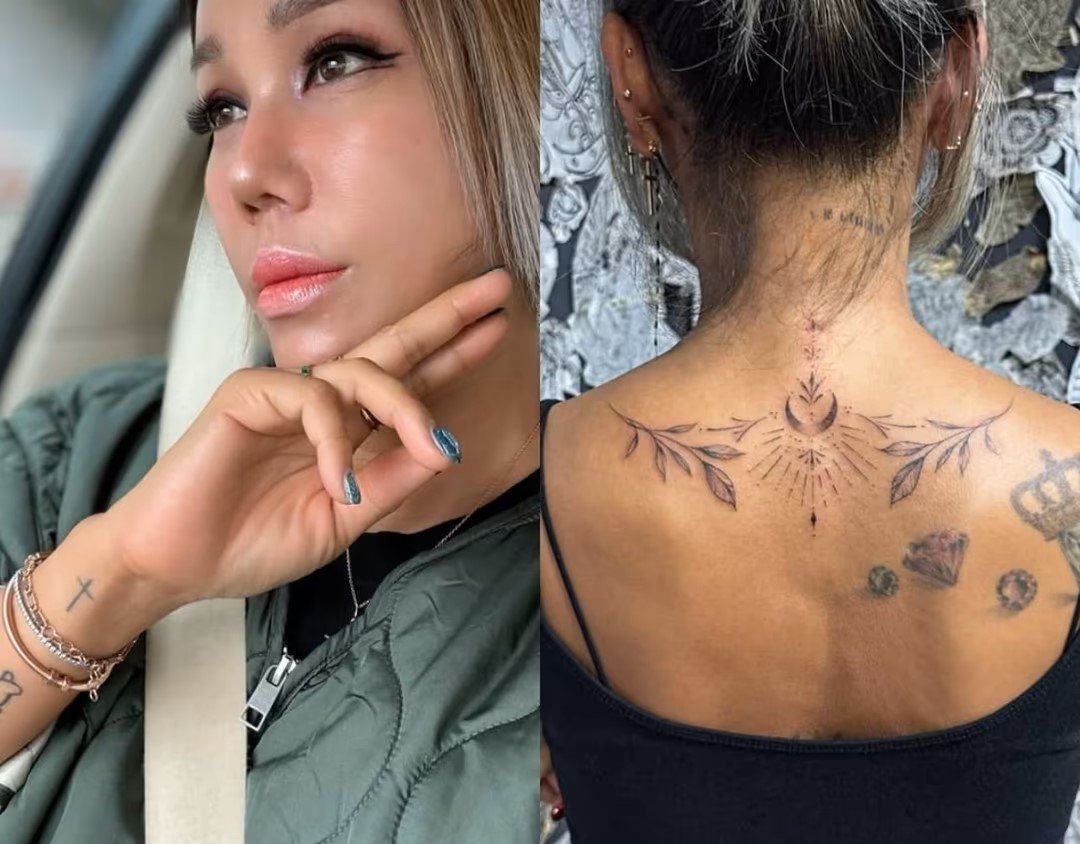
The alternate back view shows how the placement changes as Song turns. The crescent and fine branches sit across both shoulder blades, while the smaller marks below become easier to see. The images show the design’s layout and linework; they don’t provide a personal explanation for the crescent or other symbols.
Cartoon-style tattoos on the calves
The calf tattoos use rounded, cartoon-like figures with expressive faces. Their playful look contrasts with the fine-line back piece and the text on Song’s arm. The figures are placed vertically along the lower legs, with smaller marks near the ankles.

The shoes and wider crop help show the figures’ scale against the calves. In a close view, each character can seem compact; seen with the lower leg, the designs take up a longer stretch of skin. The shapes follow the calf rather than sitting in a small patch near the ankle.
These drawings add a different subject to the collection. Their outlines and faces have a lighter tone than the back’s crescent and leaves, but the photos don’t explain why Song chose them. Their appearance is clear even without assigning them a story.
Her son’s drawing and handwriting on her arm
Song has spoken about her son’s contributions to the writing on her arm. She said his handwriting was copied directly, alongside a drawing he made when he was six. News coverage describes the words as a message of love to his mother. The uneven letters preserve the shapes he made rather than turning them into a standard tattoo font.

The arm photo also shows smaller symbols and a Nike swoosh near the writing. The lettering occupies an open strip of skin, so the words remain visible beside the other marks. The baseline and spacing wander in places, keeping the original handwriting’s character.
That piece carries the most specific family meaning in the published accounts. The drawing and writing come from her son; the other nearby symbols remain visible details without a documented explanation.
A wider view shows the different tattoo placements
A composite photo brings the back, arm, calves, feet and upper-arm designs into one view. It makes clear how the tattoos are spread across the body rather than concentrated on a single arm or one side of the back. The details still appear as separate groups, each with its own scale.
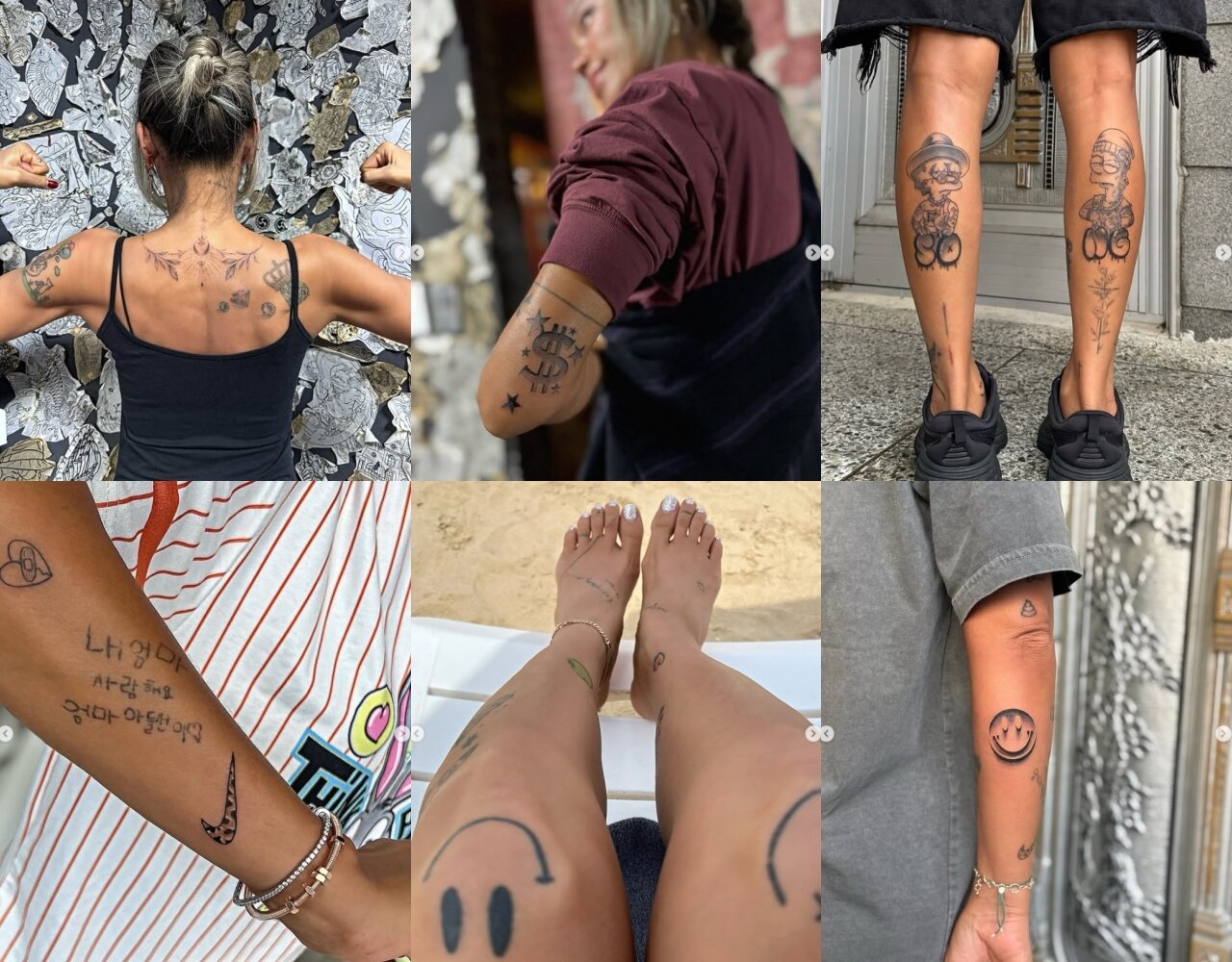
The wider frame also shows small marks on the feet and lower legs that a tighter crop can miss. Close photos are better for reading fine lines and handwriting; the multi-view image gives a better sense of how many areas carry ink and how the pieces are spaced.
The collection’s mood shifts from one area to another. A cartoon face can sit near a darker symbol, while the upper-back lines remain light and open. The photos don’t make every mark part of one theme; they show the different designs together.
Kim Song’s public story
Song is a singer, broadcaster and former dancer in South Korea. She is also publicly known through her long relationship with Kang Won-rae of Clon. Coverage of the couple has included their family life, Kang’s 2000 motorcycle accident and their marriage. Their son is part of the tattoo story because Song used his childhood drawing and handwriting in her body art.
Song has described tattooing as a personal way to release stress and has responded to criticism about her appearance. She has said the designs belong to her and that she decides what they mean in her life. That is her stated position; it doesn’t explain the private meaning of each pictured tattoo.
Her account gives context for the family writing and for tattooing as a personal choice. For the other marks, the photos show the shape and placement. The crescent, cartoon figures, small symbols and text can be described without guessing at a private story.
The designs and their documented meanings
The photos show Song mixing fine lines with darker marks, cartoon figures and handwritten text. She has tattoos across her back, arms, calves and feet rather than keeping them in one area. The upper back provides the largest fine-line composition; the calves hold rounded characters; the arm carries the family writing and nearby symbols.
Only a few pieces have a stated story in the coverage: her son’s drawing and handwriting, and her comment that tattooing helps with stress. Other designs are visible, but their meanings have not been supplied in these accounts. That difference keeps the family details distinct from visual descriptions of the rest.
How the designs fit their placements
The upper-back lines follow the shoulders and leave open skin around the crescent. On the calves, the rounded figures use the length of the lower leg; the forearm writing keeps the uneven letterforms of her son’s hand. Each area shows a different approach to scale and line.
The photographs also show why a closer view and a wider one tell different parts of the story. Close-ups bring out the fine back lines and the writing; the composite makes smaller placements on the feet and legs easier to notice. Together, they show the different placements; the meaning of designs she has not discussed remains hers to explain or leave private.