
Khvicha Kvaratskhelia tattoos have become a visual record of family, Georgia and the footballer’s changing life between Napoli, Paris and the national team. The public images do not show one single design repeated from one angle. They show a growing collection: older lettering and line work on the arm, a family-related initial, a map of Georgia, and a newer studio session that adds several fine-line elements to an already personal sleeve. Because the photographs come from different moments, the useful question is not simply how many tattoos Kvaratskhelia has. It is how each image adds a new piece of the timeline.
The selected set is deliberately tattoo-first. A Paris studio collage documents a fresh session. A Georgian sports report shows the map design on the forearm. A family photograph catches another initial in a real-life setting. An earlier close view records the first arm tattoo, while an official Paris Saint-Germain motion portrait shows further ink from a separate studio asset. The images are different originals and are mapped to the sections where they belong. The official PSG card is kept as the separate face-visible identity portrait, so the article never asks a tattoo photograph to do the job of an identity anchor.
The Paris studio reveal shows a new stage of the tattoo collection
The clearest recent image comes from the Paris studio reveal reported by Napoli Magazine. In the upper frame, Kvaratskhelia sits while an artist works across his forearm. The arm already carries several designs, but the photograph captures the process of adding new ink rather than presenting a finished tattoo as a mysterious object. A second frame in the same published source shows the footballer beside the tattoo artist, with the lettering and larger line-work visible across the arm. The paired composition makes the moment identifiable as a real session.

The studio image matters because it documents process, not just result. The artist’s position, the equipment and Kvaratskhelia’s relaxed posture place the photograph inside an appointment. That is stronger evidence than a cropped repost whose provenance is unclear. It also explains why the collection looks layered. Older tattoos remain visible around the fresh work, so the arm reads as an archive that has been expanded over time instead of a single design applied all at once.
The visible motifs are fine-lined and varied. Some marks are small enough to read only at close range, while other elements use heavier black contours. The studio photograph should not be used to invent an exact catalogue of every symbol. Its editorial value is more precise: it proves that Kvaratskhelia has continued to add genuine tattoos, and it establishes Paris as the setting for a later phase of that work.
That distinction keeps the article close to the evidence. A tattoo seen during an appointment is documented as a tattoo, but the exact meaning of every line remains personal unless the athlete or the artist has explained it. The photograph gives a reliable visual record without turning a private decision into a story the sources do not support.
The Georgia map turns the forearm into a national reference
A separate Georgian report presents a much more legible design: an outline map of Georgia on Kvaratskhelia’s forearm, accompanied by lettering above it. The layout is useful because the map can be seen in context on the arm and in a closer inset. It is not the same photograph as the Paris studio reveal. The jersey, lighting and pose are different, and the design is shown as a specific national reference rather than as part of the wider studio collage.
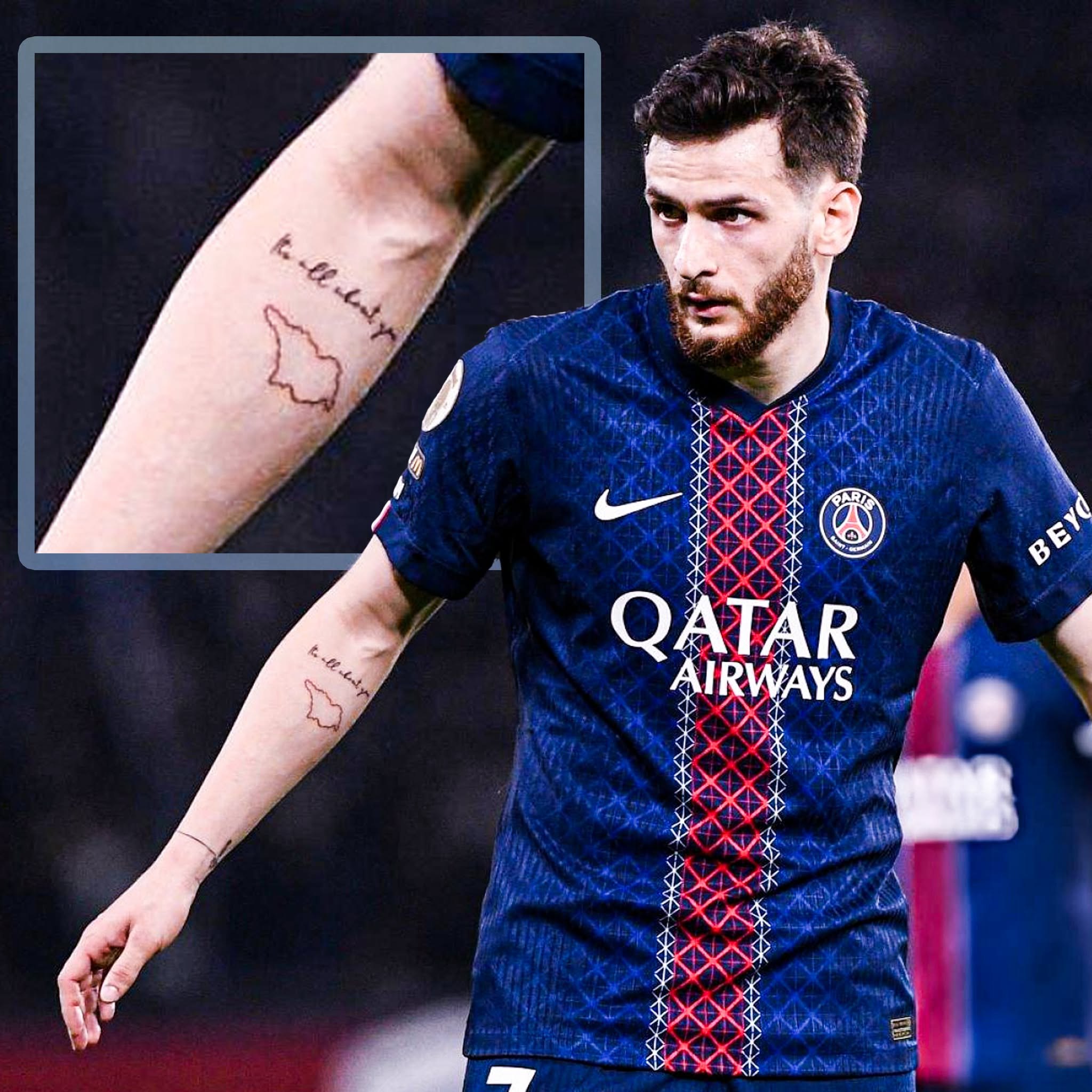
The map is a compact image of belonging. Kvaratskhelia’s career has carried him from Tbilisi and Georgian football into major European competition, but the tattoo does not need a long speech to communicate that the country remains central to his identity. The outline is immediately recognisable to readers who know Georgia, while the small scale keeps the mark intimate rather than theatrical.
The forearm placement also changes how the collection is read. On a working footballer’s body, the tattoo appears during movement, travel and competition. It is close enough to be noticed in short sleeves, yet it is not presented as a performance graphic. The image shows a personal sign carried through public life. That is why the map belongs in a section about national identity, not in a generic gallery of footballer fashion.
The report does not establish every date or the name of the tattoo artist, so those details are not added here. What it does establish is the visible design and the subject’s identity. A careful tattoo dossier can be satisfying without filling gaps with guesses. The Georgia map is meaningful because the photograph already makes its reference clear.
A family tattoo image gives the initial a different context
The family tattoo photograph comes from a Sportline report and looks very different from the studio and map images. Kvaratskhelia is photographed with family at a football setting, and a close view of the upper arm reveals a small initial-related design. The frame is not a staged tattoo portrait. That is its strength. The design appears as part of an ordinary personal moment, giving the ink a family context rather than presenting it only as a piece of celebrity styling.
The image needs careful description. It shows a small mark and its placement, but it does not prove a complete family tree or justify assigning a private meaning to every letter. The published Georgian coverage connects the design to family, which is enough to explain why the tattoo is included in the collection. The photograph itself supplies the visual evidence; the copy stays close to that record.
Small tattoos often carry the most private references. The family frame contrasts with the Georgia map because the national design speaks broadly while the initial narrows the circle. Both marks can exist on the same arm without competing. One is readable to a large audience, and the other is more likely to be understood fully by the people closest to Kvaratskhelia.
The setting also helps distinguish original photographs from recycled images. The stadium background, clothing and family arrangement are unique to this source. It is not a crop from the Paris studio collage or a second copy of the forearm reveal. That difference matters when a post promises more than one tattoo image. Every placement should add new visual information, not simply repeat the same frame with a different caption.
The first arm tattoo shows where the visual timeline begins
An earlier Sportline report records what the sources describe as Kvaratskhelia’s first tattoo. The design is a small black mark on the upper arm, shown in a football portrait with an inset detail. The original image includes editorial arrows and a magnified circle, so it is retained as documentary source material rather than presented as a clean studio photograph. Even with those graphics, it is a distinct original from a different date and a different report.

The first tattoo is important because chronology changes interpretation. Once later images show a larger collection, it is easy to imagine that all of the work appeared together. The earlier frame prevents that shortcut. It places one small design at the beginning of the visible record and helps explain how a series of additions could develop around it.
The inset also makes a practical point about tattoo photography. A mark can be genuine but difficult to see in a full-body or match-day picture. Editorial crops, close-ups and source-page details can make the difference between an unsupported claim and a documented one. At the same time, the arrow and circle must remain part of the disclosure. The post should not imply that the source image was an unedited portrait when it was actually a report graphic.
That honesty does not reduce the image’s value. It tells readers exactly what they are looking at: a published image used to identify an early tattoo, not a claim that the graphic itself belongs to Kvaratskhelia’s skin. The design is on the arm, the source identifies the subject and the report supplies the timeline. Those are the useful facts.
The PSG motion portrait reveals additional arm ink
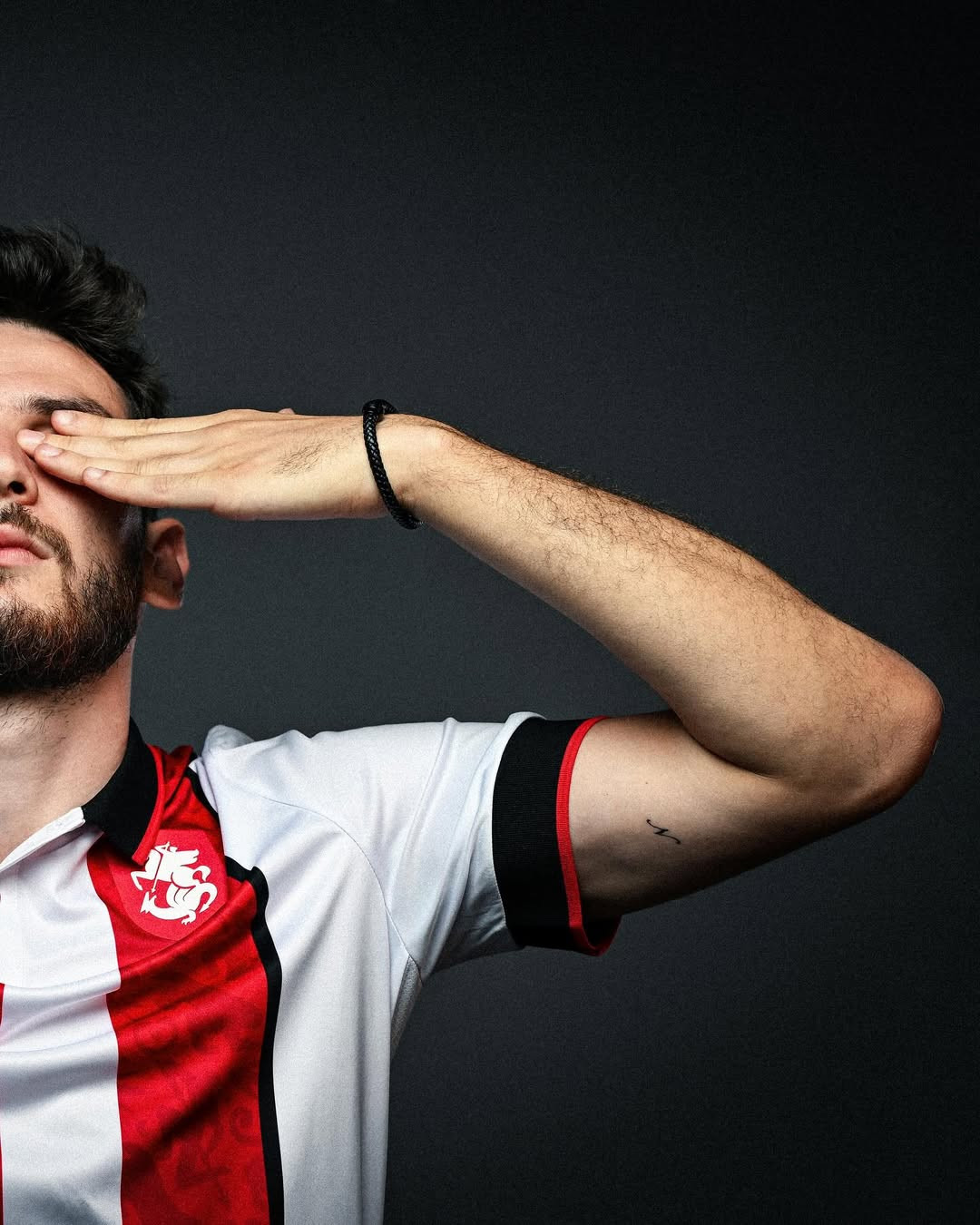
The official PSG motion asset adds another distinct view. Kvaratskhelia is turned away from the camera in the club kit, so it is not used as the face-visible identity portrait. His arm remains exposed, however, and several tattoos are visible along the forearm and upper arm. The image belongs to a separate official club production rather than to the Georgian reports, giving the collection a different setting and a new arrangement of the ink.

The back-facing pose is editorially useful precisely because it is limited. It cannot identify a face on its own, and it should not be alt-texted as a portrait. It can show how the tattoos sit when Kvaratskhelia is wearing a short-sleeved shirt, how the marks continue down the arm and how much of the collection is visible outside a close-up reveal. The official jersey also places the tattoo record in his Paris chapter without confusing club identity with tattoo meaning.
Different angles are not automatically duplicate evidence. The PSG asset is not another copy of the Paris studio collage. The body position, background, kit and visible arm arrangement are different, and the source is an official club media file. It therefore earns a separate slot. The distinction is visual and editorial, not merely a different URL for the same photograph.
At the same time, the image should not be used to name designs that the source does not identify. It supports the claim that additional arm tattoos are visible in a later official portrait. It does not supply a catalogue of meanings. The cleanest article separates what the camera proves from what only Kvaratskhelia or a tattoo artist could explain.
The subject in context
The PSG player card is the separate face-visible identity image for this article. It shows Kvaratskhelia facing the camera in the club kit and confirms the subject without being asked to prove the tattoo collection. The card is intentionally not repeated as an inline tattoo photograph. Its job is to give readers an immediate visual anchor, while the five mapped tattoo images carry the evidence about ink and placement.
This separation is especially important when a player has several tattoos and many images circulate without captions. A face-visible portrait answers who the person is. The studio reveal, map frame, family photograph, first-tattoo report and official motion asset answer what tattoo evidence can be documented. Keeping those functions separate prevents a generic portrait from being described as if it showed a design it does not reveal.
The card also marks the change in professional setting. Kvaratskhelia is now represented in Paris, but the collection still includes Georgian national imagery and family references. The tattoos do not erase the earlier chapters. They sit alongside the club identity, the national story and the private relationships that the reported designs refer to.
Reading the visual timeline
Taken together, the five tattoo-bearing originals establish a continuing visual timeline. The Paris studio image documents a new session. The Georgia-map image records a national symbol on the forearm. The family photograph shows a smaller initial-related mark in a personal setting. The earlier report identifies the first tattoo, and the PSG motion asset shows further ink in a later official club portrait. These are not five repetitions of one picture. They are five different source moments with different visual jobs.
The photographs do not establish every meaning, date or artist. They also do not prove that the collection is finished. Tattoos can be added, covered, retouched or photographed differently as a career changes. The careful editorial approach is therefore to treat the selected images as a documented snapshot rather than as a final inventory.
That restraint makes the visual story more persuasive. Kvaratskhelia’s tattoos are not presented as a generic footballer sleeve assembled for a gallery. They move between country, family, chronology and professional life. The visible designs are small enough to remain personal, yet distinct enough to create a record across several years and several source families.
Why the collection reads as a personal archive
Khvicha Kvaratskhelia tattoos are best understood as an evolving archive rather than a single statement. The map of Georgia carries a public identity. The family-related initial narrows the meaning to a closer circle. The first arm tattoo gives the sequence a beginning, while the Paris studio and PSG images show that the collection has continued to develop. The differences between the photographs are part of the story.
The strongest evidence is the combination of variety and restraint. There are enough distinct tattoo-bearing originals to show change without relying on recycled frames. There is a separate face-visible portrait to anchor identity. The sources include official club media, Georgian sports reporting and a report about the Paris studio session. Each image is placed after introductory prose and followed by analysis, so readers can see why it belongs where it appears.
Future photographs may add more designs or clarify the meaning of the smaller marks. If that happens, new images should be treated as new evidence and checked against the existing archive for duplicate frames. For now, the collection already shows a clear pattern: Kvaratskhelia carries his national identity, family references and career changes on the same working arm, adding new layers without turning the older ones into disposable decoration.
The result is a tattoo story with a recognisable human scale. A map can stand for a country, a letter can stand for family and a first small mark can become the starting point for a larger collection. The camera records those designs in studios, stadiums, family moments and official club media. Read together, the photographs show not just what ink Kvaratskhelia has, but how a public football career can preserve private references in plain sight.