Florence Pugh has never seemed especially interested in doing things the safe, expected way. That comes through in her acting, obviously, but it also shows up in the small collection of tattoos she has picked up over the last few years. None of them feel like random celebrity decoration. They’re personal, a little odd, and often tied to a moment in her life or a project that mattered to her.
Her collection is also a good reminder that a tattoo doesn’t need to be huge to have a strong point of view. Pugh’s pieces sit mostly around her wrists and forearms. They’re fine-line, easy to miss in a red-carpet photograph, and varied enough that there isn’t one single “Florence Pugh style.” There’s a worker bee, a maypole linked to Midsommar, a tiny matchstick, and a fine-line forearm image that has been described as arrows pointing toward a deer.
Florence Pugh’s tattoo collection in one look

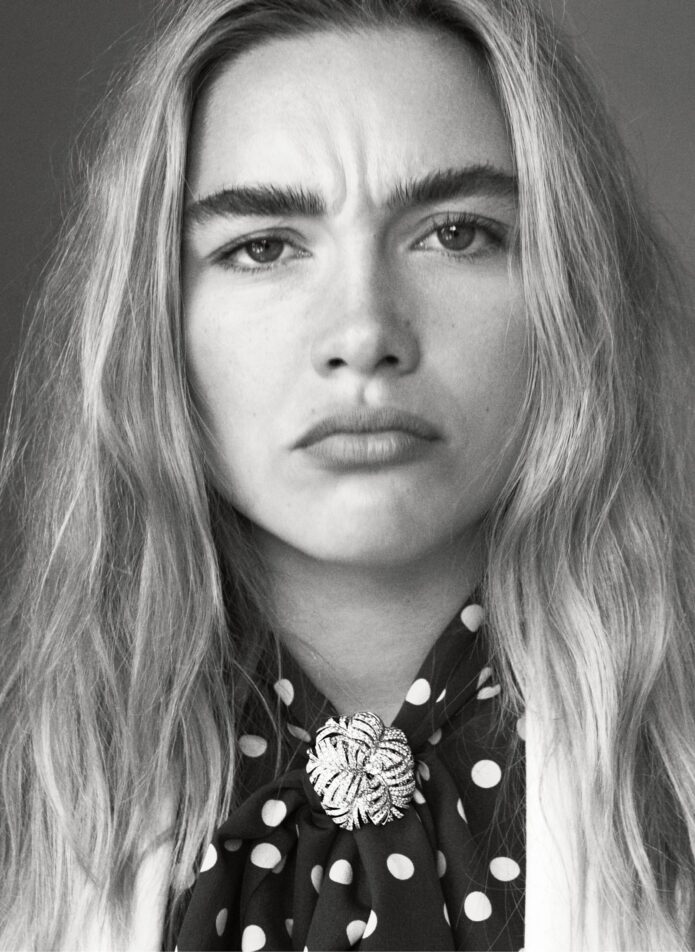
This Vogue portrait is here to set the mood around Pugh’s understated approach to personal style. The tattoos themselves are much easier to understand when you look at them as small symbols rather than as one large visual project.
The best-documented starting point is the worker bee on her inner wrist. Vogue reported that Pugh walked into a New York tattoo parlor with her sisters and ended up getting tattooed even though she had not planned to. She had originally imagined a snail, then changed her mind and asked for a bee. In the interview, she described wanting something “quite mathematical” and seen from above, rather than a lifelike insect.
That detail says a lot about the piece. It isn’t a soft, realistic honeybee with shading and flowers around it. It’s a compact line drawing, closer to a symbol or diagram. The shape has enough personality to read as a bee, but the restrained treatment keeps it light on the skin. It’s the kind of small wrist tattoo that can disappear under a sleeve and then pop back into view when the hand turns.
What the sources confirm
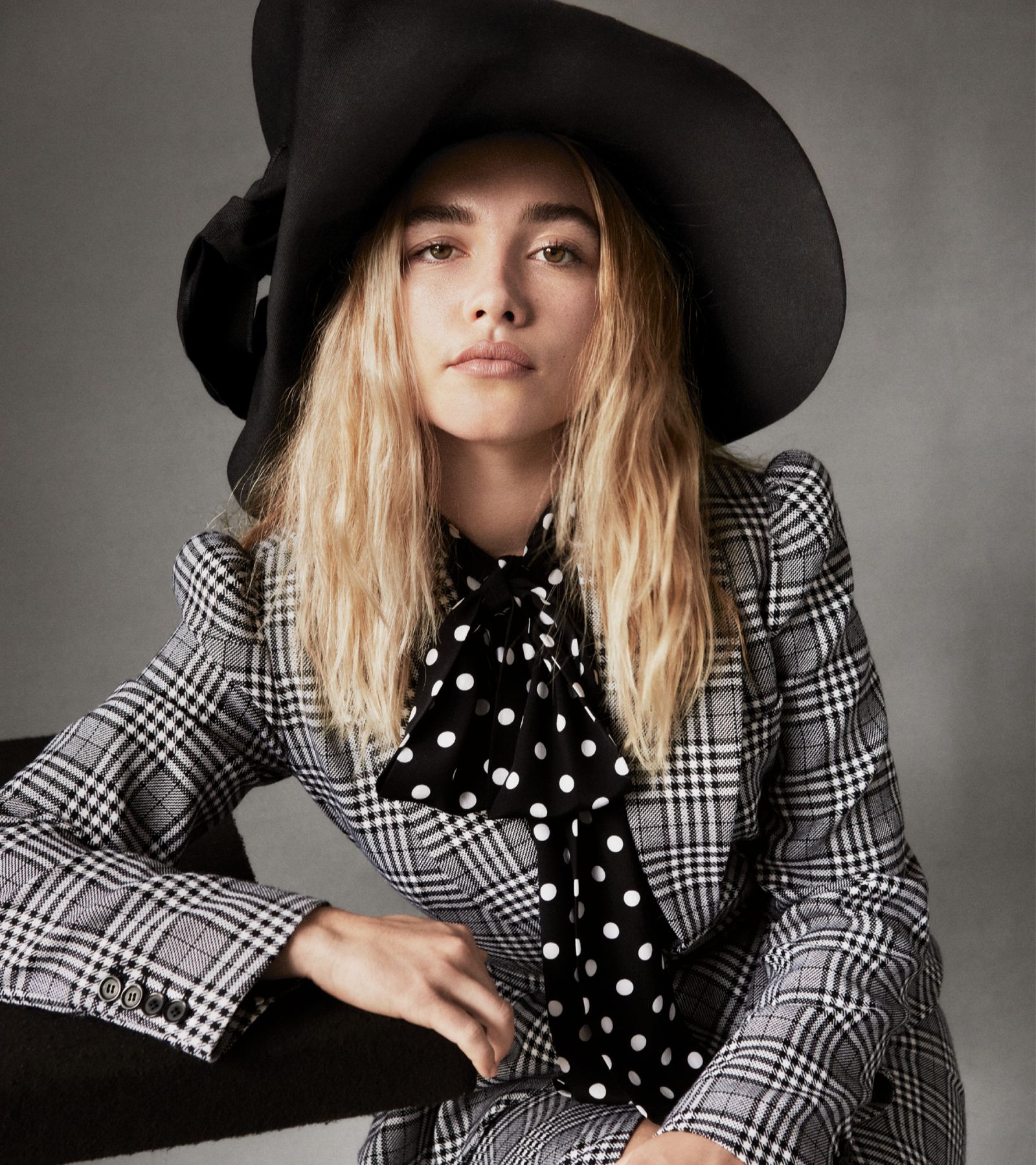
Pugh’s work in Midsommar made the maypole image especially memorable, but this editorial portrait isn’t a photograph of the tattoo. It’s included as visual context for the film connection and the period when the piece became part of her public image.
The maypole is the tattoo with the clearest film connection. Capital reported that fans spotted it during one of Pugh’s Instagram Live cooking sessions and identified it as the maypole from Ari Aster’s Midsommar. The film’s maypole is more than set dressing: it sits at the center of the strange summer celebration and the transformation of Dani, Pugh’s character.
That makes the choice feel more interesting than a standard movie logo. Pugh didn’t get a portrait of Dani or a title treatment. She chose a simple object that carries the atmosphere of the film without spelling everything out. It works as a private reference for people who know the movie and as an abstract little shape for everyone else.
Reports sometimes place the maypole on different parts of her arm, which is understandable when the reference images come from casual livestream footage and event photographs. The safest description is a small maypole-inspired symbol on her wrist or forearm, connected to Midsommar. The photo evidence is informal, so it’s better to describe what’s visible than to pretend every detail has been officially catalogued by Pugh herself.
How the collection changed
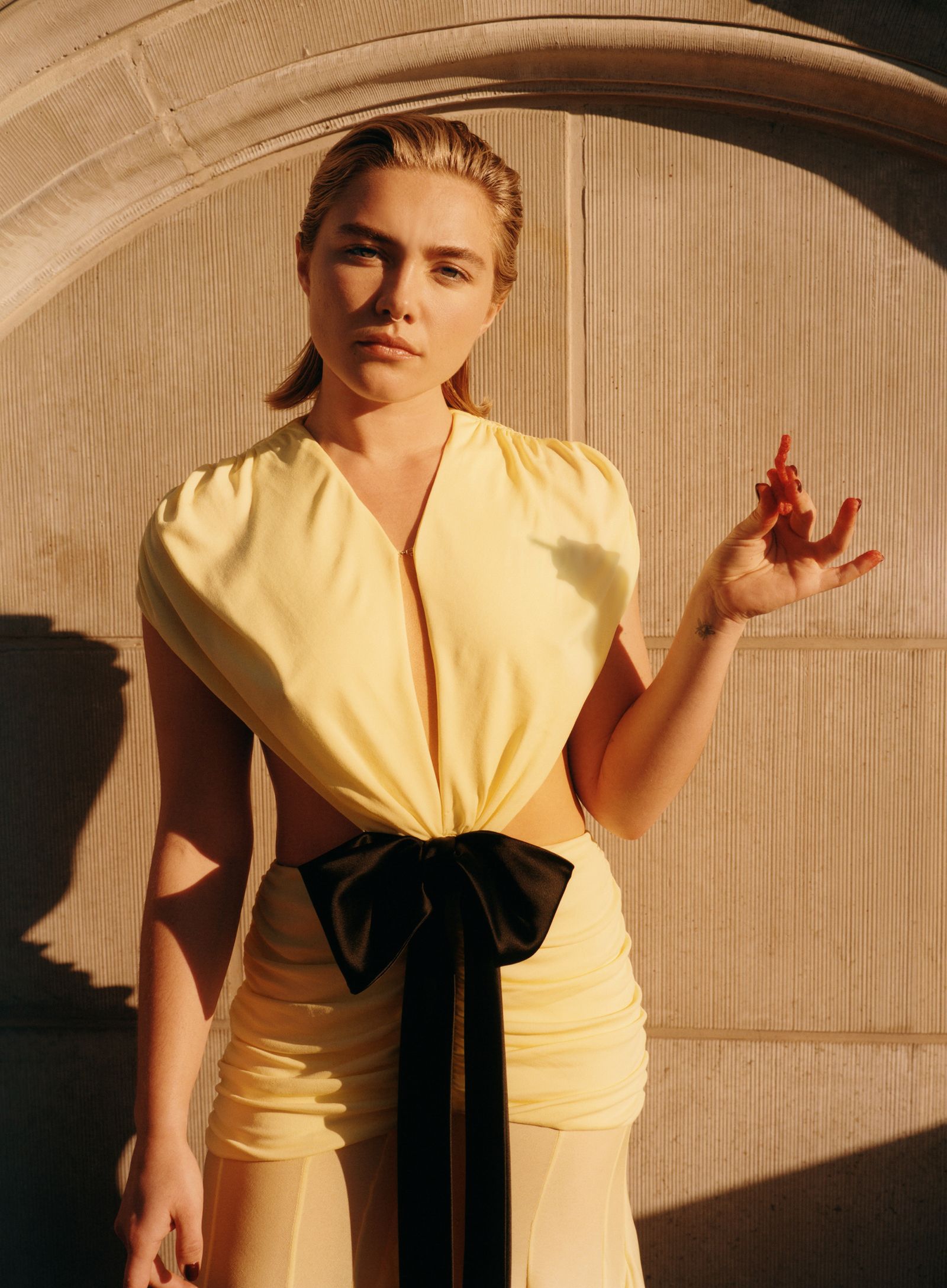
This Vogue image shows Pugh in a warm, high-fashion setting, separate from the close-up views used to discuss her actual body art.
The worker bee has a nice bit of tension in it. Bees are familiar, almost universal symbols, but Pugh’s version is stripped back and slightly technical. There’s no obvious attempt to make it cute or ornate. The choice came from an impulsive afternoon in New York, yet the finished mark sounds carefully considered. She knew she wanted the top-down shape, and she wanted the drawing to feel mathematical.
That combination is useful inspiration if you’re thinking about a small personal tattoo. Start with a symbol that already has a strong silhouette. Then remove anything that doesn’t help it read. A bee can be reduced to the body, wings, and a few clean divisions. At a tiny scale, that clarity matters more than extra texture.
Placement matters too. The inner wrist is visible when Pugh wants it to be, but it’s easy to cover with a watch, bracelet, or sleeve. That gives the piece a casual quality. It isn’t presented like a trophy. It’s simply there, part of her everyday life.
What remains uncertain
Contextual photo only – not tattoo evidence. This image is a separate editorial portrait and should not be read as proof of any specific mark on Pugh’s skin.
PopSugar’s 2021 roundup describes four known pieces: the worker bee, the maypole, a fine-line forearm tattoo involving two arrows and a deer, and a matchstick with the word “matchstick” beneath it. The last two are harder to interpret with certainty because they’re usually seen in event or social-media photographs rather than in a dedicated tattoo reveal.
The arrows-and-deer piece is a good example of why celebrity tattoo coverage needs a little restraint. Viewers can make out a fine-line composition, but the meaning has not been publicly explained by Pugh. It’s tempting to assign a deep symbolic story to every animal or arrow, but there isn’t a reliable quote to support one here. The honest description is also the most useful one: a small, fine-line image whose exact meaning remains private.
The matchstick is more direct visually. It reads like a tiny lit match, with the word below it. Text under a miniature symbol can be tricky because letters spread and soften over time, but the pairing gives the mark a playful flash of personality. It feels less like a grand declaration and more like a private joke that happens to be visible.
Together, these smaller pieces create variety without making the arms feel crowded. That’s one of the strongest lessons in Pugh’s collection. A group of tiny tattoos can have rhythm when the shapes are different and the placements leave enough breathing room.
Final thoughts
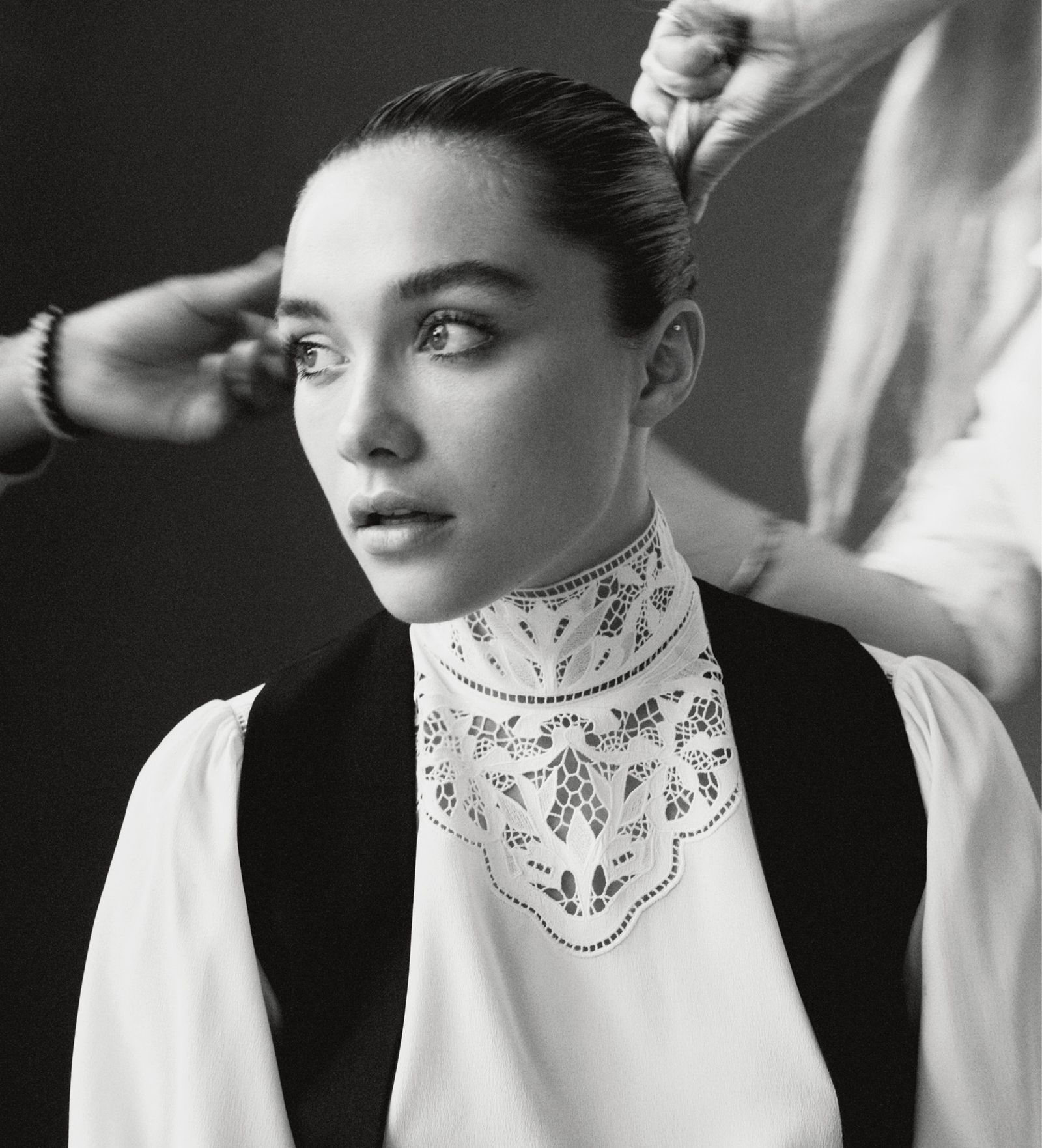
Contextual photo only – not tattoo evidence. The photo gives a separate look at Pugh’s face and styling, while the tattoo discussion stays grounded in the documented sources above.
Pugh’s known pieces are mostly close to the hands and lower arms, which makes practical sense for someone whose work involves costumes, makeup, and constant changes in appearance. Small wrist tattoos can be covered when a character needs clear skin. They can also be shown without turning every outfit into a deliberate reveal.
For anyone planning a similar placement, the inner wrist is a high-visibility spot even when the tattoo is small. It moves constantly, catches the light, and is often exposed when you gesture. That can be great for a symbol you want to live with in plain sight. It also means the design needs to be clean and the scale needs to be realistic. Fine lines that look elegant in a reference image can blur if they’re packed too tightly.
The forearm gives a little more room and tends to age more predictably, especially when the design has an open shape. A maypole, arrows, or a matchstick can all work because they have simple outlines. A good tattooer would still adjust the size and spacing to suit the individual arm rather than copying a celebrity photo exactly.
A relaxed collection, not a matching set
What makes Florence Pugh’s tattoos interesting is that they don’t look like they were planned as a matching set. The worker bee came from a spontaneous decision. The maypole connects to a film that changed the way people saw her. The other small pieces add different moods: mysterious, funny, and slightly offbeat.
That mix feels more believable than a perfectly coordinated sleeve. Real collections grow over time. One piece might come from a trip, another from a conversation, and another from a role that stays with you after production ends. Pugh’s tattoos reflect that kind of accumulation.
There’s also a useful distinction between confirmed information and fan interpretation. Vogue gives a direct account of the bee and the tattoo-parlor story. Capital gives a clear report about the maypole and where fans spotted it. PopSugar documents the broader group and repeats the visual descriptions. Beyond that, some details remain uncertain. That doesn’t make the collection less interesting. It just means the mystery belongs to Pugh.
Ideas to borrow without copying
If you like the feel of Pugh’s collection, the best move is to borrow the approach rather than the exact artwork. Pick a symbol that has a real connection to you. Keep the silhouette readable. Think about whether you want a mark that disappears under a cuff or one that stays visible. Then give the tattooer room to redraw it for your skin and the scale you actually want.
A tiny symbol can also carry more personality when it avoids the most obvious version of an idea. Pugh’s bee isn’t surrounded by honeycomb. Her film reference isn’t a literal title. The matchstick is paired with a word, but the overall piece stays small. Those decisions keep the designs casual and personal.
It’s worth remembering that small tattoos still need care. Fine-line work can look delicate while it heals, and the final result depends on placement, skin, aftercare, and how the artist handles the scale. Don’t squeeze extra detail into a space that can’t support it. The cleanest version usually lasts better and reads better.
The simple takeaway
Florence Pugh’s body art works because it feels lived-in. The worker bee has an impulsive origin but a precise shape. The maypole carries a real connection to Midsommar without turning into obvious merchandise. The arrows, deer, and matchstick add questions and humor without overwhelming the rest of the arm.
That’s a solid formula for a personal collection: choose symbols with a reason behind them, keep the drawing clear, and let each piece arrive when it feels right. You don’t need a huge statement to make a tattoo memorable. Sometimes a little bee, a strange maypole, or a matchstick is enough.