
Declan Rice’s documented tattoos form a small but increasingly detailed record of family, football and personal milestones. The clearest pieces are not hidden behind vague descriptions: photographs show lettering on his forearm, a date-and-name tribute to his son Jude, and a newer number tattoo on his leg linked to his England career. Other reports identify a number 41 piece around the knee and an inscription connected with his father.
The collection has grown in public view as Rice moved from West Ham to Arsenal and established himself with England. The available photographs do not prove every tattoo on his body, but they do show a consistent preference for words, dates and numbers. That makes the visible lettering especially important, because each mark can be tied to a placement or a documented life event without inventing a private explanation.
Declan Rice’s photographed collection
Rice’s public tattoo record is built from different kinds of photographs. A match image isolates the lower-left-arm tribute to Jude, a training photograph enlarges the 1241 marking on his leg, and a studio-style football portrait makes the John Rice inscription readable. A separate family photograph shows the same forearm in a natural setting, while another close image captures the phrase Nothing Else Matters.
Those views matter because the tattoos appear at different scales. The Jude design is legible as a line of script and numbers, the leg mark is presented as a compact block of lettering, and the forearm phrases run horizontally along the skin. A single full-body portrait would not show all three kinds of detail. The photographs therefore work as a record of placements rather than as interchangeable decoration.
The Jude name and birth-date tattoo

The most clearly explained tattoo is the tribute to Rice’s son, Jude. The Independent reported that the forearm design includes the name Jude, the date 07.08.22 and the Leo symbol associated with the month of August. The arrangement is written in fine script across the lower left arm, with the name and date sharing one compact horizontal line.
The close match photograph shows the ink against Rice’s claret-and-blue shirt. The date sits at the left of the design, followed by a centered dot and the name in a flowing script. The image does not show a large pictorial element around the lettering, so the visible identity of the tattoo comes from the text, its spacing and the small astrological symbol rather than from shading or portrait work.
Rice first revealed the tattoo after the birth of his son in August 2022. Reports described the fresh ink as a personal tribute, and later public photographs kept the same forearm placement visible. The piece is therefore one of the rare tattoos in his collection with a documented name, date, symbol and family connection all identified by reporting.
The Nothing Else Matters forearm script
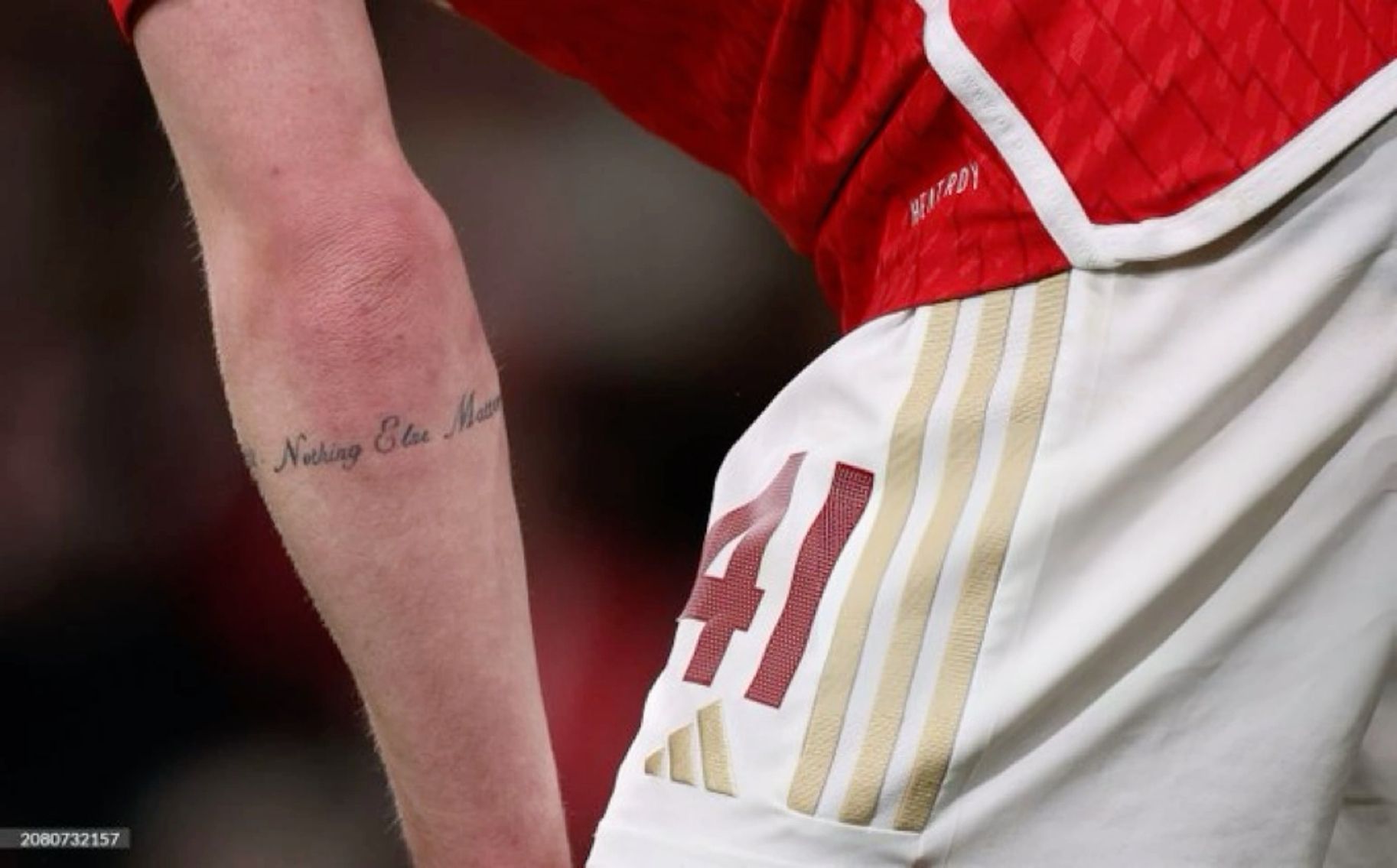
A separate forearm photograph shows the words Nothing Else Matters in dark cursive lettering. The phrase runs along the arm in a light, elongated script that follows the forearm rather than filling it with a dense image. In the close crop, the letters are the main visual subject and the surrounding skin remains open, making the tattoo easy to distinguish from the shirt and the red-and-white kit.
The phrase is often discussed alongside the Jude tribute because both appear on Rice’s forearm, but the photographs support treating them as separate visible elements. The Jude image carries a date, a name and a small symbol. The Nothing Else Matters image is dominated by a longer line of words. Its visual character comes from the rhythm of the letters and the way the phrase travels across the arm.
The available reporting does not establish a full private explanation for the lyric-like wording. It is safer to describe the lettering exactly as photographed than to assign it a relationship, anniversary or musical reference that Rice has not publicly confirmed. The phrase is documented; an invented backstory is not.
The John Rice – 07.02 inscription
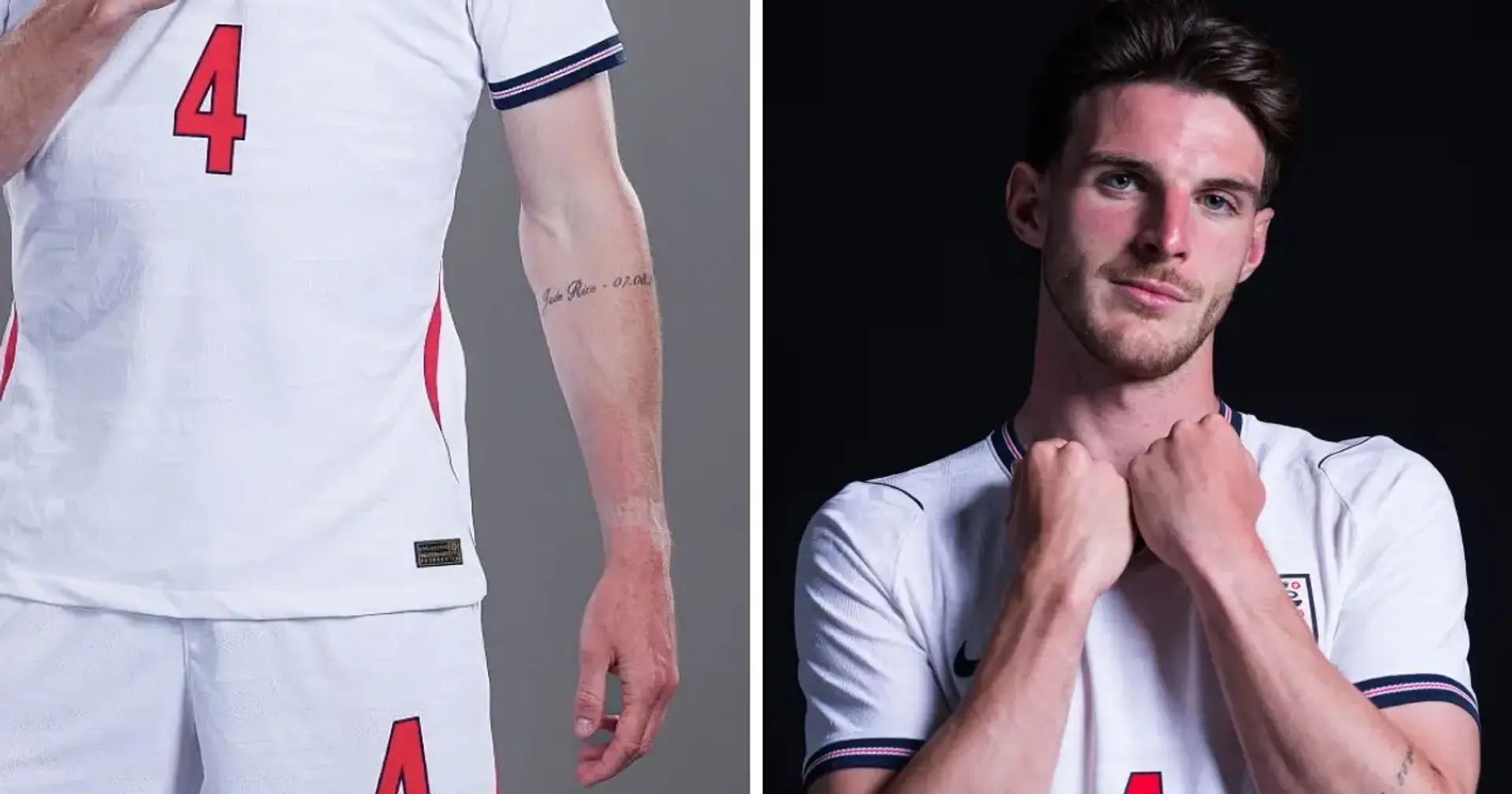
Another public image shows the inscription John Rice – 07.02 on Rice’s forearm. The writing is smaller and more compact than Nothing Else Matters, with a name followed by a date-like number sequence. It appears on the exposed arm of a white England shirt portrait, where the contrast between the dark letters and the skin makes the line readable.
The placement is important because the inscription sits on the forearm rather than the lower leg or the knee area. The words follow the length of the arm, and the numbers remain close to the name. The image does not reveal a large frame, portrait or symbol around the line, so the design is best understood as a restrained lettering tattoo.
Public coverage identifies John Rice as a family reference, while the photograph supplies the visual evidence for the placement and wording. The date-like 07.02 sequence is included because it is visible in the source image, not because a specific event has been guessed from it. The combination of a family name and a number fits the broader pattern of Rice’s documented use of personal text.
The 1241 legacy number on his leg
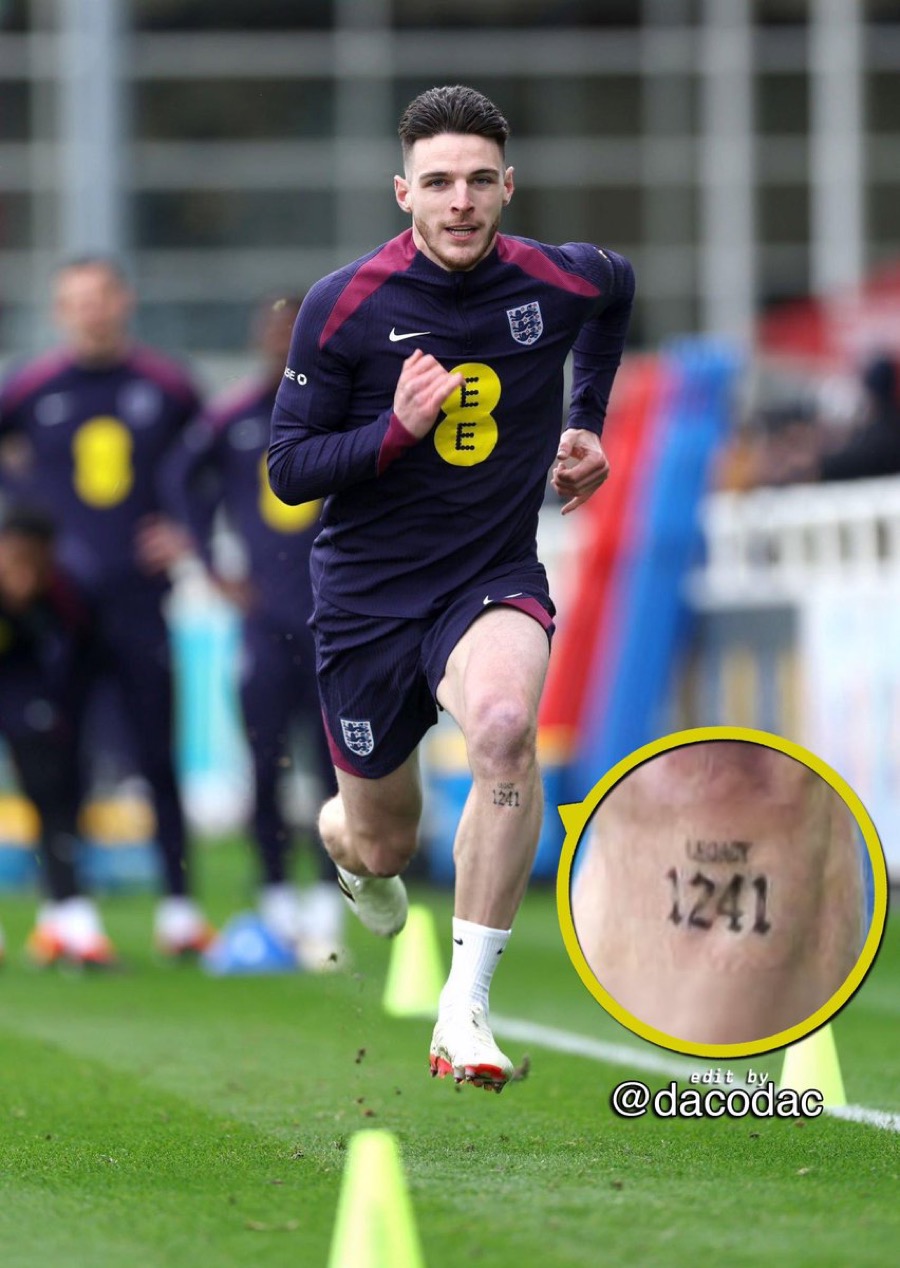
The 1241 tattoo appears on Rice’s lower leg in an England training photograph. The image shows the midfielder moving through an agility drill, while an enlarged circular inset makes the mark easier to read. The tattoo is arranged as a compact number with the word legacy above it, creating a small vertical block rather than a long line of script.
Reports connect 1241 to Rice’s official England player legacy number. The meaning is therefore tied to his international career, not to a birth date or an unverified private code. On the leg, the tattoo occupies a much smaller area than the forearm phrases. Its strongest visual features are the stacked layout, the dark numerals and the relationship between the word legacy and the number below.
The training photograph also shows how the leg placement changes with movement. The skin bends around the knee and shin as Rice runs, but the compact design remains distinct in the inset. The source does not provide a full catalogue of the leg, so the reliable claim stays with the visible 1241 mark and its documented England connection.
The forearm tattoo in public family photographs

A family photograph of Rice holding Jude supplies a different view of his tattooed forearm. The arm is not posed for a studio close-up, yet the dark lettering remains visible against the skin while he supports his son. This setting reinforces the family context of the ink without turning the photograph into proof of a different design.
The forearm is partly angled toward the camera, so some letters become softer at the edges than they do in the close match image. That change is useful rather than confusing: it shows how the same tattoo reads in an ordinary public photograph, with the arm bent and the body in motion. The visible marks remain consistent with the date-and-name tribute reported after Jude’s birth.
The image also separates the human context from the design details. Rice’s son is present in the frame, but the tattoo itself is still a small piece of script on the forearm. The meaning is documented through the name, date and reporting; the photograph adds a family setting and another angle on the placement.
Rice’s changing public timeline
Recent football coverage reports a number 41 tattoo around Rice’s knee, linking the mark to the squad number that has followed him through his career. The report places the tattoo in a different area from the forearm lettering and the 1241 legacy mark. That distinction matters because the numbers are not interchangeable: 41 is a shirt and career identifier, while 1241 is reported as an England legacy number.
The reported knee design extends the collection’s timeline into Rice’s Arsenal years. Earlier photographs document family lettering and the Jude tribute. Later coverage adds career numbers associated with club and country. The published evidence therefore shows a shift from intimate names and dates toward a second group of marks that preserve football milestones.
The 41 tattoo is described here as reported rather than visually catalogued because the supplied close photographs focus on the forearm and the 1241 mark. The available evidence supports its existence and broad connection to Rice’s football identity, but it does not establish every line, font or surrounding detail.
Family and football milestones
Across the visible pieces, Rice repeatedly uses compact text as the central design language. Jude and 07.08.22 preserve a family event. John Rice – 07.02 records another family reference. Nothing Else Matters supplies a longer phrase, while legacy 1241 and the reported 41 knee tattoo connect the collection to England and Rice’s professional path.
The designs are visually different even when their subject matter overlaps. The Jude tattoo is fine script with a small symbol. The John Rice inscription is a shorter line. Nothing Else Matters stretches farther across the forearm, and 1241 is condensed into a stacked number block on the leg. These contrasts keep the collection from reading as one repeated font or one continuous sleeve.
The public evidence also has clear limits. Photographs show the arm and the leg mark, while reports add the family and career associations. They do not reveal every tattoo that may be covered by clothing, and they do not explain every private decision behind the ink. Rice’s documented collection is strongest when the visible wording, placement and source-backed meaning stay together.
What the public images show
The image set moves from close lettering to wider identity views without treating ordinary portraits as extra tattoos. The Jude photograph proves the date-and-name tribute, the Nothing Else Matters frame isolates the forearm phrase, and the John Rice portrait makes another family inscription readable. The 1241 training image provides a leg placement, while the father-and-son photograph adds a second public view of the forearm.
Lighting and posture change the apparent weight of the ink. The red-and-white kit makes the cursive lettering contrast sharply, while the England training frame places the leg mark against moving skin and a blurred pitch. The family image softens some edges because the arm is bent, but it confirms that the tattoo remains visible outside a posed reveal.
Taken together, the photographs and reports show a collection shaped by names, dates, words and numbers. Rice’s tattoos are not documented as generic decoration: each of the clearest marks has a placement and a public connection, whether to Jude, John Rice, England’s legacy system or the career number 41. The documented evidence remains specific without pretending to catalogue work that the sources do not show.