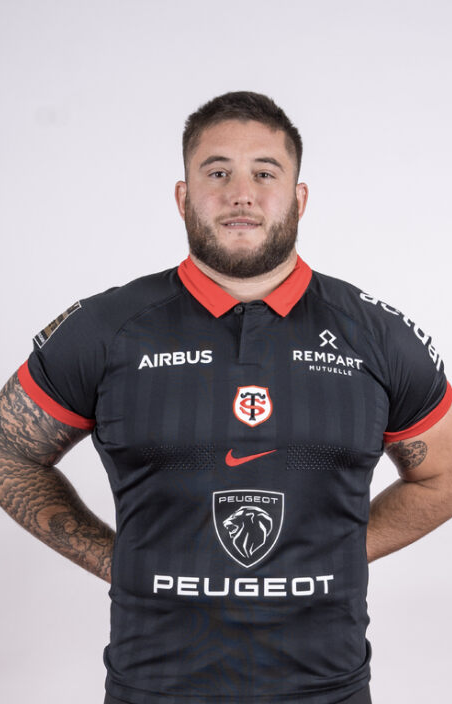
Cyril Baille’s tattoos are unusually easy to read as a family record. The French prop’s right arm carries a dense sleeve of clouds, religious imagery and figures connected to the people closest to him, while older and newer photographs reveal how the same work changes with posture, kit and light. A single image can suggest the scale of the ink, but the full story needs several views.
The most reliable account comes from Baille’s own explanations in L’Équipe. He described tattoos linked to his grandfather, his mother, his father, his sister and his daughter Anna. The designs are not presented as a fashion checklist. They are a visual way for a quiet athlete to keep family history visible, even when his rugby career takes him from Toulouse to the France team and the biggest European stages.
The family map begins on the tattooed right arm
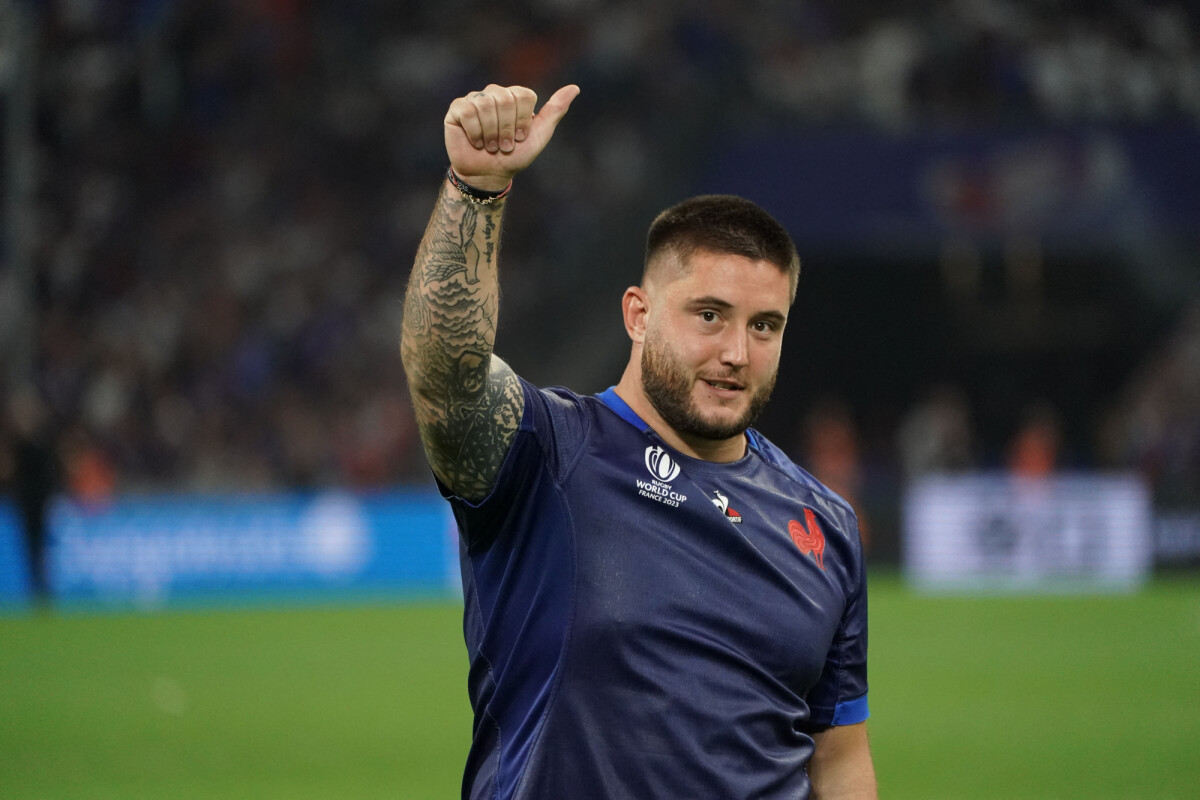
The clearest wide view shows Baille raising his right arm after France’s 2023 World Cup match against Namibia. The photograph makes the sleeve’s overall structure visible: dark blackwork runs from the upper arm toward the wrist, while pale waves and cloud shapes create a softer surface inside the larger composition. The ink is substantial without becoming a single flat block of black.
That broad arrangement matters because it gives the documented meanings somewhere to live. L’Équipe describes an Egyptian key as a tribute to Baille’s grandfather, an angel connected with his mother, and a Maori cross associated with his father. Religious figures, including Christ and the Virgin Mary, sit within the same personal landscape. The image does not prove the location of every individual symbol, but it does show how the pieces work together as one family-focused sleeve.
The sleeve is best understood as a map of relationships rather than a collection of disconnected motifs. That reading is supported by the way Baille speaks about the work. He has said his tattoos allow people to know who he is, which makes the visible density feel intentional. The arm is not simply covered; it is arranged as a sequence of reminders that remain close during travel, training and competition.
Clouds and religious figures build the upper-arm sleeve
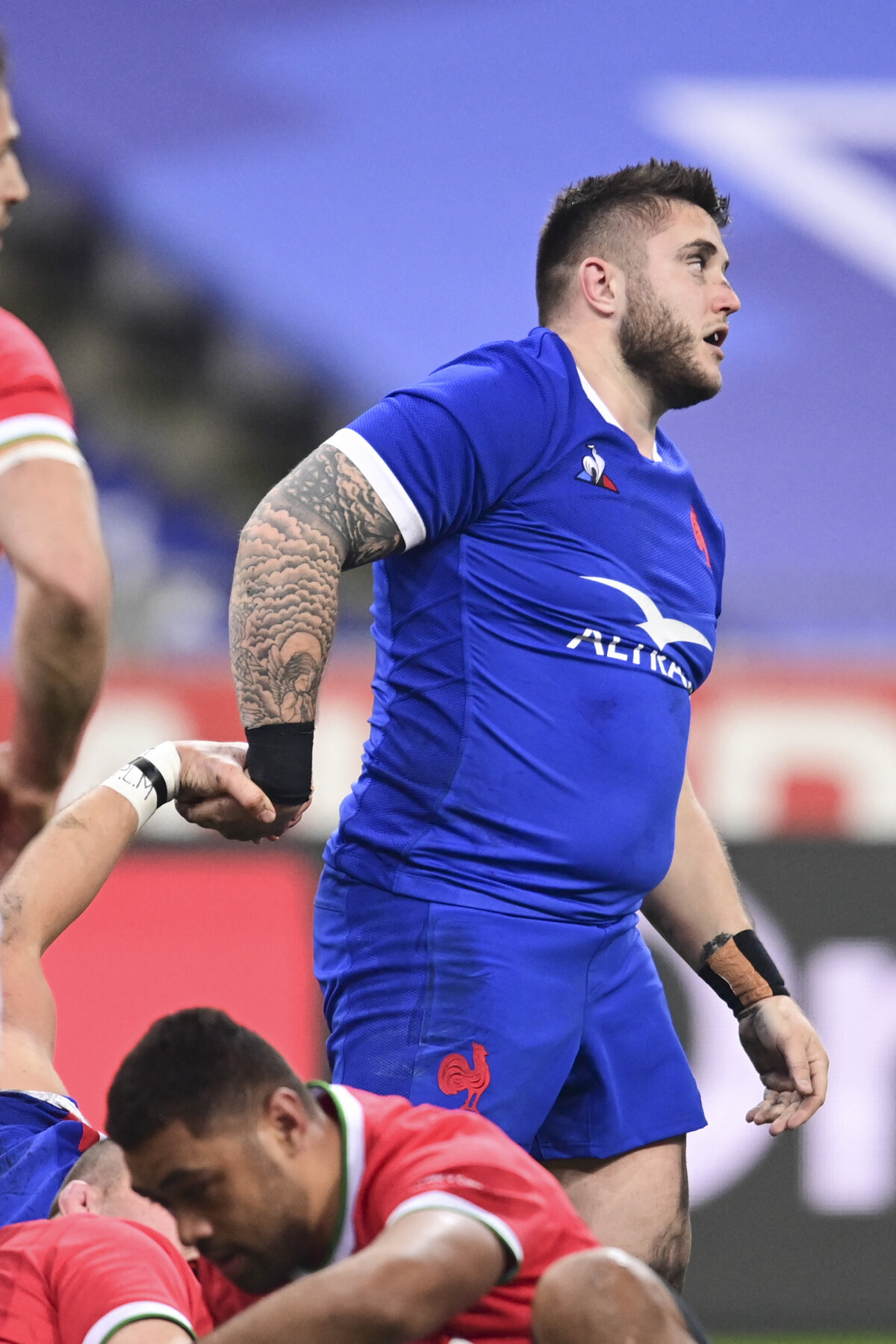
A Six Nations action photograph from 2021 brings the upper arm much closer to the camera. The side view shows the layers of the sleeve more clearly than a front-facing portrait. Repeating cloud forms run across the shoulder and upper biceps, while darker illustrative work appears beneath them. The lower part of the arm contains a portrait-like figure and smaller details that would be easy to miss in a distant match frame.
The clouds are important to the story reported around Baille’s tattoos because he connects them with family members who have passed away. That explanation gives an otherwise atmospheric pattern a specific emotional role. The clouds soften the hard edges of the darker images, creating a visual transition between memory, faith and family portraiture.
The religious imagery is equally personal. Baille has described an angel for his mother and Christian figures that reflect his faith, including a connection to Lourdes. Those details should be kept close to the documented record. It is possible to describe the visible Christ and Virgin Mary references without inventing a symbolic meaning for every line, shadow or ornamental border surrounding them.
The photographs show a sleeve that mixes realism, blackwork and open skin instead of following one rigid style. The result feels assembled over time. Each new piece can sit beside an older one because the clouds and dark shading provide a loose visual bridge, while the family meanings keep the composition from becoming purely decorative.
A daughter’s portrait adds a personal focal point
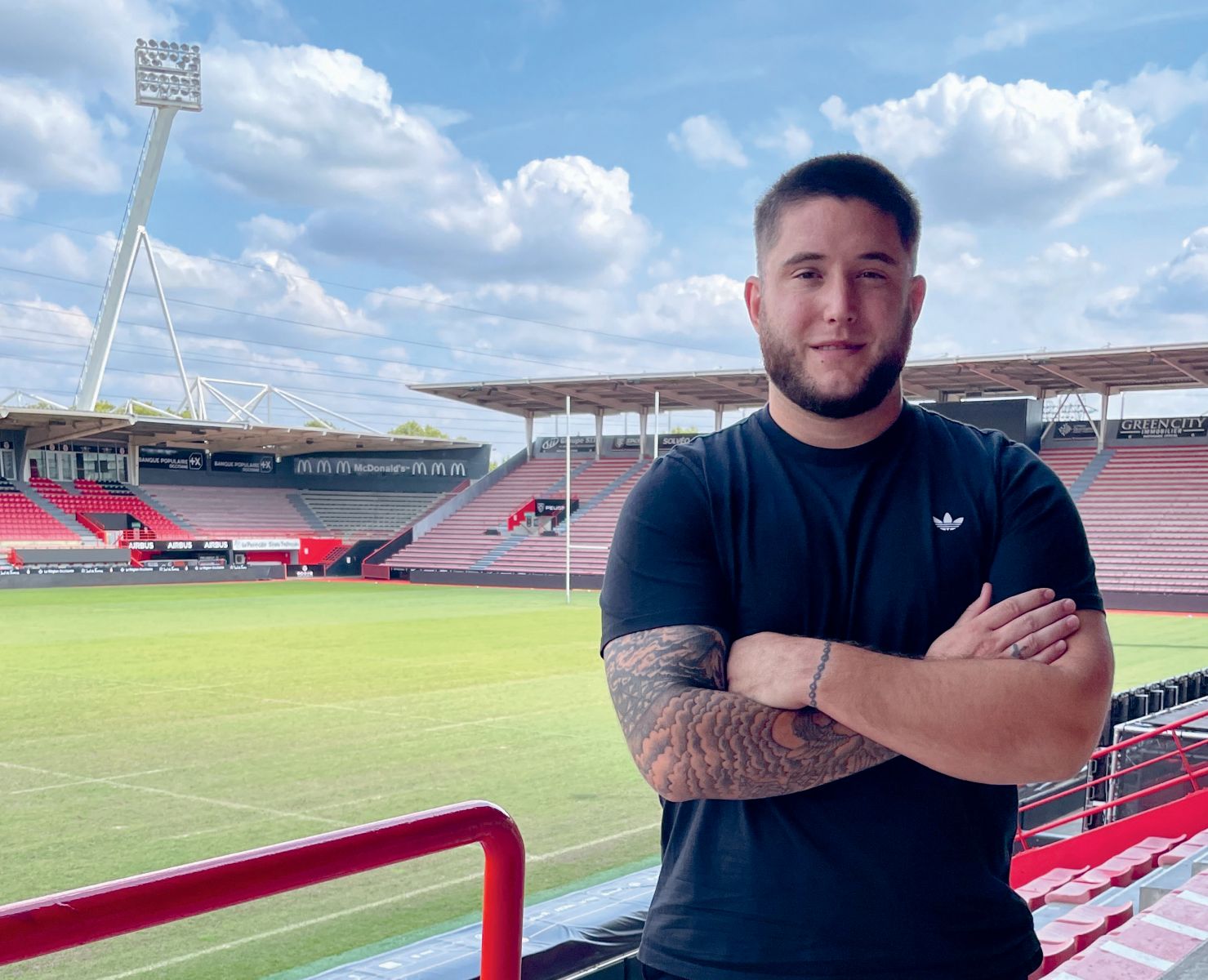
The Toulouse Magazine portrait changes the mood. Baille stands in the stadium with his arms folded and his tattooed forearms exposed, giving the camera a calm, almost conversational view of the work. The sleeve is less compressed than it is during a tackle or a scrum. The photograph also makes the transition from the larger upper-arm images to the finer marks near the wrist easier to follow.
Among the newer additions, Baille has spoken about a portrait of his daughter Anna based on her first photograph in the maternity ward. That detail gives the collection a very different centre from the religious and memorial imagery. It is not only about ancestors or faith. It also records the arrival of a new generation and the specific moment when he first saw his child.
The portrait is difficult to isolate in every public photograph, so its meaning should not be confused with a claim that one frame shows the complete design. What the sources establish is the subject and the origin of the reference image. The available views establish the broader sleeve, the clouds and the layered shading around it. Together, those facts are enough to explain the design without pretending that a low-resolution match image reveals every facial detail.
Anna’s portrait gives the sleeve a forward-looking element. The key for Baille’s grandfather and the angel for his mother look backward toward family memory, while the daughter’s portrait marks an experience that continues into the present. That movement through generations is one reason the collection feels coherent even though the imagery comes from different tattoo sessions.
The Maori cross links one tattoo to family memory
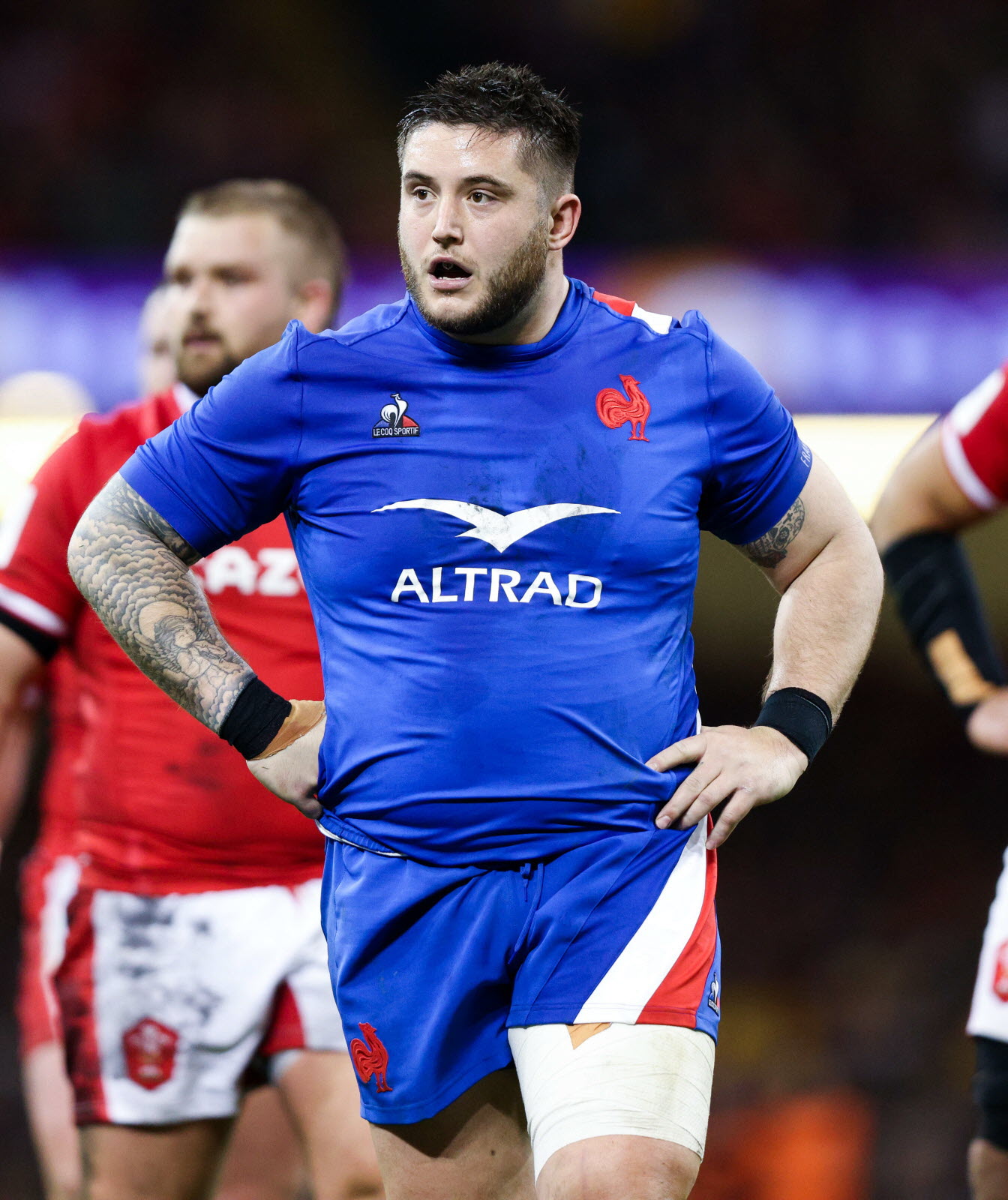
A France squad photograph from Le Dauphiné shows Baille with both hands on his hips and the right-arm work spread across the frame. The pose is less intimate than the Toulouse portrait, but it confirms how much of the sleeve remains visible when the shirt is short-sleeved. The clouds, heavy black sections and illustrative figures form a continuous path from the shoulder toward the forearm.
In the L’Équipe account, Baille identifies a Maori cross as a tribute to his father. That is one of the strongest placement stories in the documented reporting because it is attached to a named family relationship rather than inferred from the shape of the design. The cross belongs to the same arm as the key, angel and religious figures, so the sleeve becomes a visual conversation among several generations of his family.
The phrase Maori cross should not be expanded into a claim about ancestry or cultural identity that Baille himself has not made. The safer and more accurate description is that he has explained this particular tattoo as a tribute to his father. The visible shape can be discussed, but its personal meaning comes from the interview, not from outside interpretation.
That distinction is useful for the collection as a whole. Public tattoo photographs can show location, scale, shading and repeated motifs. Only the subject or a credible report can establish why a particular design was chosen. Baille’s sleeve rewards that evidence-led approach because the visible work is elaborate enough to invite guesses, while the documented explanations are already meaningful without extra speculation.
Match photographs show the sleeve in motion
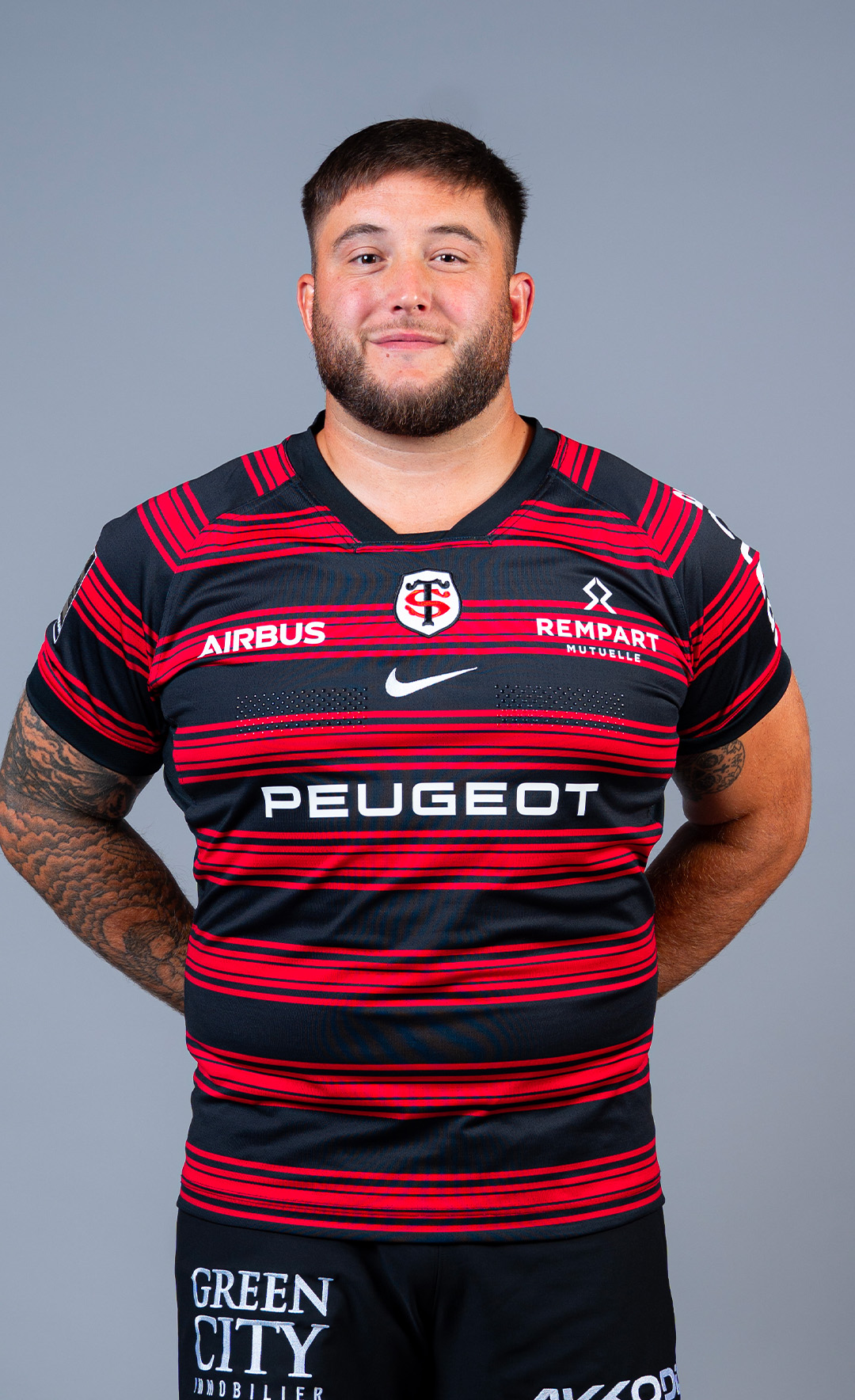
The official Stade Toulousain portrait from 2025 offers another angle on the same body map. Baille faces the camera in a club jersey with both arms held behind him, and the blackwork on the forearms remains visible on either side of the shirt. The pose is formal, but it makes the tattoo placement easy to compare with the older France photographs.
Rugby images also show why a collection like this should not be read from one frozen outline. Sleeves move as Baille binds in a scrum, reaches for a tackle or raises an arm after a match. The clouds can look broader when the elbow bends, while the darker lower-arm work becomes more compact when the wrist turns away. Different lenses and crop choices add another layer of variation.
The changing views do not mean the designs are inconsistent. They show that tattooed skin is a moving surface. The 2021 action shot, the 2023 World Cup celebration, the stadium portrait and the 2025 club image repeat the same broad facts: Baille has a heavily tattooed right arm, the work extends into the forearm, and the imagery is built from several connected pieces rather than one simple band or logo.
Movement is part of the visual identity. Baille is known through rugby photographs, so the tattoos are most often seen while he is working, recovering, celebrating or preparing to play. The sleeve therefore carries a practical athletic context. It belongs to a body that is constantly braced, rotated and placed under pressure, not a body posed only for a tattoo catalogue.
What the photographs can establish
Some public photographs show ink on both forearms, but the right arm remains the best-documented centre of the collection. The official club portrait and the Toulouse Magazine image expose the opposite side more clearly than full-kit match coverage. They also show how the work continues toward the wrists while leaving enough skin and jersey space for the individual motifs to remain legible.
It is tempting to label every visible shape, especially when the photographs are sharp. That would go beyond the evidence. The reliable inventory includes the Egyptian key, angel, Maori cross, religious figures, clouds, family names or references, and Anna’s portrait as reported in the L’Équipe interview. Smaller marks are better described by location and style unless a source identifies them.
This restraint does not make the collection less interesting. It creates a clearer boundary between what a reader can see and what Baille has chosen to explain. The forearms show texture, line weight and the relationship between darker and lighter passages. The interview supplies the emotional map. Neither source needs to be stretched to do the other’s job.
What the documented record says about Baille’s style
Baille’s tattoos combine a full-arm visual commitment with a private set of references. The sleeve is large enough to read from the stands, yet its meaning depends on details that appear in family stories: a key for a grandfather, an angel for a mother, a cross for a father, religious figures tied to faith, and a daughter’s portrait drawn from an early photograph.
The style is also defined by contrast. Cloud forms and pale skin breaks sit beside dense blackwork. Realistic or portrait-like elements share space with symbols. The designs are connected by shading, but they do not look like one uninterrupted mural. That balance gives the arm movement and keeps the individual memories distinct.
The strongest conclusion is also the simplest: Baille’s tattoos are a visible family archive. Their public meaning comes from the explanations he has given, while their visual impact comes from the way they occupy the arm. The photographs reveal changing angles and athletic movement. The interview explains why the images matter. Taken together, they show an athlete whose ink speaks for a personal history that he does not always narrate aloud.
That is why the collection remains compelling across different eras of his career. A France jersey, a Stade Toulousain portrait or a stadium photograph changes the setting, but the family references remain. Baille’s tattoos are not a separate performance from rugby. They travel with him into the same rooms, fields and changing areas, carrying the people and beliefs he has chosen to keep close.