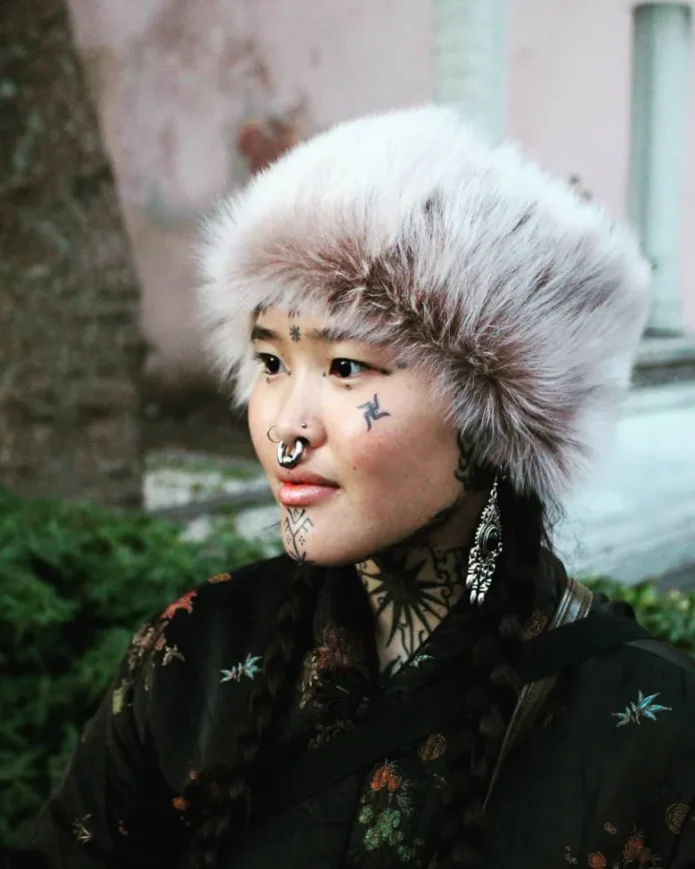
Tattoo artist Candice Soleillant’s iNKPPL interview describes ornamental ink across her face, back, arms, hands and legs. She calls the designs a body language and connects them with several artistic and cultural traditions.
The photographs show black geometry, repeating dots and bands of open skin. Soleillant explains the meaning of some facial tattoos; many other marks are documented through their appearance and placement.
Candice Soleillant’s path into the work
Soleillant was born in Ho Chi Minh City, Vietnam, adopted at birth and brought to France at five months. She says she returned to Vietnam at fifteen to meet her biological family. She describes her tattoos as a search for origins, drawing on more than one tradition.
She began getting tattooed at eighteen while studying at the Beaux-Arts in Lyon. Tattoo artist Jules later worked across most of her body and taught her during the first lockdown. She practised on him, herself and friends before working as a guest artist around France.
An identity expressed through many traditions
Soleillant says the ornaments give her a clear sense of self and work as a thin armor. She calls tattooing a return to origins, ties it to spirituality and belief, and describes it as magical. She recalls an artist calling one tattoo protection from the evil eye. These are broad meanings for her work, not a separate code for every mark.
She names Japanese, Nordic, Italian, French and Tibetan influences, and describes the facial designs through Mongolian, Berber, Japanese and Slavic references. In her account, these traditions meet in one collection rather than forming a single uniform system.
Her process is hands-on: she draws on bean paper with Indian ink, brushes and feathers, then darkens the paper with coffee for an aged look. She says she values the irregularity of a hand-drawn mark.
Geometric and ornamental work across the back
A photograph shows a central black ornament between Soleillant’s shoulder blades. A circle and diamond sit inside a larger geometric frame, with dots and short lines extending around them.
The pattern narrows into angles below and opens toward the shoulders. The lines leave skin visible between them, so the back piece reads as a layered drawing rather than a solid black fill.
Soleillant describes ornaments as body language, but the interview does not give a separate meaning for this exact back design.

Long geometric ornament on the arm
A long geometric tattoo runs down one arm. Its central line is built from stacked angles, circles and pointed forms; a narrow spear- or branch-like shape sits near the top.
Lower down, crossing lines, small circles and triangular borders form a sequence of separate marks. Open skin keeps the pieces distinct along the length of the arm.
The interview connects her ornaments in general with protection, strength and belief, but does not assign a title or personal explanation to this exact arm design.

Lotus design and linework on the leg
A lower-leg photograph shows a lotus-like shape above a rectangular geometric band. Dots and short angled marks sit around the sides, leaving open skin around the design.
The flower uses fine black outlines and separated petals; below it, straight lines, small squares and crossing bars form a distinct base. The two parts meet but remain easy to distinguish.
The photograph shows the tattoo’s scale and placement on the lower leg. It is a compact piece, with space around its outline.

Geometric banding through the arm
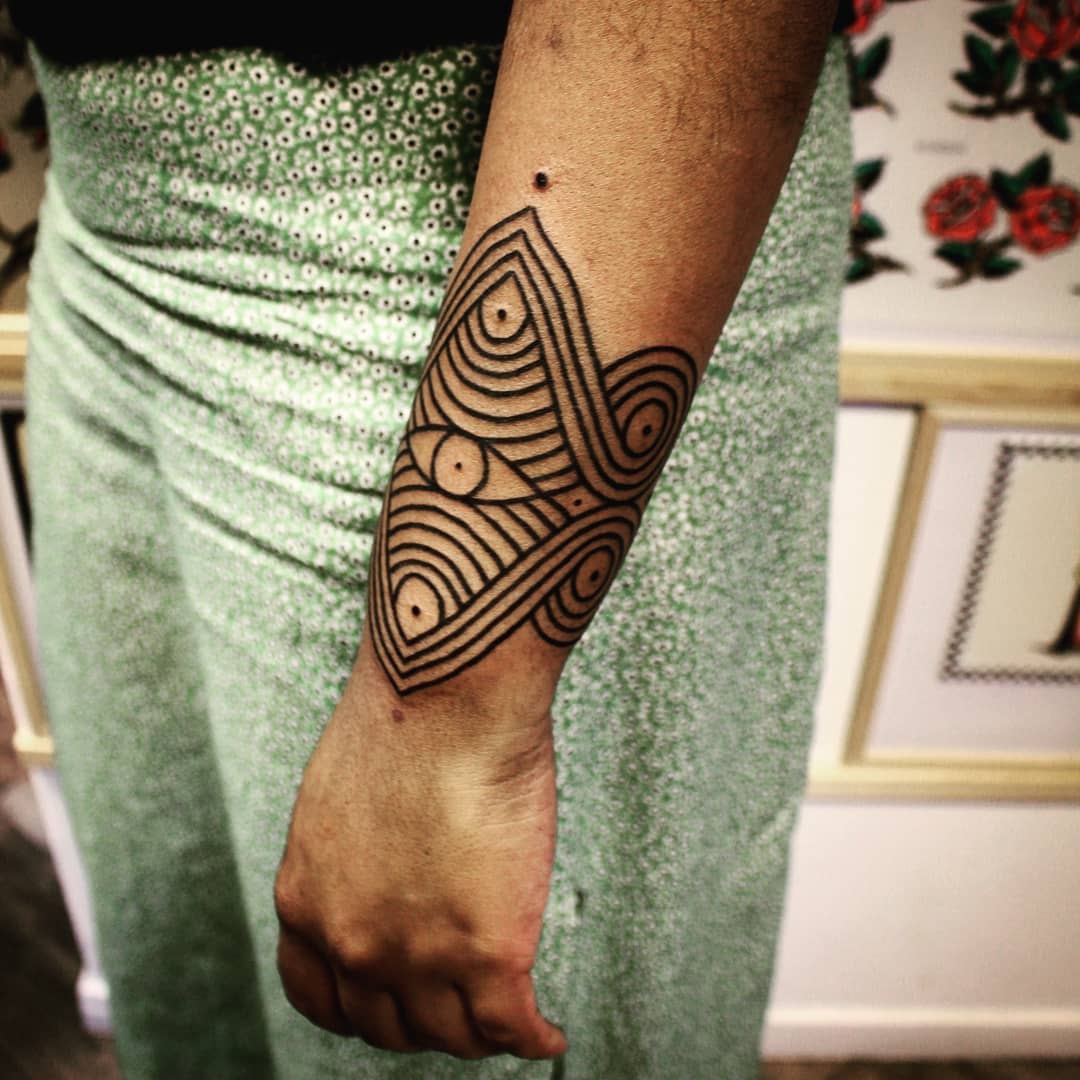
A second arm piece uses angular shapes and lines that wrap around the limb. Several black bands break into smaller gaps, and a diamond-like form sits near the centre.
Short marks and dots surround the central shape. The pattern narrows and widens as it follows the arm, so the bands shift when the arm turns.
Soleillant does not give this geometric band a separate meaning. The photograph shows how the lines follow the arm rather than forming a flat rectangular panel.
Hand symbols and compact linework
A central symbol runs along the hand, with angular lines, dots and short marks extending toward the fingers and wrist. The design is dense but leaves gaps between the marks.
Crossed lines, star-like points and narrow borders vary in size around the central motif. The hand’s joints divide the pattern, and its open spacing helps keep the symbols distinct when the hand moves.
The interview does not provide a separate explanation for each hand symbol. The photograph documents their layout and scale.

The personal meanings behind Soleillant’s marks
Soleillant gives specific meanings for several facial tattoos. She says Mongolian ornaments on her forehead relate to good destiny; a Berber ornament sits on her chin; Japanese flames stand for strength; and Slavic ornaments on the opposite side of her face represent protection.
A heart sits on her cheek. Soleillant also identifies a swastika as a Hindu symbol of well-being and welcome, and explicitly distinguishes it from the Nazi symbol.
The forehead marks frame her eyes, while the chin ornament runs down the centre of her face. The cheek heart is more recognizable than the surrounding geometry; flames and side ornaments make the arrangement asymmetrical.
Why the photographs read as a single system
Across the photographs, black lines, dots and open skin recur. Geometric bands sit alongside organic forms such as the lotus and heart, while the face carries the specific meanings Soleillant names.
“The ornaments are like a body language,” Soleillant says in the interview.