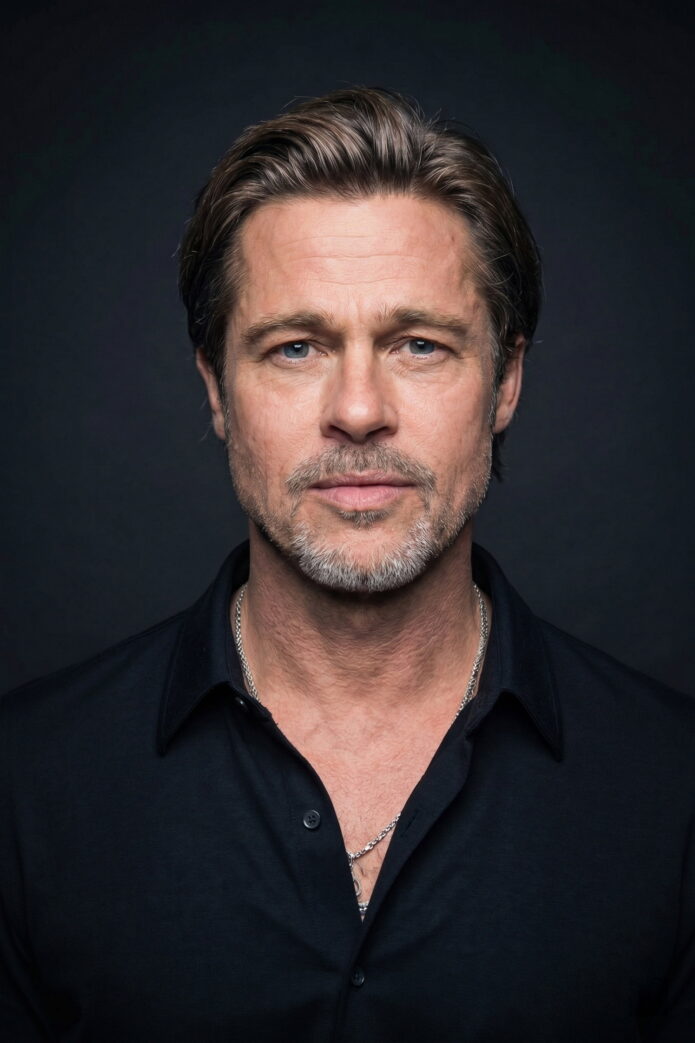
Brad Pitt’s tattoos feel less like a matching set than a notebook he has kept over the years. They mix family history, lines from writers he admires, private jokes and designs that only come into focus in the right photo. Some have been discussed in interviews or repeatedly identified by tattoo coverage; others are visible without a confirmed story behind them.
That mix makes the collection interesting. Pitt can appear in a suit with almost no ink on show, then turn up shirtless in a beach photo or film teaser with designs across his arms, ribs, back and stomach. It makes sense to take the tattoos one at a time and keep documented details separate from guesses based on distant pictures.
The torso and Khmer script keep the family-era ink visible
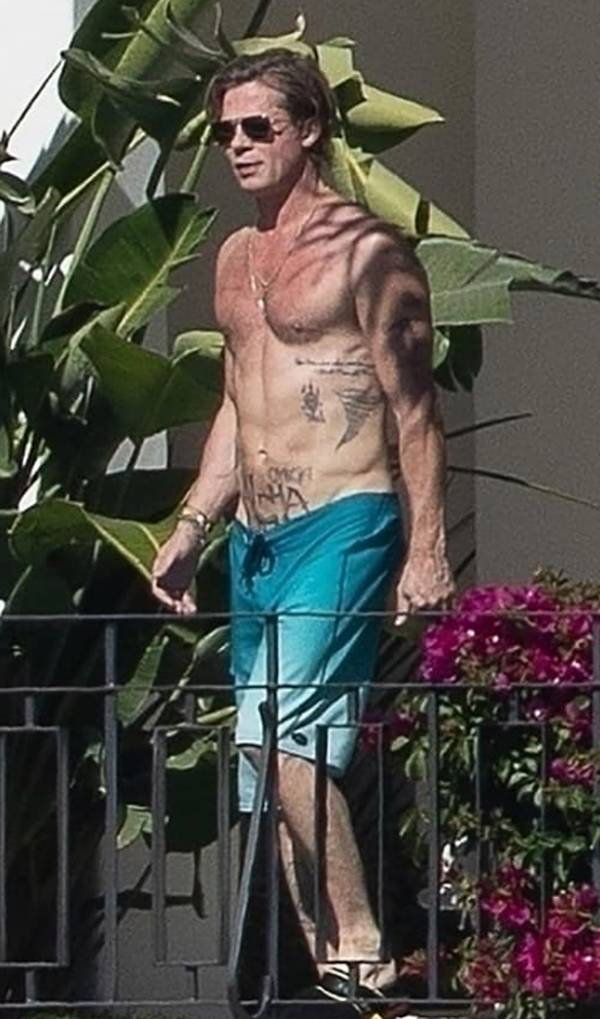
One of the clearest parts of Pitt’s collection is the Khmer script low on his torso. It has often been reported as Angelina Jolie’s birth date, written in the Cambodian script associated with the country where she was born. The placement keeps it mostly out of sight unless Pitt is shirtless or wearing low-rise clothing.
That location matters. It is not a design meant to be read from the red carpet; it sits near the centre of his body and belongs to a particular family chapter. Pitt and Jolie were known for sharing tattoos and choosing designs connected to their children, so older photos often show several pieces together.
Nearby marks have also been described as family symbols, including a cross-like arrangement connected with the couple’s children. Public photos do not always show the lettering or layout clearly enough to identify every detail. The careful takeaway is that this torso work belongs to Pitt’s family-era ink, even if online roundups sometimes claim more precise translations than the pictures support.
The tribal forearm design is easy to spot in candid photos
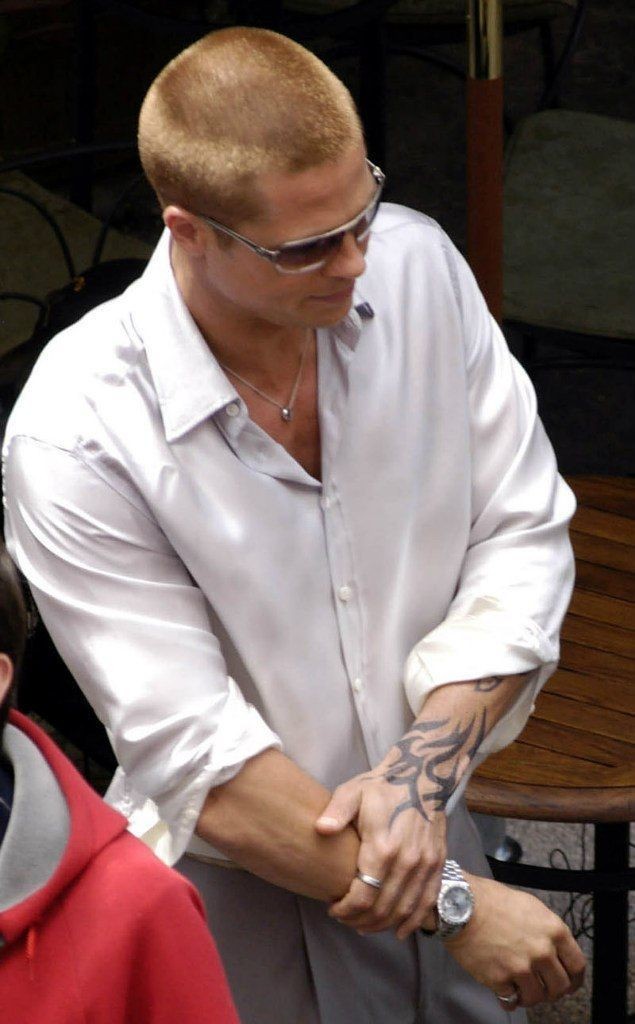
Pitt has a dark, graphic design on his forearm, often described as tribal or geometric. Its heavy black shapes make it easier to recognise than the smaller writing elsewhere. In a quick photograph it can look like part of a sleeve, but closer shots show it as a bold design on its own.
Pitt has not offered a reliable public explanation of its symbolism. Tattoo roundups sometimes assign a sweeping meaning to abstract blackwork, but there is no need to invent one here. Whatever its personal significance, visually the darker shapes balance the more literary pieces on his arms.
The forearm placement also brings it into view in everyday photos, from rolled-up cuffs to film publicity. It is a good example of how the collection reads as a group: the smaller writing can disappear, while this design remains easy to see.
Invictus turns a poem into a forearm statement

One of Pitt’s best-known tattoos is Invictus, written on his forearm. The word points to William Ernest Henley’s poem of the same name, which is often read as a statement about resilience and keeping control of one’s inner life in hard circumstances.
The design is spare: a single word, without a banner or a larger scene around it. It works like a reminder that is usually personal but can be glimpsed when his sleeve shifts. Among the more mysterious designs, this is one of the references that is easiest to trace.
It is sometimes reduced to a message about toughness, but the poem is more nuanced than that. “Invictus” is not simply about being invulnerable; it is about holding on to your sense of direction when life is difficult. That gives the tattoo the feel of a literary marker, not just a slogan.
Ötzi the Iceman is one of the clearest documented pieces

Another distinctive design in Pitt’s collection is the small figure commonly identified as Ötzi the Iceman. Ötzi is the Copper Age mummy found in the Alps; the tattoo appears as a fine, standing figure on Pitt’s arm. Once you recognise it, the unusual image is surprisingly easy to pick out.
Tattoo coverage has connected it to Pitt’s interest in history and the idea of someone preserved across thousands of years. That reading is plausible, but Pitt has not given a detailed public account of his personal reason for choosing it. The figure is widely identified as Ötzi; what it means to him remains less clear.
Its delicate, almost sketch-like lines offer a pause beside the heavier blackwork. It is also an unexpected historical reference, far from the more familiar symbols often seen in celebrity tattoo galleries.
The Rumi tattoo is about a meeting place beyond arguments
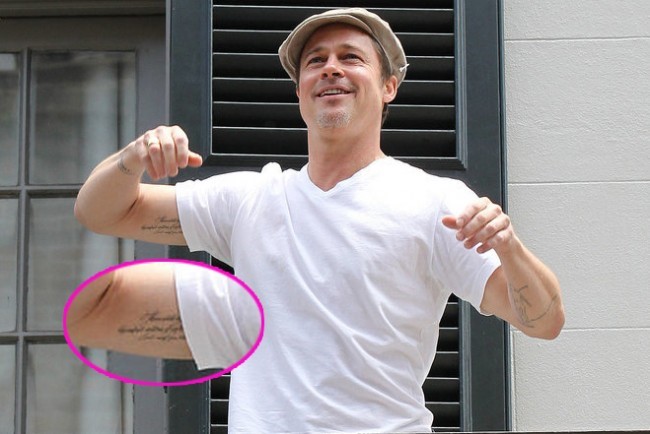
On the inside of Pitt’s arm is a line attributed to the Persian poet Rumi: “There exists a field, beyond all notions of right and wrong. I will meet you there.” It is a longer, more reflective choice than a typical one-word tattoo, imagining a place beyond the urge to win an argument.
The quote has often been discussed as part of Pitt and Jolie’s shared tattoo history. Still, Rumi’s words do not belong only to that relationship. The idea of meeting beyond conflict can also speak to family, friendship or personal change.
The inner-arm placement gives the line a quieter feel than lettering across the chest. Pitt can see it easily, while others may only catch it when he turns his arm. It seems like a phrase carried for himself, even though photos brought it into public view.
The older shirtless photos show how much the collection has changed
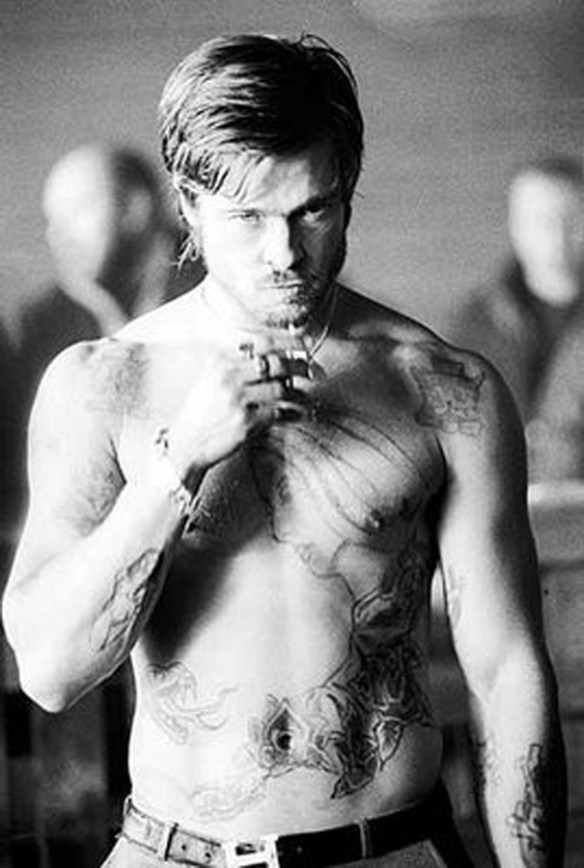
Older shirtless photos help show how Pitt’s tattoos built up over time rather than arriving as one planned sleeve. They reveal the Khmer script, lines on his back, family-related marks and larger designs that usually sit under clothing. More recent film and beach images offer glimpses of additions and of how he presents the ink now.
Tattoo coverage has also described a submarine on his left arm, a tornado on his side, a horse-like image on his back, and smaller geometric marks across his torso. Some reports mention a rhino outline on one leg and a skull outline on the other. These designs have been photographed, but their meanings are less firmly established than the Rumi quote or Invictus.
A little caution helps with older photos. Film roles can involve temporary tattoos or makeup, and shadows in a distant paparazzi shot can resemble ink. It is safer to focus on designs that recur across appearances and label one-off details as reported rather than confirmed. Pitt’s collection is large enough without counting every uncertain mark.
The rib lines and smaller marks are harder to pin down
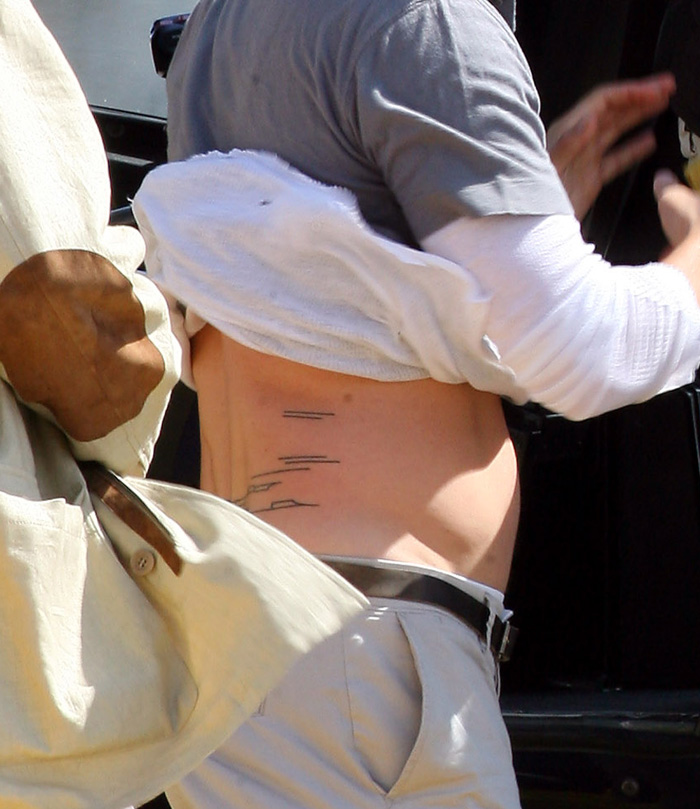
Thin lines and small marks around Pitt’s ribs and back are among the hardest parts of his collection to catalogue. They show up in older photos and have been described as minimalist symbols or lines drawn by someone close to him. The shapes look deliberate, but the images do not always make each one easy to identify.
That uncertainty is part of the story. Pitt has never treated his skin like an official catalogue, and the rib placement keeps these tattoos mostly private. They come into view as glimpses, rather than declarations.
Taken together, the collection has a loose rhythm: literary references, family memories, history, dark graphic work and a few designs that may simply have appealed to him. It does not follow one clean aesthetic, which helps it feel lived in.
Pitt’s tattoos make more sense as a work in progress than as one finished sleeve. The well-documented pieces already tell a story, and the less certain ones leave room for privacy. Invictus, Ötzi, the Rumi line, Khmer script and the bold forearm design each occupy a different part of it; none needs a louder explanation than the ink itself.
Watch Brad Pitt talk about his work
For a glimpse of Pitt away from tattoo photos, this interview looks at his acting career and recent work.
One thought on “Brad Pitt keeps a whole life in the margins of his tattoos”