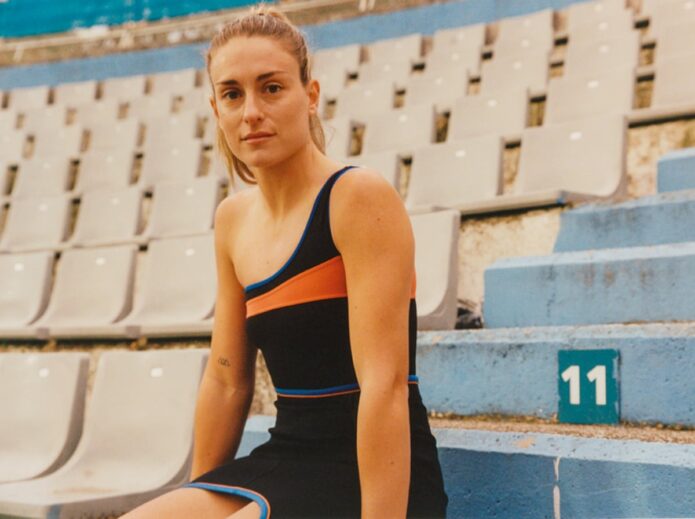
Alexia Putellas has built a tattoo collection that reads like a compact record of family, football, Barcelona and personal resolve. The most discussed work sits across her back, where a Latin motto is joined by a father-and-child silhouette, a city reference and a group of smaller symbols. Other marks appear on her arms, wrist and right foot. Public photographs do not show every tattoo with the same clarity, so the clearest account comes from comparing the images with interviews and published descriptions rather than treating every dark line as a separate design.
The central feature is the phrase Labor omnia vincit improbus, a Latin line commonly translated as “persistent work conquers all.” Putellas has used the shorter phrase Labor omnia vincit in the title of her documentary series, and reports about the tattoo place the extended wording on her upper back. That connection gives the collection a clear thread, but the other tattoos keep it from becoming a single-slogan design. Her ink moves between biography, football iconography and small protective or symbolic images.
Alexia Putellas’s back tattoo map
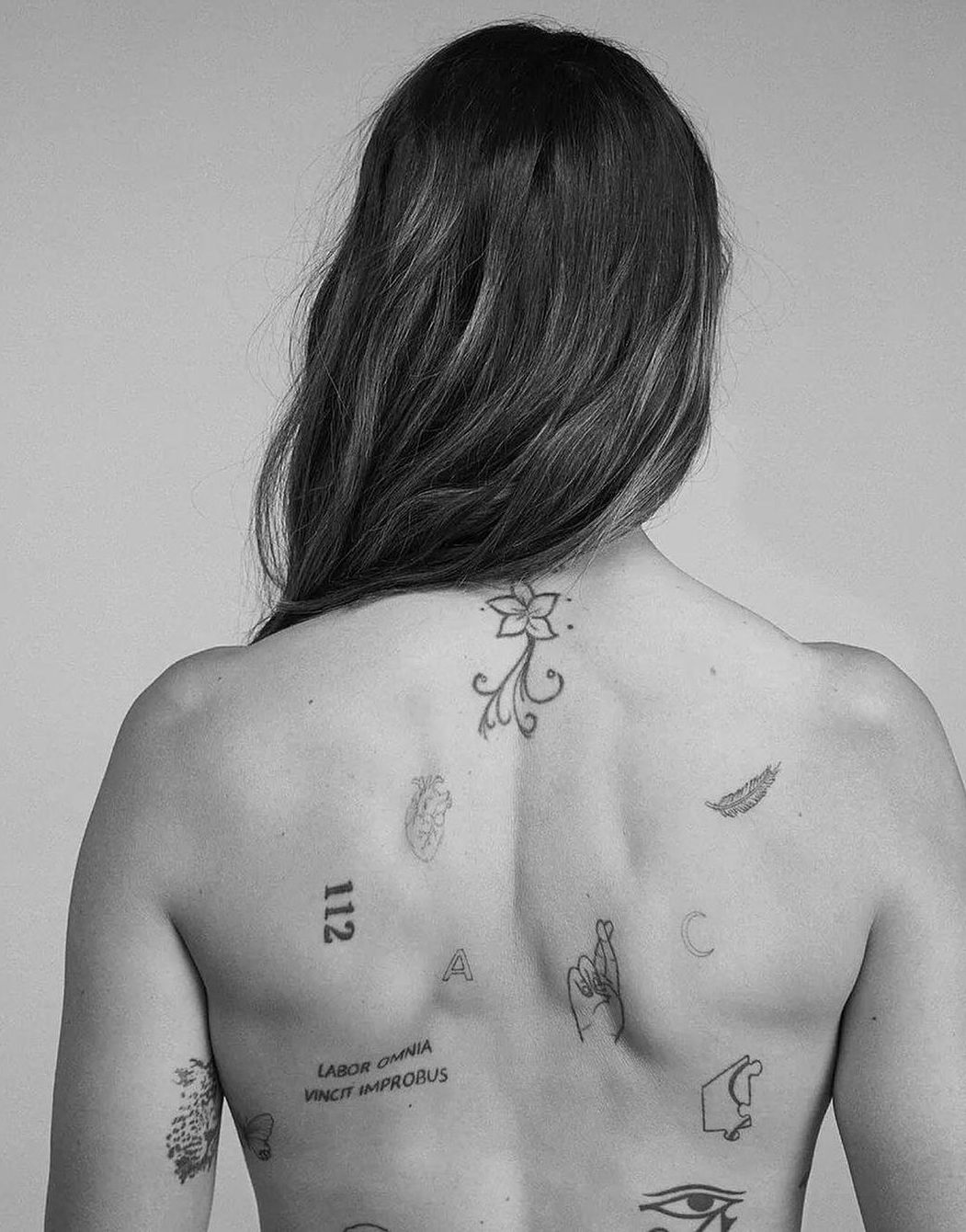
The clearest public view of Putellas’s collection is a back photograph in which several separate pieces can be read as a group. The lettering sits high on the back, while the silhouette of a father holding a child with a football occupies a more figurative area below it. Around those major elements are compact drawings and numerals. The composition is not a single solid field of blackwork. It has open skin between the designs, which lets each symbol keep its own outline and makes the back read more like a personal map than a continuous mural.
Published descriptions identify more than ten tattoos across the visible collection. They name an Eye of Horus, a Barcelona panot tile with the words “Made in,” a butterfly, a feather, a moon, a football and the number 112. They also describe a large Hand of Fatima on the right foot. The written inventory matters because some of the smallest marks are difficult to identify in event photography, especially when a jersey, hair or a hand covers part of the back. The photographs establish placement and arrangement; the reports supply the names and meanings.
The back also carries the most intimate image in the collection. It shows the outline of Putellas’s father with her as a baby, with a small Barça ball included in the scene. El País has described the image as an old photograph translated into a tattoo, while later coverage again identifies the father-and-child silhouette on her back. The design therefore sits beside the motto without being absorbed into it. One piece speaks in words about work, and the other preserves a family memory through a simple black outline.
The photographs as evidence
The visual rhythm of the back is unusually varied. The Latin lettering is horizontal and text-led, the portrait is figurative, the panot is geometric, and the small marks behave like emblems. That mixture is why photographs of the collection invite close reading. The tattoos do not present one repeated style or one uniform scale. Instead, the placement leaves room for a viewer to move from the motto to the family image and then to the smaller references surrounding them.
Putellas has not presented every mark as a public explanation. Interviews reported by El País say that some of her tattoos have clear meaning while others do not. That distinction is useful when reading the collection. The family portrait and the football-linked number have documented associations, but a small symbol seen in a photograph should not automatically be assigned a private story. The strongest account keeps the visible details separate from interpretations that Putellas has not stated publicly.
A collection read through images
Putellas’s tattoos are most legible when the images are read alongside the reporting that names them. A rear photograph establishes the arrangement of the back pieces, while an event image can isolate a wrist or upper-arm mark that disappears in a full-body view. The photographs do not function as a catalogue of every tattoo, but they show how the designs sit on the body and how clothing changes what can be seen.
The collection also shifts with context. A football shirt reveals the lower back and arms in one setting, while a formal gown exposes the back in another. That change of setting explains why different reports emphasize different details. The Latin lettering is consistent across the record, but the smaller symbols emerge only in closer or more revealing photographs.
The Labor Omnia Vincit lettering

The phrase on Putellas’s upper back is the tattoo most directly tied to a public project. Coverage of her Amazon documentary uses Labor omnia vincit as its title, while the fuller tattoo is reported as Labor omnia vincit improbus. The added word changes the emphasis from work in general to determined or persistent work. In the photographs, the words are arranged in a compact serif-like script that follows the upper-back area rather than stretching into a large banner.
Putellas has explained the thought behind the phrase in connection with the documentary and her career. Reports from the presentation quote her saying, “Really, I believe it: work conquers everything.” That statement is one of the more reliable links between a tattoo and a stated meaning in her collection. It also explains why the wording reappears in the title of a series that follows her football life, injuries, ambitions and public role.
The tattoo is not isolated from the football story, but it is not a club crest or a list of achievements either. Its subject is effort, which gives it a broader scope than the Barcelona references elsewhere on her back. The lettering functions as a motto, while the father-and-child silhouette and the number 112 preserve more specific pieces of her history. Together they show how Putellas combines a general principle with details that point back to family and football.
The phrase in public photographs
Photographs made at matches and formal events often reveal the phrase only in sections. A shirt may cover the lower line, or the angle may compress the letters into a dark band. The high-resolution back images provide a better sense of the spacing, but the published text remains important for the exact wording. The reliable form is the extended Latin phrase, not a guess based on a partial crop or on the name of the documentary alone.
The motto also gives the collection its strongest visual anchor. Most of the surrounding tattoos are small enough to function as symbols, while the lettering can be read from a distance. That hierarchy makes the upper back the natural center of the collection in public photographs. It is the piece that identifies the body of work before the smaller Eye of Horus, panot, football, moon and feather become visible.
The father-and-child portrait
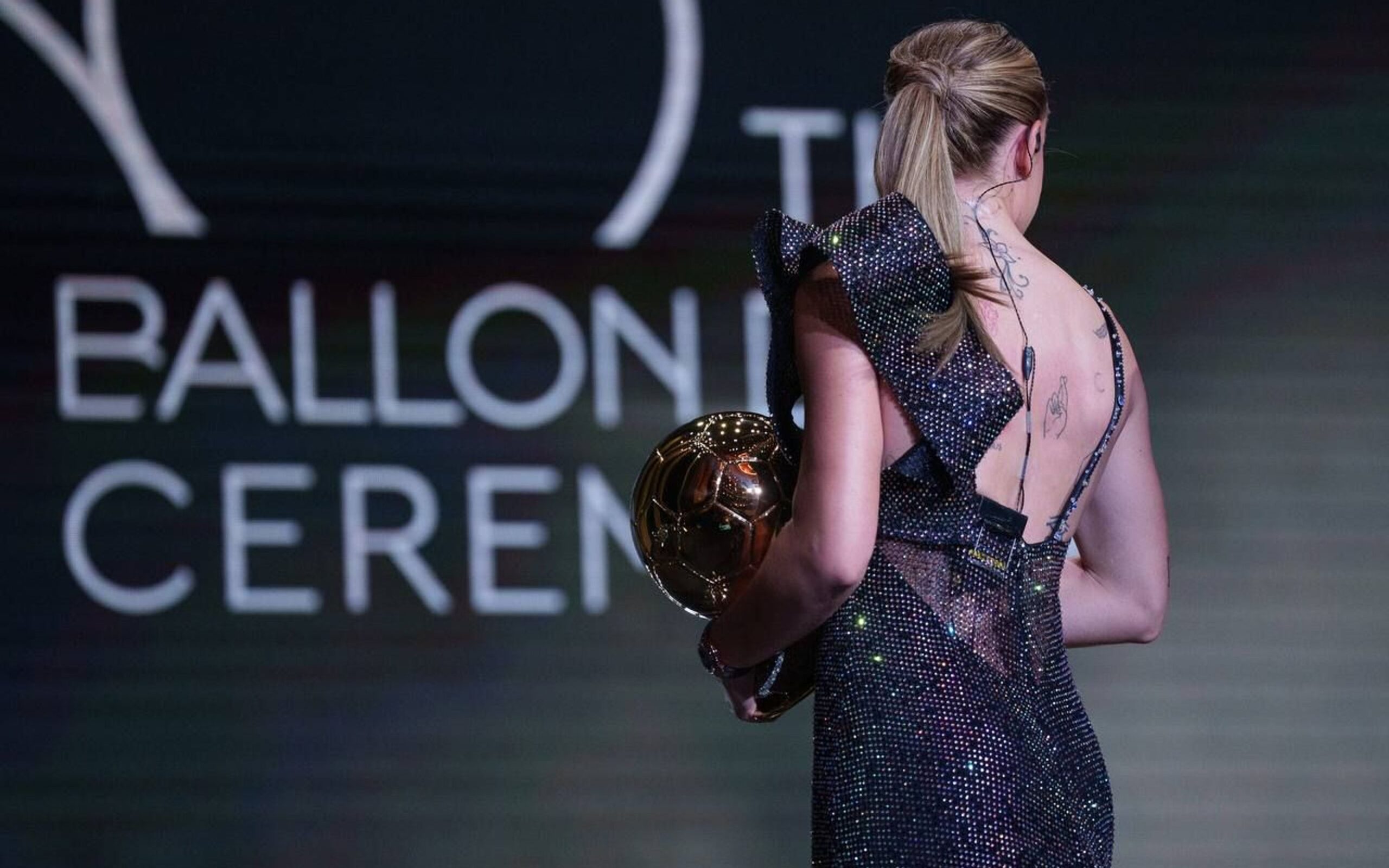
The father-and-child silhouette is the most clearly biographical image in Putellas’s tattoo collection. Reports describe her father holding her as an infant and handing her a football marked with the Barça connection. The design is rendered as an outline or silhouette rather than a highly shaded portrait. That choice keeps the scene readable while allowing the tattoo to preserve the shape of a remembered photograph instead of attempting a literal photographic reproduction.
El País has described an old photo tattooed on Putellas’s back with her father, and later reporting identifies the same scene as a father holding his baby daughter with a small Barça ball. The football is a specific detail, not a generic addition. It connects the family image to the path that became Putellas’s professional life, while the adult tattoo itself remains focused on the relationship between the two figures.
The placement gives the portrait a different emotional role from the Latin phrase above it. The motto is declarative and public, a sentence that can stand for a career. The silhouette is quieter. Its meaning comes from the people and the moment depicted, not from a phrase that needs translation. The two pieces are close enough to be seen together, but their visual languages remain distinct: letters at the top, human figures below.
In rear-view photographs, the small football helps identify the scene even when the figures are partly softened by distance. The image is one reason the back tattoos are repeatedly discussed in profile pieces about Putellas. It is a personal reference that can be photographed without requiring a new explanation every time, because the outline itself carries the narrative of a parent, a child and the sport that shaped the child’s future.
Putellas has also spoken about her father’s influence on her football development, which gives the tattoo context beyond the design alone. The documented reporting does not require a more elaborate symbolic reading. The silhouette is already specific: it preserves a family image, incorporates a Barça-linked football and sits among the other marks that record the places and ideas central to her public story.
The phrase in interviews
Putellas has spoken more openly about some tattoos than others. The motto has a stated connection to persistence, and the father-and-child image has been described through the family story behind it. Other marks are identified by published coverage without a confirmed personal explanation. That unevenness is part of the record, and it prevents the smaller symbols from being given meanings that have not been documented.
The interviews also place the tattoos within a longer football history. The Barcelona reference, the number 112 and the football in the family silhouette connect the ink to places, shirts and people that shaped Putellas’s career. The collection is therefore biographical without being a literal timeline. Different pieces point to different parts of her life, and the back brings them together through spacing rather than through one repeated image.
The small arm symbols visible at the ceremony

The smaller symbols below and around the lettering give Putellas’s back its most varied section. Huffington Post coverage identifies an Eye of Horus, a Barcelona panot tile with “Made in” above it, a butterfly, a feather, a hand with crossed fingers, a moon and a football. These are not all presented at the same scale. Some are compact emblems, while the panot and the eye have stronger graphic silhouettes that remain recognizable when the entire back is photographed from several steps away.
The panot is a particularly local reference. The modernist tile is associated with Barcelona, the city where Putellas has lived and played, and the words “Made in” make the city reference explicit. It sits beside imagery that points to her family and football career, so the group does not read as a random collection of travel symbols. The reported design instead places her identity, hometown and sport in the same visual field.
The Eye of Horus gives the collection a different register. It is a recognizable ancient symbol with a strong outline and a compact shape, which contrasts with the delicate butterfly and feather. Published descriptions name the symbol but do not establish a private statement from Putellas about why she chose it. The visible tattoo can therefore be described confidently, while its personal meaning remains open unless she has directly explained it.
Reading the smaller marks
The reported number 112 is more directly linked to football. Coverage describes it as a combination of the 11 associated with her Barcelona shirt and the 12 she wore at the beginning of her Spain career. The number turns two shirt histories into a single small mark. It is an example of the way Putellas’s tattoos compress chronology into symbols that can sit next to a phrase, a city tile or a family image without needing a large explanatory design.
The smaller tattoos also explain why a single photograph cannot show the collection in full. A hand, shirt or camera angle can hide one mark while exposing another. The strongest visual record uses full-back images for the arrangement and closer event photographs for the individual details. Putellas’s collection is therefore best understood as a set of linked pieces rather than one image that reveals every tattoo at once.
The small wrist tattoo visible in public photographs
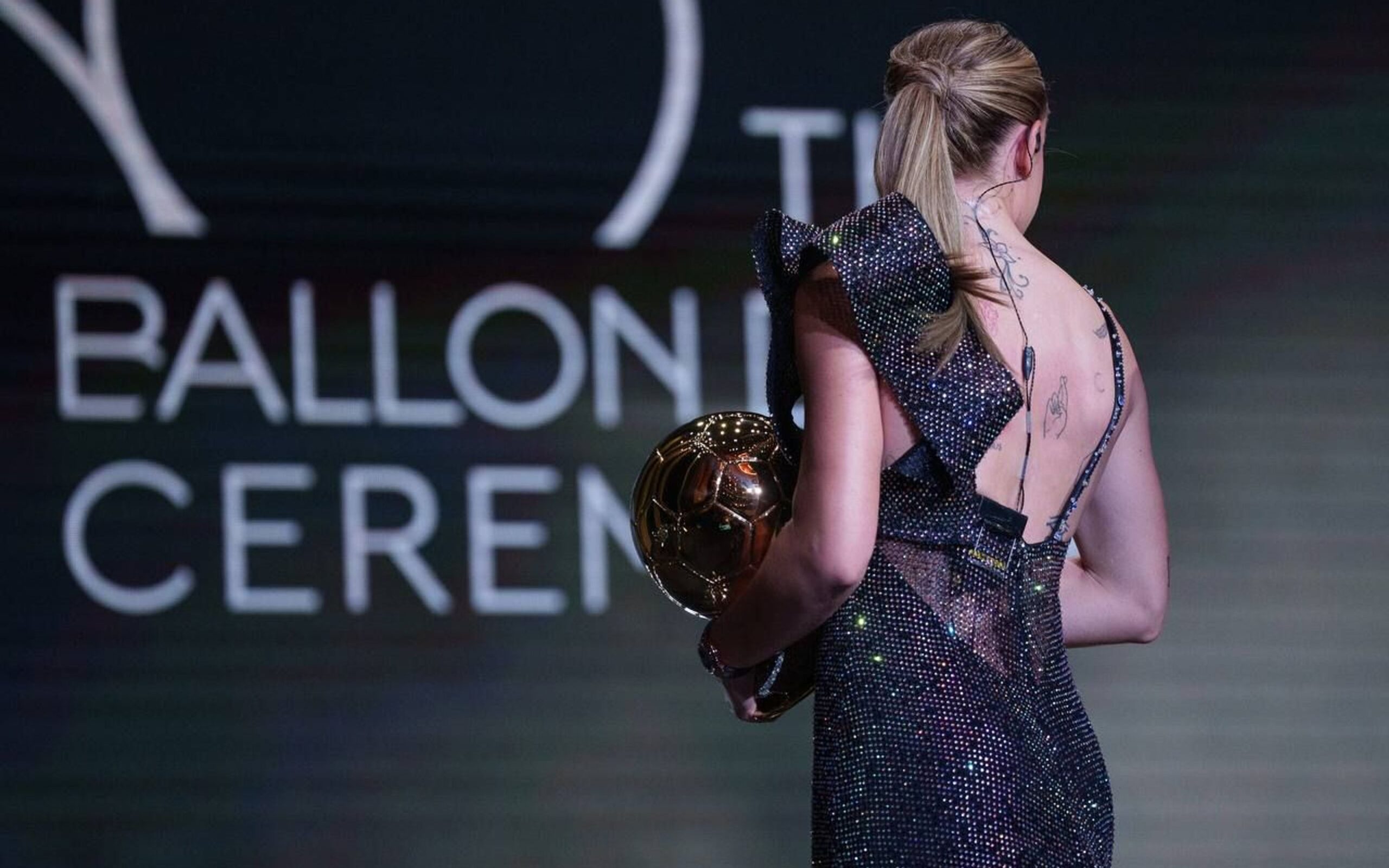
The fifth photograph is less dramatic than the back views, but it records an important part of how Putellas’s ink appears in public. At the Ballon d’Or ceremony, a small black mark is visible on her wrist as she holds the trophy. It is easy to miss because the image is dominated by the ball, the dress and the stage lighting. The wrist tattoo is nevertheless distinct from the larger back pieces and confirms that the collection extends beyond the area most often discussed in profiles.
The wrist mark is not identified as the Eye of Horus, the panot, the 112 or the Hand of Fatima in the sources used for this article. Treating it as an unidentified small tattoo is more accurate than assigning it a symbol from another photograph. That restraint matters because the collection contains several compact designs, and a distant crop can make unrelated marks look similar. The event image proves its location and visibility without proving a private meaning.
The right foot carries the collection’s largest reported piece outside the back: a Hand of Fatima with a heart of health and colored detail. It is described in published coverage as an XXL tattoo, a scale that makes it different from the small wrist mark shown here. The contrast between the two placements is revealing. Putellas’s tattoos range from a large, detailed foot design to tiny marks that appear only when a sleeve or pose exposes them.
Different scales in the collection
Public photographs also show how clothing controls the record of her tattoos. Football shirts and formal dresses conceal most of the back, while sleeveless outfits can reveal the wrist and upper arm. The back pieces became widely discussed after images and interviews made them easier to see, but the collection has never been limited to that one surface. The small wrist tattoo is part of the same body of work, even when it receives less attention.
Taken together, the images show a collection with several visual scales and subjects. The back carries the motto, family silhouette and Barcelona-linked symbols. The wrist supplies a smaller, less documented mark. The right foot holds the large Hand of Fatima described in reports. Putellas’s tattoos are therefore not a single statement repeated across her body. They form a layered record in which some designs are fully explained, some are identifiable but private, and some are best left unnamed until she documents them herself.
Putellas has described a collection in which meaning is uneven by design. The Latin motto has a public explanation, the father-and-child silhouette has a documented family history, and the football-linked 112 connects two stages of her career. The panot records Barcelona, while the Eye of Horus, butterfly, feather, moon and crossed-fingers hand broaden the visual vocabulary. The Hand of Fatima on the right foot adds a large, detailed piece beyond the back. Seen together, the tattoos are a record of people, places, symbols and work, with the clearest stories attached to the marks Putellas has actually discussed.
The documentary title and the back lettering reinforce each other, but the collection is richer than its motto. Its strongest image is the family silhouette, its most recognizable text is the Latin phrase, and its most football-specific details are the ball and the number 112. Public photographs supply the visual evidence, while the interviews and profiles supply the names and meanings. That combination keeps Alexia Putellas’s tattoo history specific without turning uncertain details into fact.