Xavier McKinney’s tattoo story is unusually easy to place because one published session shows the work at full scale. In December 2023, TMZ reported that the Green Bay safety had a large torso piece completed by an artist connected with Ganga Tattoo. The article identified several recognizable elements, including Thanos, the Joker, Groot, the words “Most Wanted,” and “Beware of Dog.” McKinney also shared the line “Tattoos over war wounds ..”, which gives the project a personal frame without pretending that every design has a public explanation.
The photographs matter more than guesses about private meaning. They show a chest and torso collection built from portrait-style imagery, lettering, heavy black-and-grey shading, and smaller marks that connect the larger pieces. This guide keeps the evidence in view: the first three images are the tattoo-bearing photographs from the same published report, while the final two inline images are clearly labelled supplemental portraits used for identity and career context after the tattoo-image search was exhausted. The visual order follows the evidence, moving from the torso details that can be inspected to the wider context around the player.
Chest tattoo: cross and upper-body work
The first TMZ frame is the broadest useful view of the torso. McKinney’s face appears at the left of the composite while the tattooed chest and abdomen fill the right side. A large cross anchors the upper body, and the lettering “In God We Trust” is visible across the chest. The composition is dense, but the main shapes remain readable because the chest centre, ribs, and abdominal line provide clear landmarks.
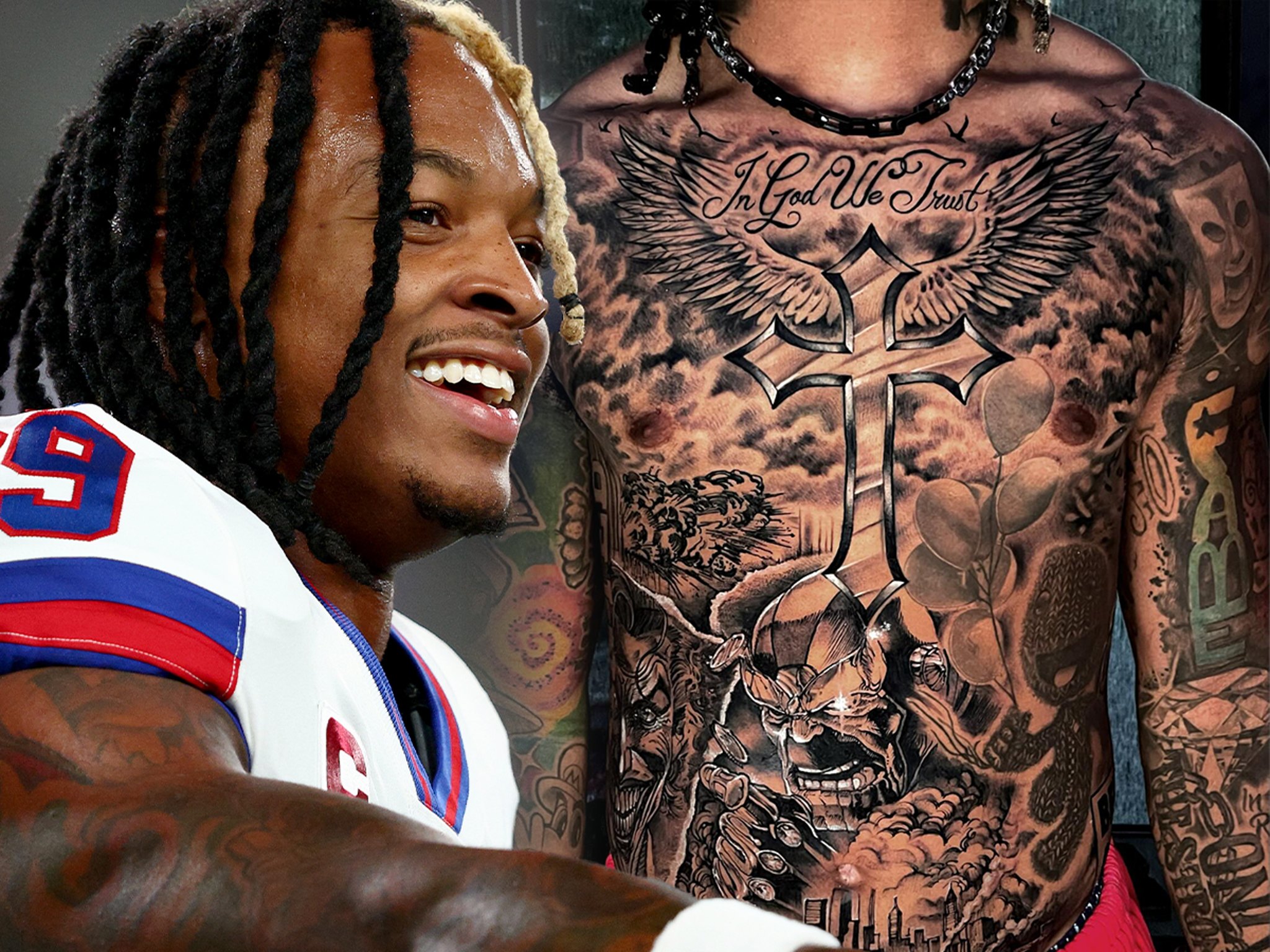
That wide view changes how the later close-ups should be read. The cross is not an isolated emblem floating on open skin. It sits inside a fuller field of shaded work that reaches toward the shoulder and down the torso. The visible contrast between dark outlines, mid-tone fill, and open skin makes the piece look layered rather than flat. The chest is the collection’s visual anchor, but the photograph does not establish a single event or one private story for every surrounding mark.
It is also important not to overstate what can be seen through the framing. The photograph documents the front of the torso from one angle, not every tattoo McKinney has ever had. It confirms the chest lettering, the cross, and the surrounding density. It does not prove the order in which the areas were completed, the exact artist responsible for each line, or the reason the words were selected. Keeping those limits visible makes the description more reliable.
Side-torso tattoo: Most Wanted lettering
The second tattoo photograph shifts closer to the side of the torso. “MOST WANTED” is the clearest text in this frame, and it works almost like a title over the darker portrait-led artwork beneath it. The lettering is bold enough to read even when the torso turns, while the surrounding shading pulls the eye toward the rib and upper-abdomen area. The design therefore reads as both text and structure.
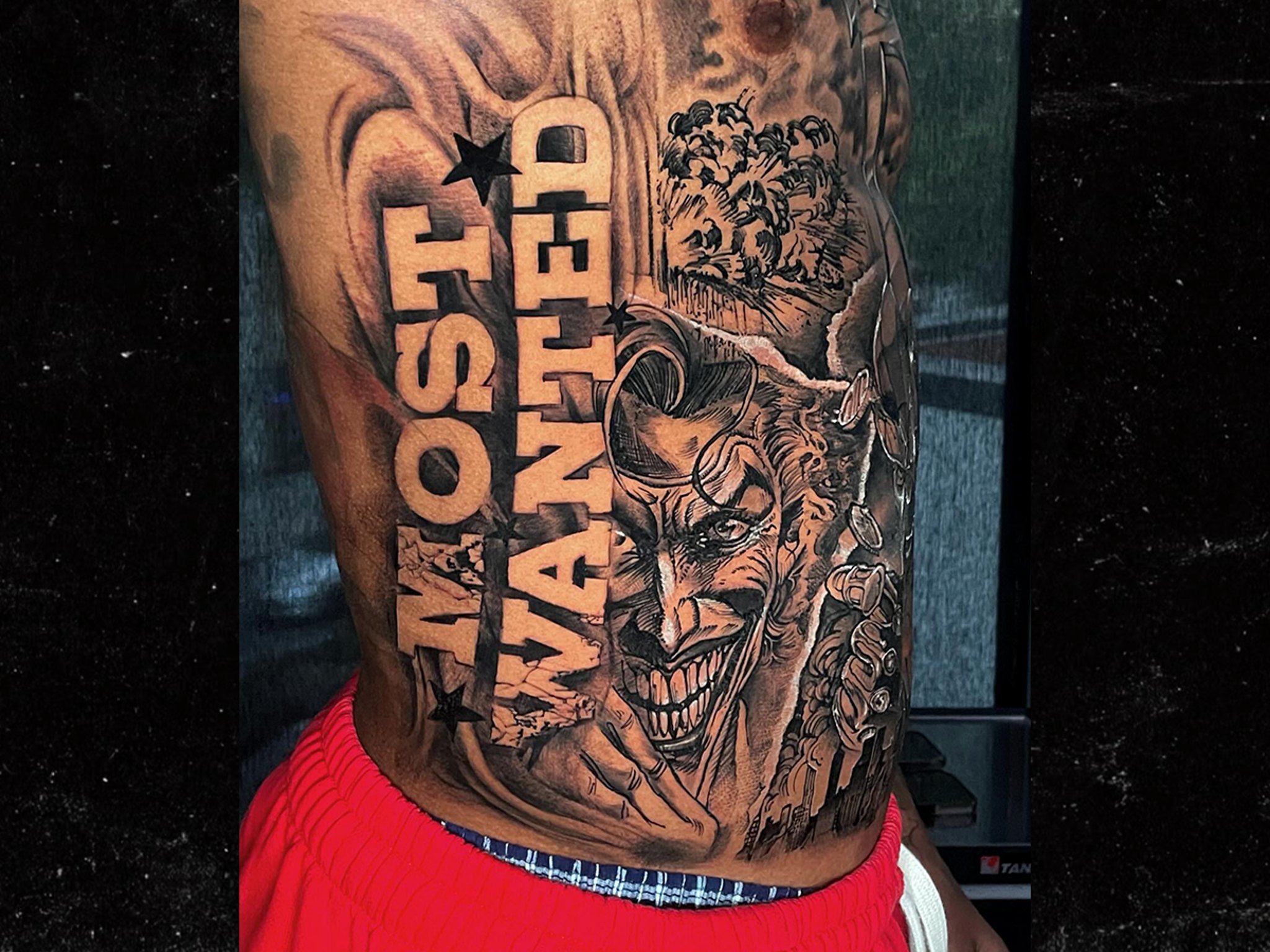
Below and around the words, the ink uses a mixture of hard edges and softer grey transitions. A face-like subject appears within the dark work, although the available report supports identifying the broader pop-culture imagery more confidently than assigning a precise role to every small shape. “Most Wanted” is the safest visual label because it is plainly legible and repeatedly associated with the photographed piece.
The side angle also explains why different photographs can make the same torso seem to contain different proportions. Skin curves around the ribs, and the camera sits closer than it did in the first frame. The lettering stretches with that curve, while shadows deepen the lower half of the image. Those changes are photographic effects, not evidence that the tattoo moved or was redesigned. Comparing the text with the chest and shoulder landmarks keeps the views connected.
Torso tattoo: Groot and Beware of Dog
The third close-up provides the most distinctive combination of character imagery and words. TMZ described a Groot design on the torso, and the photograph shows a large, expressive figure surrounded by dark shading. Alongside it, “BEWARE OF DOG” is visible in capital letters. The phrase gives the lower torso a strong horizontal line, while the character art supplies the rounded focal shape above it.
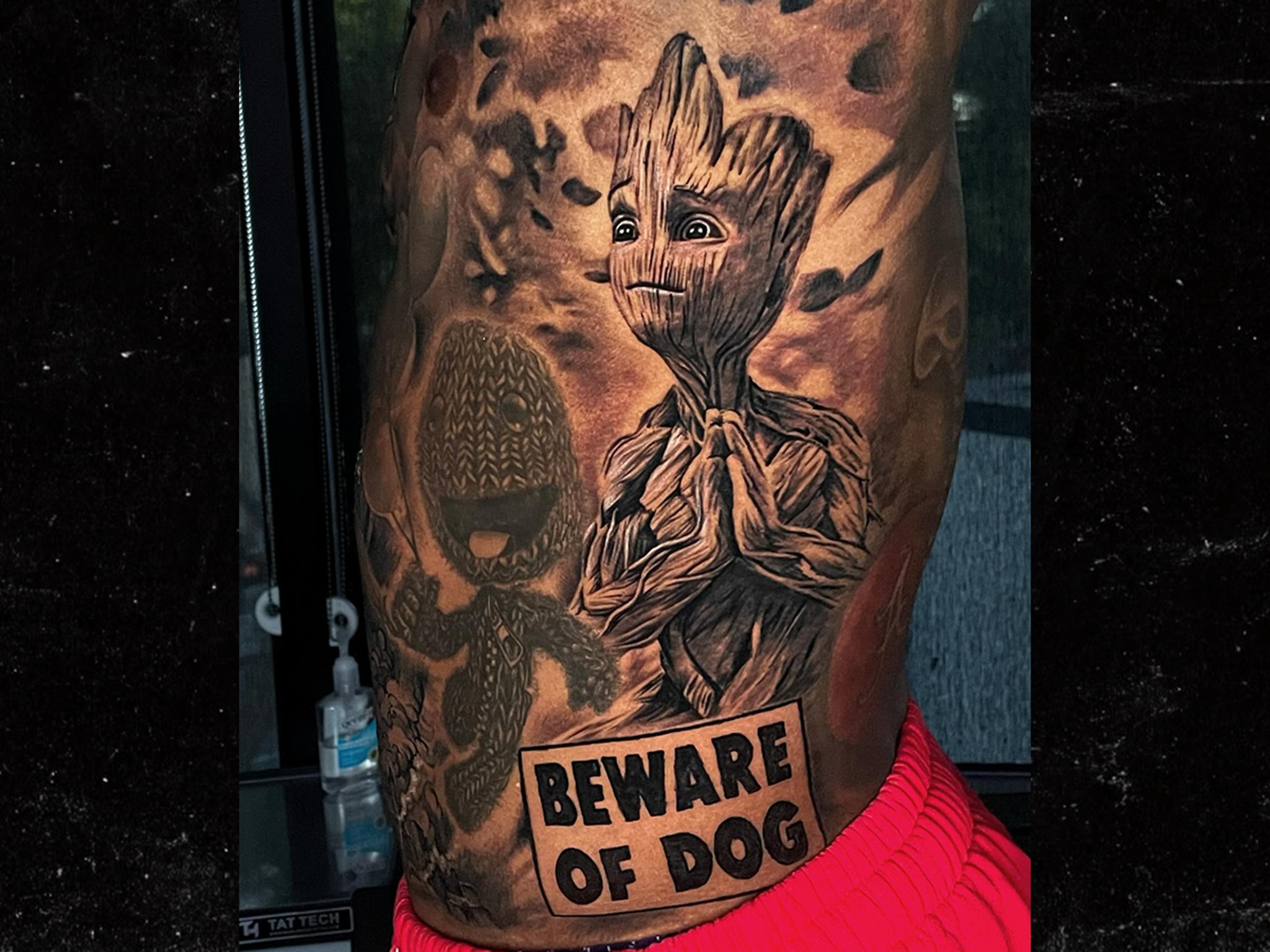
Groot’s placement is useful because it demonstrates how McKinney’s collection mixes a recognisable fictional subject with custom lettering. The photograph does not reveal whether the character carries a private family meaning or simply reflects a favourite piece of culture. It does show how the portrait sits within the wider field: heavier black areas frame the figure, and lighter skin breaks keep the subject from disappearing into the surrounding work. The character image is documented; its private meaning is not.
The “Beware of Dog” lettering is likewise best treated as a visible feature rather than a slogan to interpret. Its placement and scale are clear in the close-up, but the source does not explain why McKinney chose those words. The careful description is enough. It identifies the letterforms, places them on the torso, and leaves the personal reason with the person who wears the tattoo.
What the photographed collection establishes
Taken together, the three TMZ images document a torso project rather than three unrelated tattoos. The chest cross and “In God We Trust” lettering establish the upper-body centre. “Most Wanted” marks the side-torso view. Groot and “Beware of Dog” show how character art and text share the lower frame. The same body landmarks recur across the images, which lets the viewer compare scale without treating every crop as a new design.
The work is visually connected by contrast. Black-and-grey shading gives the major images weight, while lettering creates readable pauses across the torso. Portrait-style faces bring a human focal point to areas that could otherwise become a mass of dark ink. There is also a practical photographic lesson in the sequence: a wide image explains geography, a side image clarifies text, and a close frame reveals line and shadow. Each view answers a different visual question.
The published report also preserves McKinney’s own short caption about tattoos being over war wounds. That sentence is evidence of how he presented the session, not a complete explanation of the individual designs. It supports a broad reading of the work as personal and resilient, but it does not turn the cross, characters, or lettering into confirmed autobiographical symbols.
The player behind the photographed work
McKinney entered the Packers’ 2024 roster as a veteran safety after beginning his NFL career with the New York Giants. Green Bay’s official 2024 and 2025 roster galleries place him in the team’s visual archive through both headshots and action photography. That context matters because the tattoo report is tied to an active professional athlete whose public images change with uniforms, seasons, and media days.
The roster material also confirms the identity of the person in the tattoo photographs. The face, hair, build, and neck ink line up across the official headshots and the TMZ frames. The connection is strongest when the image is treated as identity context rather than as additional tattoo evidence. The portrait supports who is shown; the tattoo photograph supports what is shown.
That distinction keeps the article from padding the tattoo record with unrelated game images. McKinney has many public photographs, but only the three TMZ frames in this dossier were selected for direct discussion of the torso piece. The official portraits are used later as supplemental context, with their role clearly separated from the tattoo-bearing set.
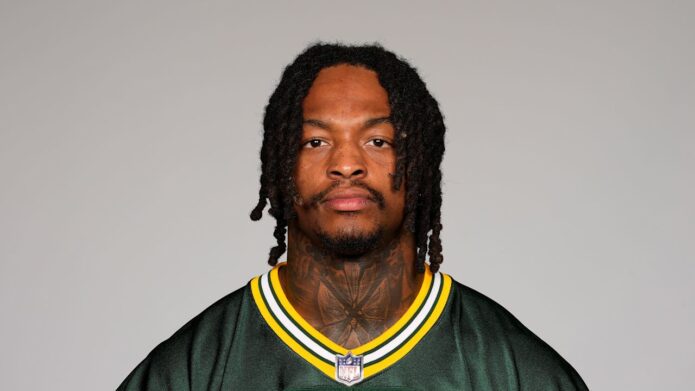
A clear official headshot
The 2024 Packers roster headshot gives a face-visible view of McKinney against a neutral background. His expression and neck tattoo are easy to see, and the tight crop makes it a useful identity portrait. It is not a substitute for the torso close-ups: the jersey covers most of the chest and the image does not show the reported Groot, cross, or lettering work.
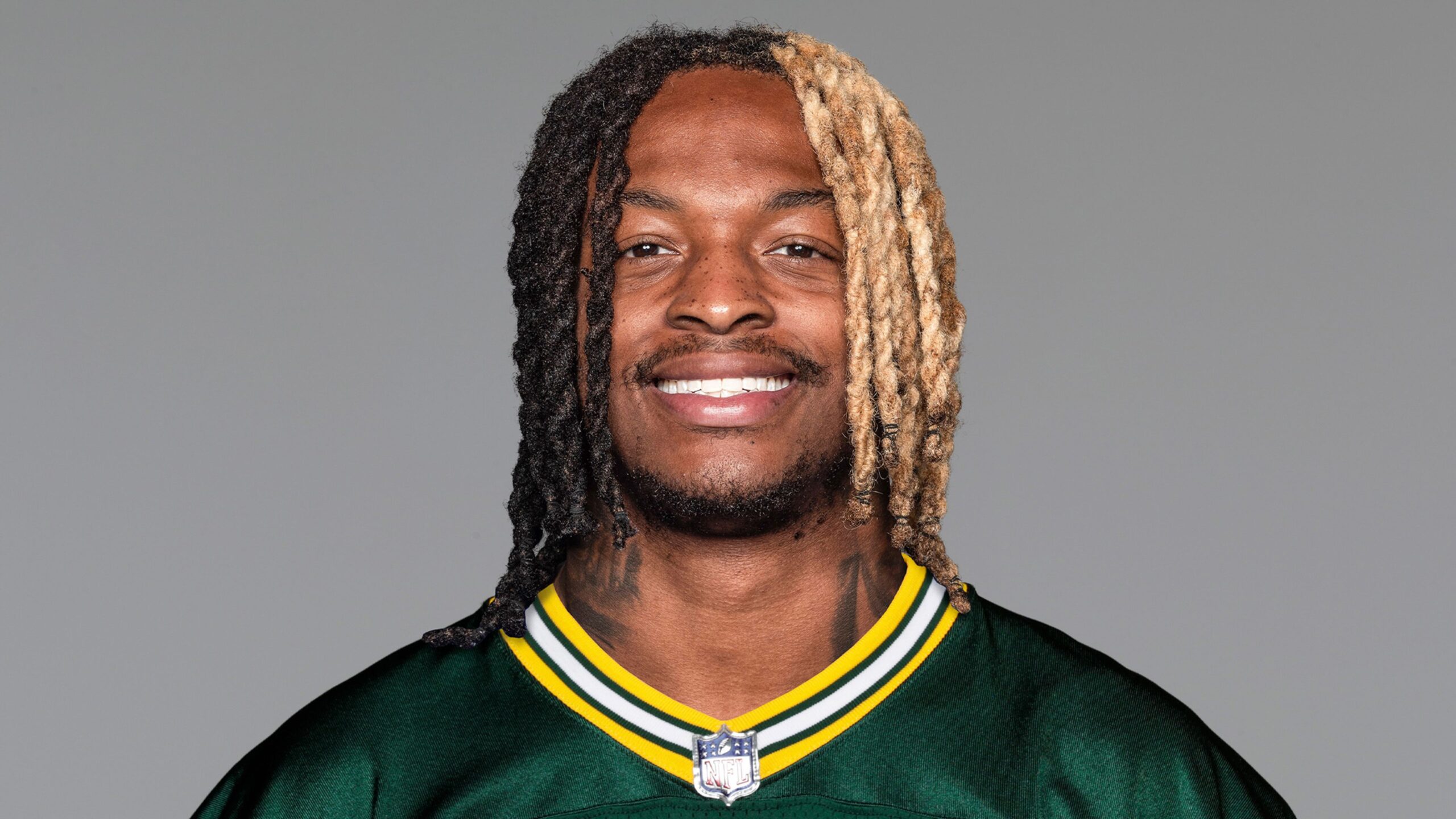
Used in this limited role, the headshot helps the reader connect the detailed torso photographs with the player who appears in Green Bay’s official archive. It also shows why a separate portrait route was required. A face-visible photograph gives the page a stable introduction, while the tattoo images can remain focused on placement, scale, and design. The two kinds of evidence work together without being confused.
A wider Packers moment
The Packers signing-gallery photograph gives a different kind of context. McKinney is seated and smiling at the camera in team-branded clothing, with his name and the signing-day setting visible around him. The frame is broader and more narrative than the headshot, but it still keeps his face clear. It shows the player in an arrival moment rather than presenting another view of the torso tattoo.
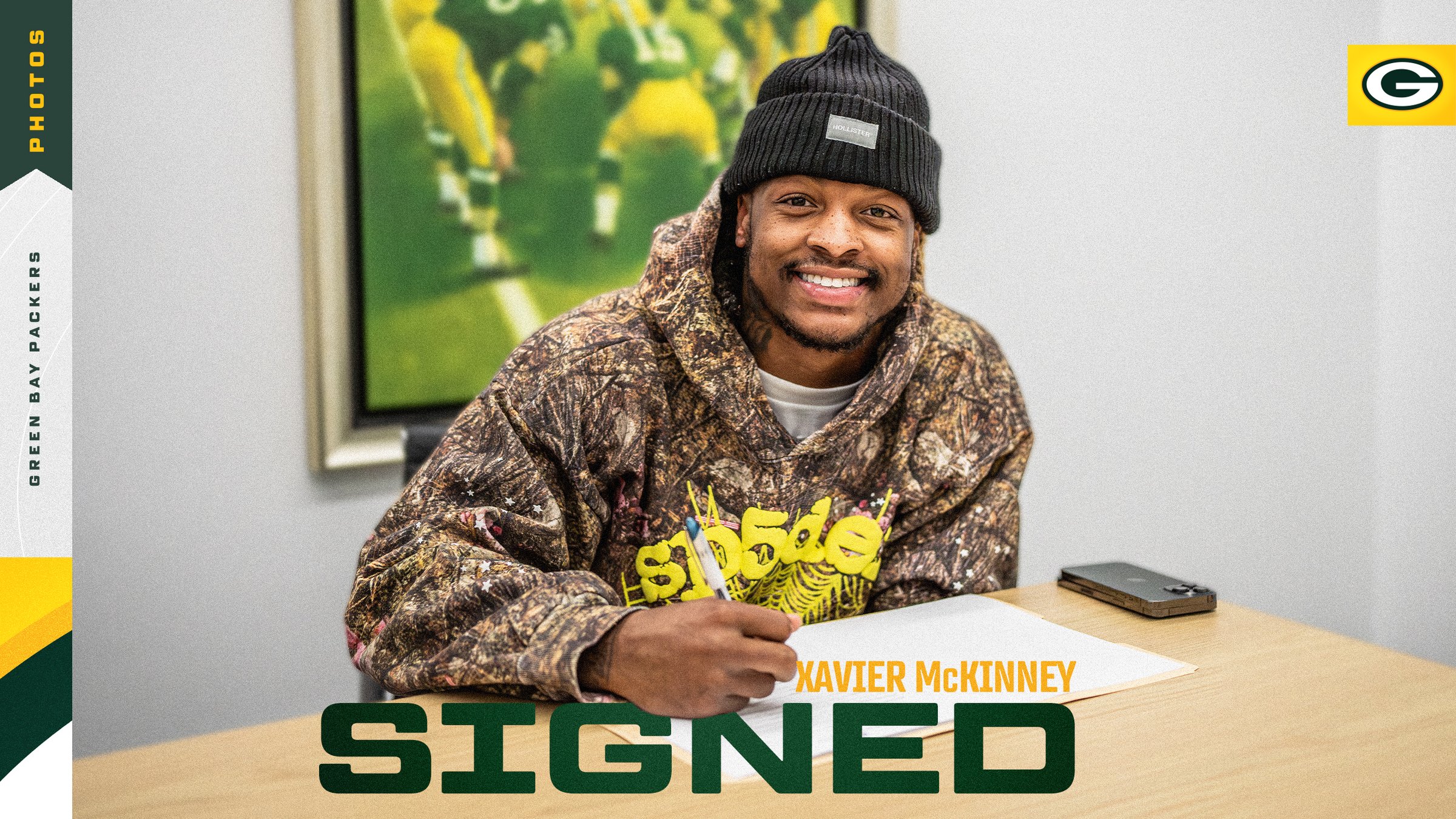
That wider context helps explain the article’s visual pacing. The tattoo-bearing photographs come first because they carry the design evidence. The two portraits arrive only after that search is exhausted, and both are labelled as supplemental context. No portrait is being used to invent a tattoo detail; each one simply makes the subject and career setting easier to recognise.
What remains unconfirmed
The sources do not provide a complete catalogue of McKinney’s tattoos, a full chronology of the session, or a private explanation for every visible character and phrase. They also do not justify turning a design category into a personal biography. The strongest claims are therefore visual and bounded: a large torso project was reported, the photographs show a cross, chest lettering, “Most Wanted,” Groot, and “Beware of Dog,” and McKinney publicly shared a short caption about tattoos and war wounds.
There is no need to fill the gaps with speculation. The cross can be described as a cross. The character imagery can be identified where the report supports it. The lettering can be transcribed when it is readable. Everything beyond those observations belongs to McKinney unless he chooses to explain it. That approach keeps the article specific while respecting the difference between a photographed mark and a private meaning.
A concise visual summary
McKinney’s documented torso work is defined by scale, contrast, and a deliberate mix of imagery and words. The chest view establishes the cross and “In God We Trust.” The side angle makes “Most Wanted” legible. The close frame adds Groot and “Beware of Dog.” Together, the images show a connected upper-body project with portrait-led subjects, heavy shading, and clear lettering.
The official Packers portraits serve a separate purpose. They confirm the face and career context, offer a clean route for the featured image, and keep the page from asking a single tattoo frame to do every job. The final reading is straightforward: McKinney’s ink is richly documented in photographs, while the personal meanings that remain private should stay private.
For a reader interested in the player beyond the still images, the Packers interview below adds current voice and team context without being presented as tattoo evidence.