
MC Cabelinho’s tattoos form a published record of changing names, large-scale storytelling and a dense collection of ink across his neck, chest, arms and back. The Brazilian rapper has discussed the work in interviews and television appearances, while Brazilian entertainment outlets have documented later changes to the same areas. The clearest story is not a single isolated design. It is a body map that has developed in layers, with intimate lettering beside larger scenes and symbols.
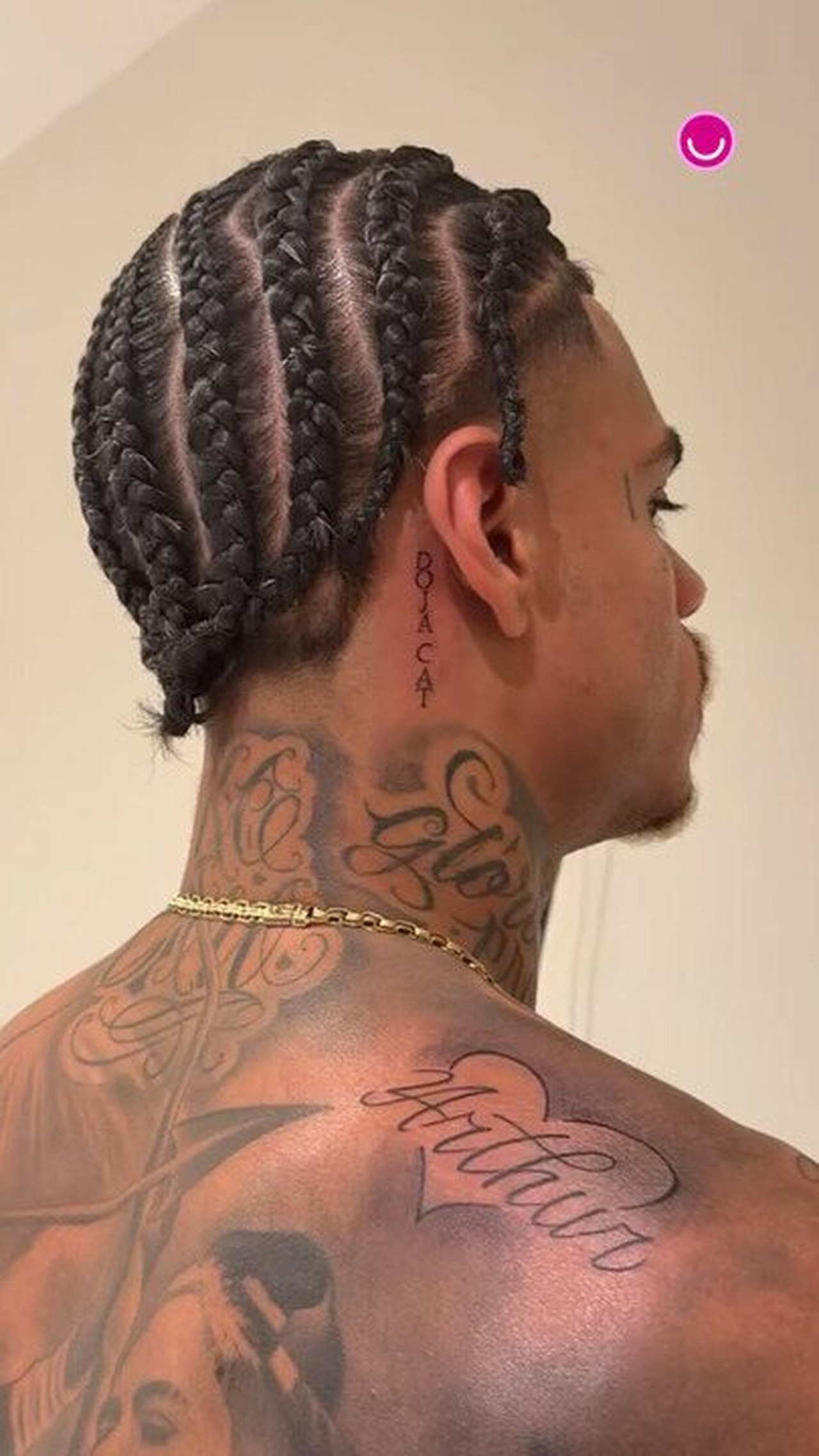
The photographs also show why a careful tattoo guide needs more than one press image. A close profile makes the Doja Cat lettering readable. A before-and-after composite records the change from an earlier name. GNT footage reveals the back tattoo in a wider setting, and later portraits show how the chest, neck and face-area marks work together. Those different views support a grounded description without inventing meanings that Cabelinho has not publicly assigned.
MC Cabelinho’s public image is closely associated with his ink, but the photographs show several different kinds of tattoo decisions rather than one uniform style. The neck and face-area pieces sit near the eyes, jaw and collar, where even a cropped portrait can reveal them. Lettering appears beside larger shaded scenes. On the torso, the designs expand into a much more narrative scale.
The coverage spans several dates and source families. Older GNT reporting focuses on the extensive back piece and the unusual use of general anesthesia. More recent Brazilian reports focus on the new Doja Cat name tattoo and its relationship to the earlier Bella Campos lettering. These are separate episodes, yet they overlap visually because the work occupies the same neck and upper-body map.
That overlap matters when reading the images. A photograph can show what is present at the time it was taken, but it cannot automatically explain when every mark was made or what every symbol means. The safest approach is to describe the visible placement first, then attribute a reported change or explanation to the named source. That keeps the visual guide useful while leaving private interpretations private.
MC Cabelinho’s Doja Cat tattoo replaces an earlier relationship tattoo
The most clearly documented recent change is the lettering behind MC Cabelinho’s ear. Brazilian coverage from O Dia and CNN Brasil reports that the name Doja Cat was tattooed over the place where the name Bella Campos had appeared previously. The close profile makes the new letters easy to read and places them in the narrow area behind the ear and along the upper neck.
The decision is visually striking because the placement remains almost identical while the text changes. Instead of treating the new tattoo as a completely new area of the body, the reports describe it as a cover-up or replacement. That distinction is important for anyone studying the design. The same patch of skin carries a new word, so the story is about revision as much as addition.
The close-up also shows the lettering alongside the neck and chest collection. Cabelinho’s face remains visible, which helps confirm the subject, but the actual evidence is the readable name behind the ear. The image does not establish the tattoo artist, the exact date of the session or a private reason for choosing the new name. Those details should not be supplied by guesswork.
For tattoo design reference, this is a useful example of how a cover-up can preserve an existing placement while changing the message. The lettering is narrow, dark and positioned to remain visible in a side profile. It works with the face rather than sitting on an isolated patch of the body.

The tattoo cover-up story is visible in before-and-after photography
A separate composite published by Diário de Cuiabá is valuable because it places the earlier Bella lettering beside the later Doja Cat version. The two panels create a compact visual timeline. The reader can see that the reports are not merely discussing two unrelated tattoos in the same general area. They are describing a change to one recognizable placement.
Composite images need to be read carefully. Each half is a different photographic moment, and the lighting, head angle and crop are not identical. The design evidence is therefore about the location and the legible lettering, not about making a pixel-perfect claim that every surrounding line stayed unchanged. The composite is strongest as before-and-after context.
This kind of documentation is especially helpful in celebrity tattoo coverage because names and relationships can dominate headlines. The photograph gives the story a physical anchor. It shows how a personal reference can be revised without expanding the tattoo into a new part of the body. The result is a cover-up narrative that is visually specific and easy to locate.
The visible change also illustrates a broader design principle. When lettering is placed behind the ear or high on the neck, it can be read in profile and still remain integrated with larger chest and collar tattoos. Cabelinho’s images show that the cover-up does not erase the importance of the original placement. It makes that placement part of the story.

MC Cabelinho’s back tattoo was completed under anesthesia
GNT’s Na Piscina com Fê Paes Leme and several Brazilian reports document the unusually large back tattoo that MC Cabelinho completed with general anesthesia. The GNT image shows him lifting his shirt while another person looks at the work, revealing a broad, dark composition that extends across the back and side of the torso. The story is about the scale and length of the session, not about a shortcut to ordinary tattooing.
Published descriptions identify a scene connected to Cabelinho performing in a community, with a favela setting, fans and an orixá figure included in the composition. The reports attribute those elements to the design and to Cabelinho’s own explanation during the television appearance. The photograph supports the wider point that this is a narrative back piece rather than a small emblem.
The image also shows how a large tattoo changes the silhouette. The artwork fills the space between shoulder, ribs and lower back, so the body becomes a continuous canvas. Smaller tattoos on the arms and neck remain visible around it, but the back piece sets a different scale. It reads like a scene with depth, figures and background rather than a single symbol.
The anesthesia detail should be kept in its proper context. It is a documented part of the reported completion process, but it does not change the visual description of the tattoo. The design remains the evidence: a broad scene, heavy shading and a performance-related subject spread over the back.

The full torso tattoo collection brings together portraits, lettering and symbols
Portrait photography from Terra and other Brazilian outlets shows how the back and chest work sit within a larger torso collection. In a shirtless outdoor frame, Cabelinho’s face, neck, chest, shoulders and arms are visible at once. The image is useful because it gives a sense of scale. The tattoos do not stop at one feature. They create a connected field from the collar area down toward the ribs and upper abdomen.
The chest includes bold lettering and larger graphic shapes, while the arms carry their own mixture of shaded imagery and smaller marks. A wide photograph cannot make every detail legible, yet it can show how the pieces are distributed. The eye moves from the face-area tattoos to the neck, then across the chest and down the arms. This creates a strong vertical flow that is different from the side-profile lettering story.
It is tempting to assign one meaning to the entire collection, especially when a portrait presents so much ink at once. The sources support a more precise reading. They document particular names, a large back scene and the visibility of symbols and lettering, but they do not publish a complete explanation for every mark. The design language can be discussed without turning every shape into a confirmed reference.
For someone collecting tattoo ideas, the torso photograph demonstrates how different scales can coexist. Fine face marks, compact neck lettering and a large back narrative can belong to the same visual identity when the work is distributed across natural body planes. The overall effect is dense, but the changes in scale keep it from becoming visually flat.

MC Cabelinho’s neck and face-area tattoos change the visual balance
Close portraits make the smallest tattoos in MC Cabelinho’s collection easier to see. The face-area marks sit close to the eye and cheek, while the neck carries larger lettering and curved symbols. A Gshow image from the Doja Cat coverage shows how the new name sits behind the ear while other ink continues downward. The result is a profile that is readable even when the chest and arms are cropped out.
Face and neck tattoos have a different visual responsibility from a back piece. They are seen in conversation, performances and everyday photographs, so they become part of the immediate outline of the face. Cabelinho’s portraits show that the placement is not hidden decoration. It changes the balance between hair, cheek, jawline, chains and shirt collar.
The close-up also makes the difference between evidence and interpretation clear. It confirms the subject, the face-visible placement and the readable lettering. It does not confirm a private emotional meaning for every mark around the ear or throat. That distinction is particularly important when a tattoo is connected to a public relationship or a reported cover-up.
The practical design lesson is about framing. A small tattoo can become the focal point when the camera moves close, while a wider image restores it to the context of the torso collection. Cabelinho’s published images use both approaches. The close profile records the name change. The wider portrait shows how the same area participates in a much larger network of ink.
What the published photos can confirm
Taken together, the photographs and reports establish several secure points. MC Cabelinho has a large tattoo collection spanning his face area, neck, chest, arms, torso and back. His back work was widely reported as a major narrative piece completed after a session involving general anesthesia. More recent reports document the Doja Cat lettering behind his ear as a replacement for the earlier Bella Campos name in the same location.
The images also confirm why no single portrait is enough. The side profile supplies legible lettering. The composite supplies a before-and-after comparison. The GNT frame provides a wider look at the back. The torso portrait shows how the larger composition relates to chest and arm tattoos. Together, those views make the article visual rather than purely anecdotal.
What remains uncertain is equally important. The published coverage does not offer a complete inventory, a definitive timeline for every piece or a private meaning for every symbol. A responsible guide therefore distinguishes between what a source says, what a photograph shows and what remains open. That restraint still leaves a rich design story: revision, scale, narrative imagery and a body map that keeps expanding.
Research references
O Dia coverage of the Doja Cat and Bella Campos lettering; CNN Brasil report on the cover-up; Gshow report on the back tattoo and GNT appearance; SBT coverage of the anesthetized tattoo session; MC Cabelinho back-tattoo video.
One thought on “MC Cabelinho Tattoos: Doja Cat Cover-Up, Back Piece and Body Map”