
Danilo Sellaro is a Swiss reality-TV personality and the 2025 Bachelor whose public image is unusually well documented through a dedicated BLICK tattoo gallery. The April 15, 2026 feature describes him as a tattoo lover and pairs his explanations with a thirteen-image record of his body art. That source makes it possible to discuss his tattoos from distinct photographs rather than from one repeated portrait or an unverified social repost.
The gallery covers the back, chest, arms, neck and legs. Sellaro connects some pieces to family, faith, sport and popular culture, while other meanings are left to the image and his own descriptions. This guide keeps those categories separate. It identifies what the photographs clearly show, records the meanings documented by BLICK, and avoids turning a partial view into a complete inventory.
The featured image is face-visible and tattoo-bearing, providing a separate identity route. The inline sequence then uses nine different original tattoo photographs, each mapped to the body area it documents. The images are intentionally distributed through the article so that a reader can compare placement, scale and linework without treating near-identical crops as separate evidence.
Danilo Sellaro’s full back composition
The full-back view establishes the scale of Sellaro’s collection. A large central composition spreads across the upper back, with a statue-like figure, surrounding rays and the contrasting words loved and unloved. The frame is wide enough to show that the work is not one isolated emblem; it is a layered arrangement designed to follow the shape of the back.
BLICK describes the back pieces through the ideas of Aphrodite, Zeus and the sun. The photograph supports the visual description, while the interview supplies the meaning. It is useful to keep those forms together because the composition reads as a conversation between classical figures, text and geometry rather than as a collection of unrelated stickers.
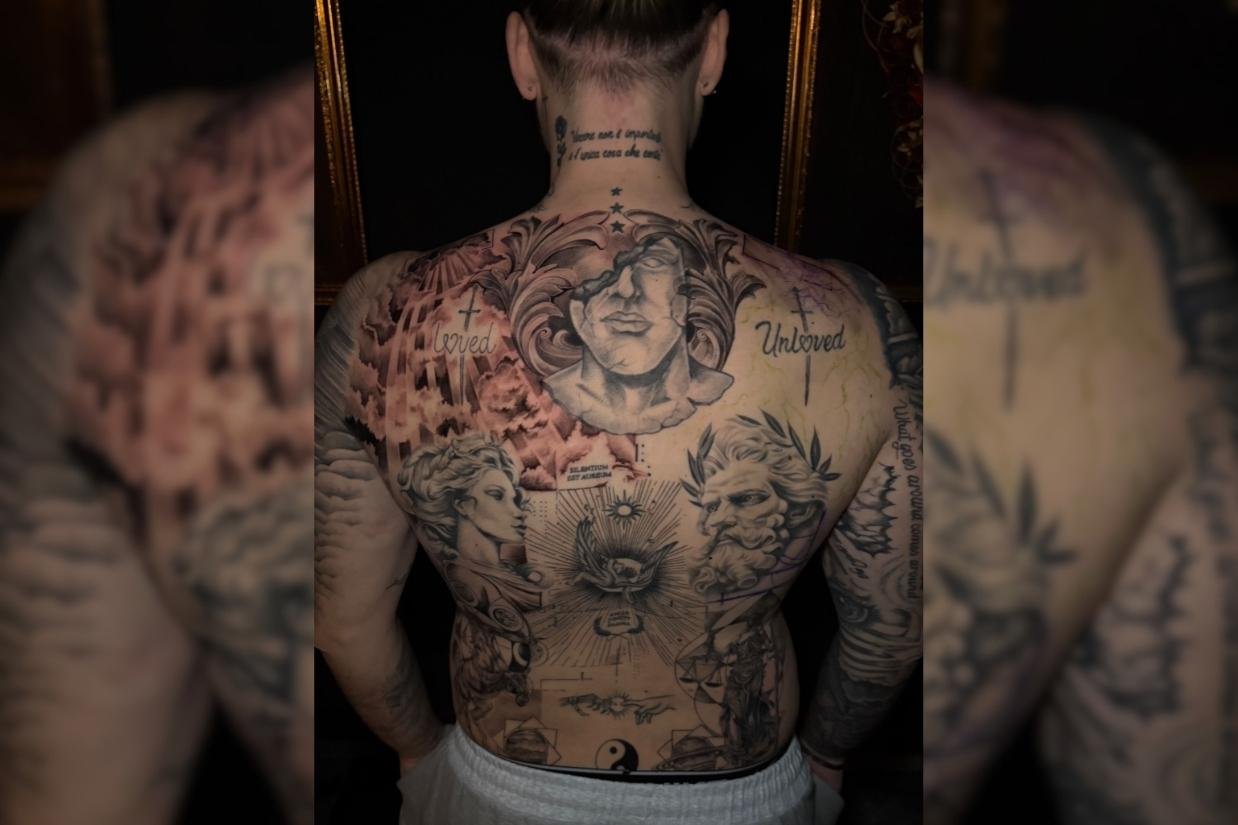
The view also shows why one image should not be made to stand for the whole record. The shoulder line, lower back and side angles are only partly visible here. A second close view can clarify the upper-back portrait, while another lower view reveals Justitia and Saturn. Each frame adds a different section of the documented work without pretending that the gallery was photographed as a single diagram.
For design reference, the strongest lesson is proportion. The main portrait has room to breathe because the surrounding lettering and rays are arranged around it. The dark shading gives the figures weight, while the open skin between elements prevents the back from becoming an unreadable block. Those observations describe the photographed composition, not a claim about why every gap was left open.
Justitia, Saturn and the lower-back geometry
The lower-back photograph moves to a detailed symbolic scene. Justitia is visibly placed inside geometric forms, holding scales and a sword, while Saturn appears below. Sagittarius, moon signs and Jupiter are also documented in the gallery, giving this area a different vocabulary from the portrait and text on the upper back.
The image is valuable because it isolates linework that disappears in a full-back frame. The scales, drapery and sword remain readable, and the surrounding circles create a strong vertical structure. The photographed view does not prove the order in which these pieces were made, so the article treats them as one documented area rather than reconstructing an appointment history.
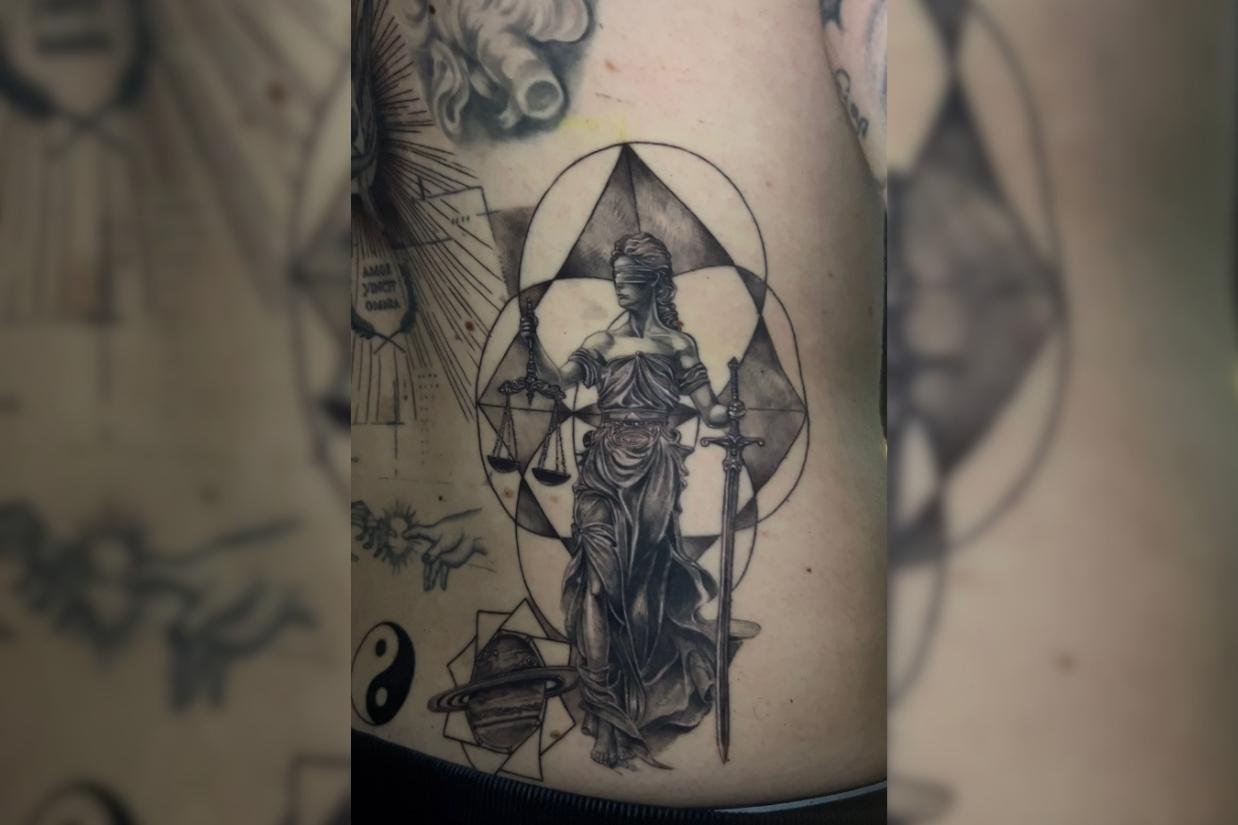
Sellaro’s back is therefore better understood as a visual map than as a single theme. Classical justice, planetary references and personal wording occupy different zones, yet they share a black-and-grey realism approach. The meanings are not interchangeable. Justitia can be discussed as Justitia because BLICK identifies it; the exact significance of every geometric border remains undescribed.
The lower-back frame also demonstrates the value of using original image variants. It is not a crop of the full-back photograph and it contributes different evidence. A reader can see how the central body of the figure sits relative to Saturn and the surrounding geometry. That is more informative than repeating the same wide portrait with a different caption.
Grateful, Blessed and the chest dates
Sellaro’s chest work combines words, dates and figurative imagery. The close photograph shows Grateful and Blessed across the upper chest, Roman-numeral dates connected with his parents, and a Creation of Adam reference associated with Michelangelo. Lower lettering includes Trust God, with angels and clouds extending the religious visual language.
The chest image is one of the clearest examples of meaning and placement working together. The words sit across a broad horizontal area, while the dates provide a private family marker within the larger composition. The image makes those elements visible, but the caption should not imply that every surrounding cloud or figure has a separately documented explanation.

The religious references also connect with the rest of the collection without making the entire body art religious. On the back, classical and planetary imagery appears beside personal text. On the arm, family wording and a rose take a more direct memorial form. The photographs show a person collecting symbols from different parts of life rather than following one narrow flash-sheet style.
From a placement perspective, the chest needs to be read with posture and clothing in mind. The upper words become prominent when the neckline is open, while the lower imagery disappears under a shirt. That changing visibility is part of the photograph’s information. It explains why a face-visible featured portrait can show genuine ink while still leaving the close chest view to a dedicated section.
The cracked eye and the right-arm quote
The right-arm photograph records a cracked eye and a multi-line English quote. The eye is a compact focal point, while the lettering occupies the longer plane of the arm. In the BLICK gallery, Sellaro discusses the tattooed arm as part of a broader collection of statements, symbols and images rather than as a single isolated design.
The crack is visually important because it changes the emotional tone of the piece. It is not described here as a psychological diagnosis or a fixed symbol; the photograph only establishes the form. The quote can be mentioned as text because the source image makes the lettering visible, but a complete interpretation would require a direct statement that is not supplied in the selected evidence.
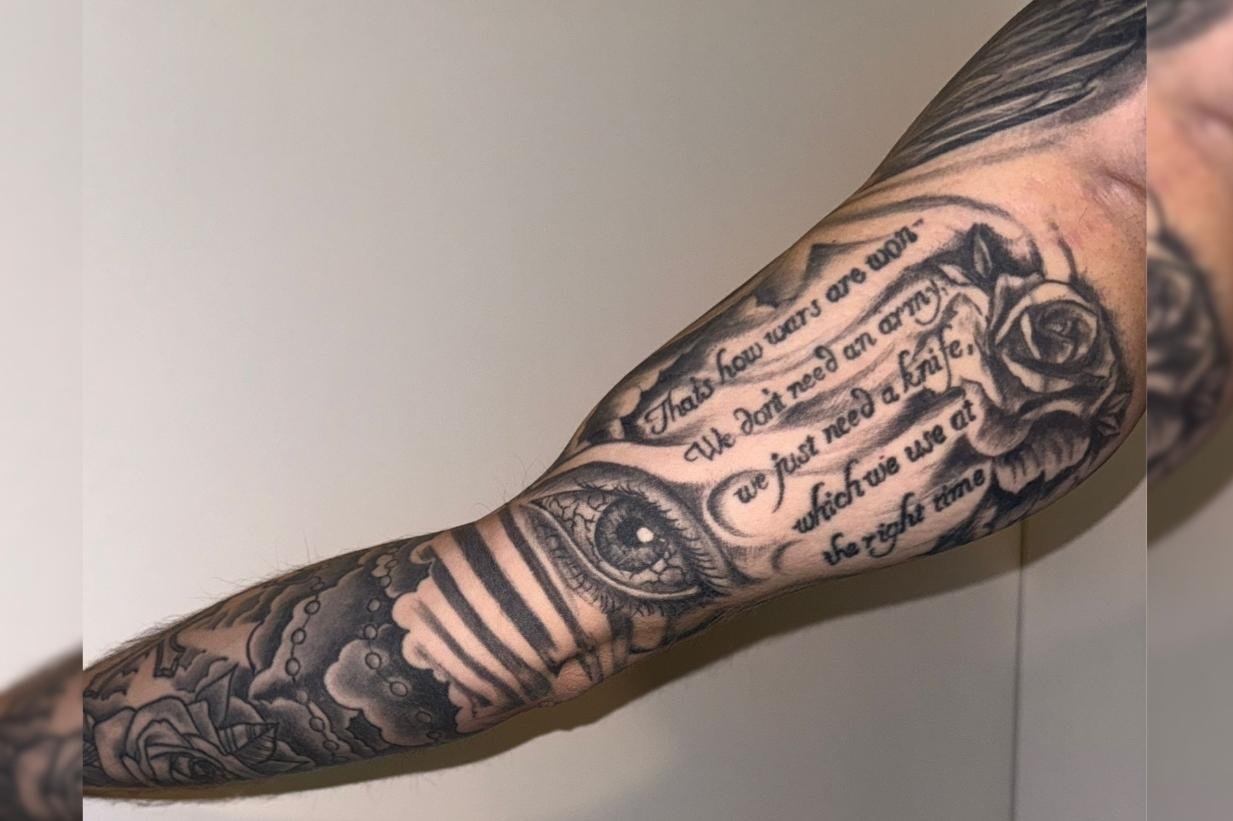
The arm also shows how typography can be used to bridge separate areas of a sleeve. A short image can sit above a longer block of words, giving the eye a point of entry before it follows the lines down the limb. That relationship is a design observation. It should not be mistaken for proof that the pieces were planned in one session.
This view is deliberately different from the family-rose photograph that follows. Both are arm images, but they expose different original frames and different motifs. Keeping them separate prevents the article from making one close-up carry every arm claim and gives readers a more accurate sense of how much visual material the BLICK gallery actually contains.
Family lettering and the 1994 rose
A second arm photograph shows Italian family lettering, a rose and the year 1994. The lettering is placed along the forearm, where the long shape can be read with the arm turned toward the camera. The rose adds an illustrative counterpoint to the text, while the year functions as a clearly visible personal date rather than a generic decorative number.
BLICK’s description connects the wording with family and identifies Sellaro’s birth year as 1994. That is a documented association, so it can be stated with more confidence than a guessed reading of an indistinct script. The article still avoids assigning a separate meaning to every petal, leaf or background line when the source does not do so.
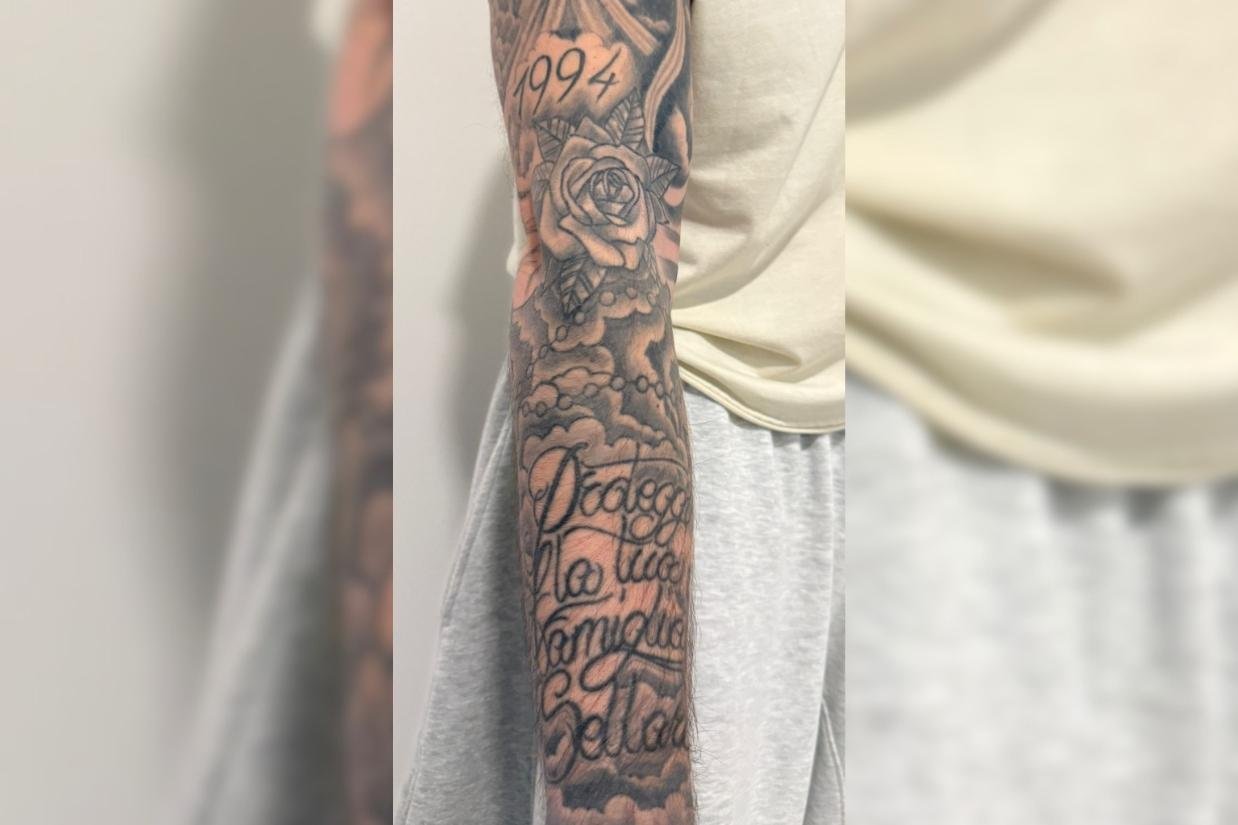
The combination is a useful example of how personal tattoos can use familiar visual shorthand without becoming anonymous. A rose is widely used, but in this frame it sits beside family language and a date that make the composition specific to Sellaro. The meaning comes from the relationship between the elements and the person, not from the rose alone.
The photograph also gives the collection a different rhythm from the dense chest and back work. It is narrower, more linear and easier to read at a glance. That contrast matters when documenting a large tattoo collection: not every piece occupies the same scale, and the smaller, text-led zones can be just as biographical as the large realistic figures.
The neck message and Juventus stars
The neck photograph shows an Italian phrase translated by BLICK as “winning is not important, it is the only thing that counts”. A rose sits nearby, and three Juventus stars appear across the upper back and neck area. Together, the elements link text, a floral motif and football allegiance in one compact, face-adjacent placement.
Because the phrase is close to the face, it changes the way Sellaro’s identity is read in a portrait. It remains visible when the rest of the body is covered, making it one of the collection’s most immediately recognizable zones. The photograph is a close detail rather than a generic portrait, so the Italian lettering can be discussed without relying on a blurry crop.
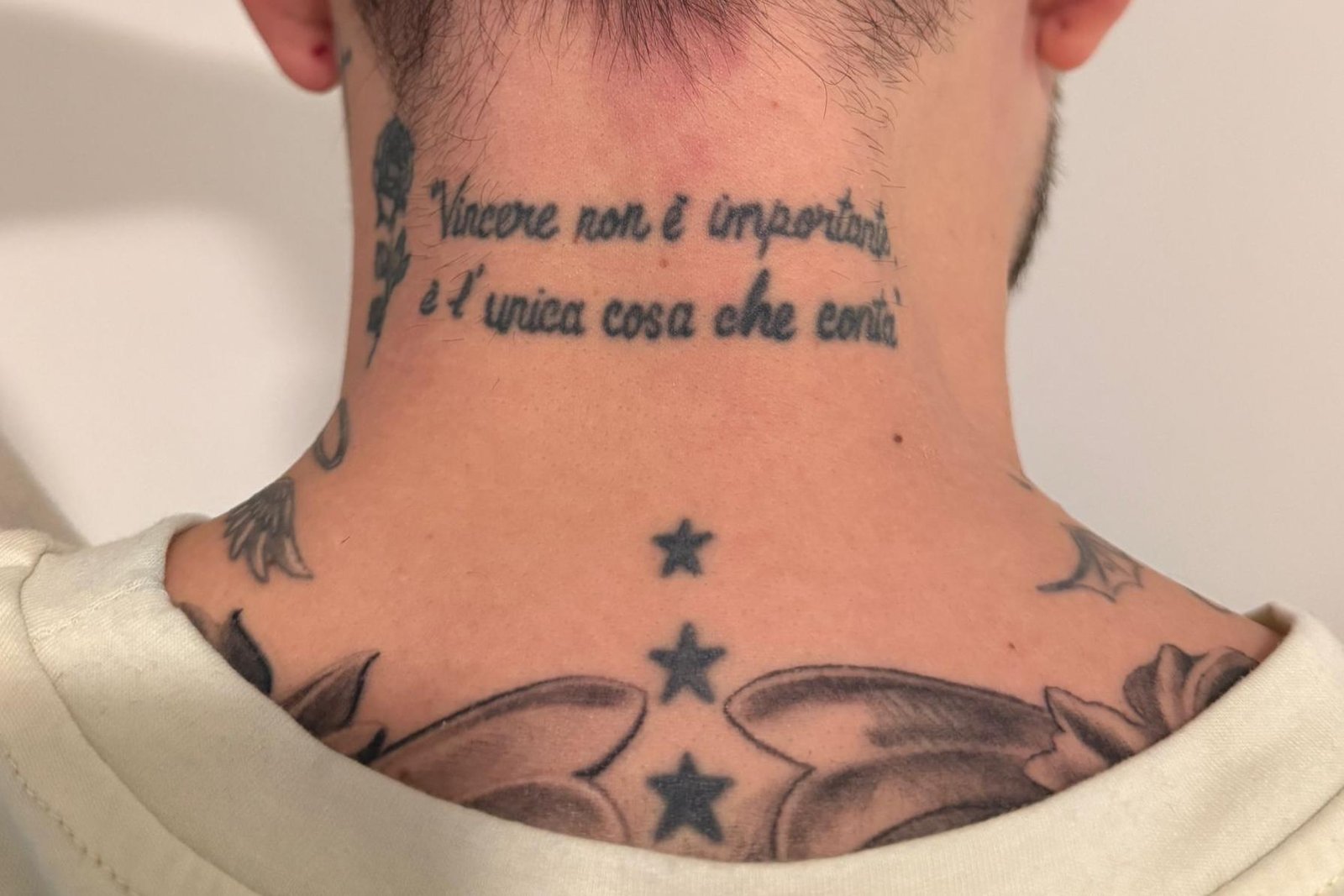
The Juventus stars are especially useful as an example of how a small symbol can carry clear subject context. BLICK identifies the club connection, and the three-star arrangement is visually distinct from the larger classical figures elsewhere. The design does not need to be inflated into a larger mythology; its strength is its concise, legible placement.
The neck view also explains why tattoo-first ordering matters. A face-visible image can establish identity, but a close tattoo photograph is still needed to document the words and stars. Using both routes gives the page a stronger record than a portrait alone, while keeping the featured image and inline evidence distinct.
The upper-arm figure work
The upper-arm photograph shows a large angelic or classical figure composition with layered shading. The figure occupies most of the visible arm, and the surrounding clouds and dark tonal transitions create the look of a continuous sleeve section. It is a different source image from the chest and lettering views, so the scale and texture can be examined on their own terms.
The figure’s face and drapery are more legible than the smaller motifs in the full-body gallery frames. That makes the photo useful for describing realism, contrast and body contour without claiming a specific religious identity that BLICK does not explicitly assign. The safe description is a large classical or angelic figure, with the exact iconography left open where the source is not definitive.
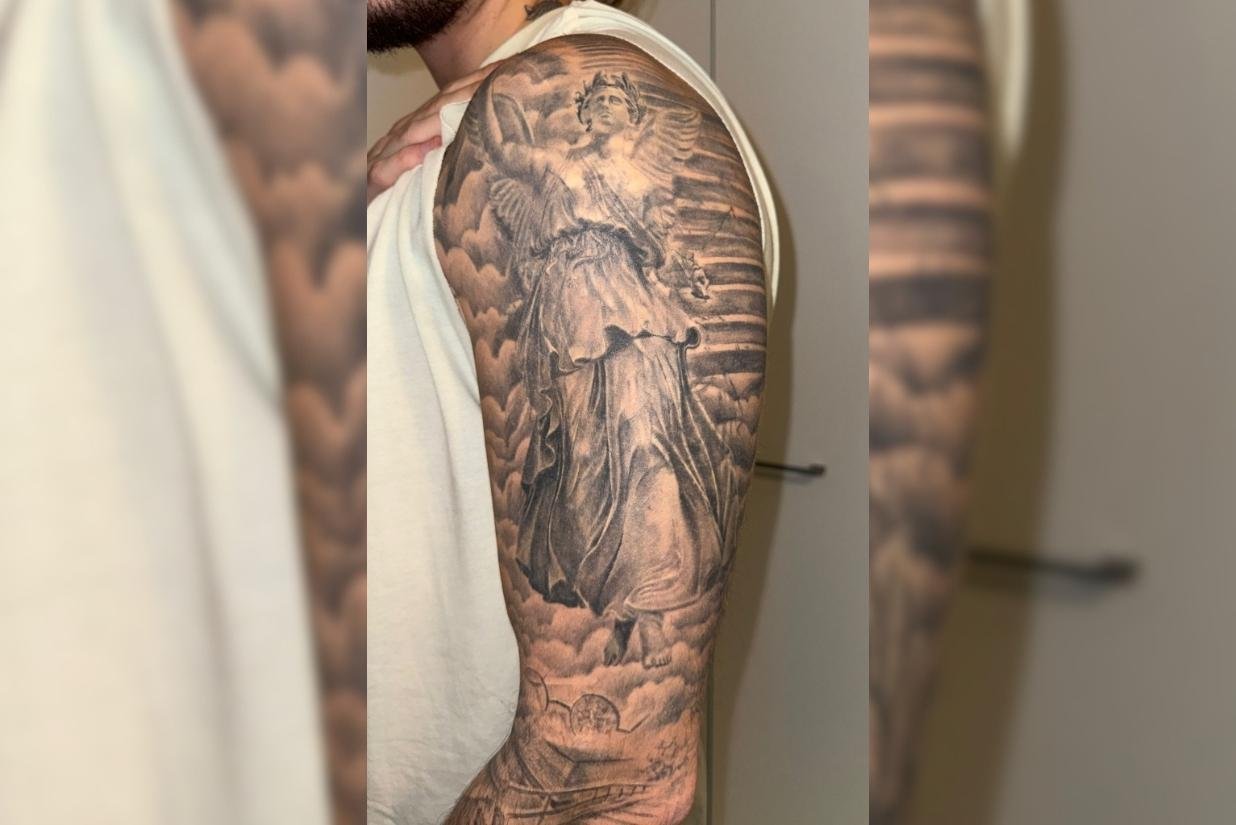
Placement is doing much of the visual work. The shoulder provides a broad rounded surface for the figure, while the lower arm narrows and forces the shading into a tighter vertical rhythm. The photograph records how the design follows that change in anatomy. It does not establish whether the surrounding pieces were made at the same time or by the same artist.
Placed beside the forearm scene, the image shows how Sellaro’s arms carry different visual registers. One area uses a large shaded figure, another uses smaller narrative objects, and another uses words and a rose. That variety is more accurate than describing the entire arm as one uniform sleeve.
The forearm scene and smaller motifs
The separate forearm view reveals smaller narrative motifs that are easy to miss in a wide portrait. A shark-like figure, a chair or television scene and additional linework are visible across the arm. The image is not used to force a definitive title onto every object; it is a record of recognizable forms and their placement on the forearm.
This kind of photograph expands the article beyond the most dramatic pieces. Large back figures and chest lettering naturally attract attention, but the smaller scenes show how a collection can accumulate through references that are meaningful to the wearer. The gallery makes their existence clear even when the public explanation for each individual object is limited.
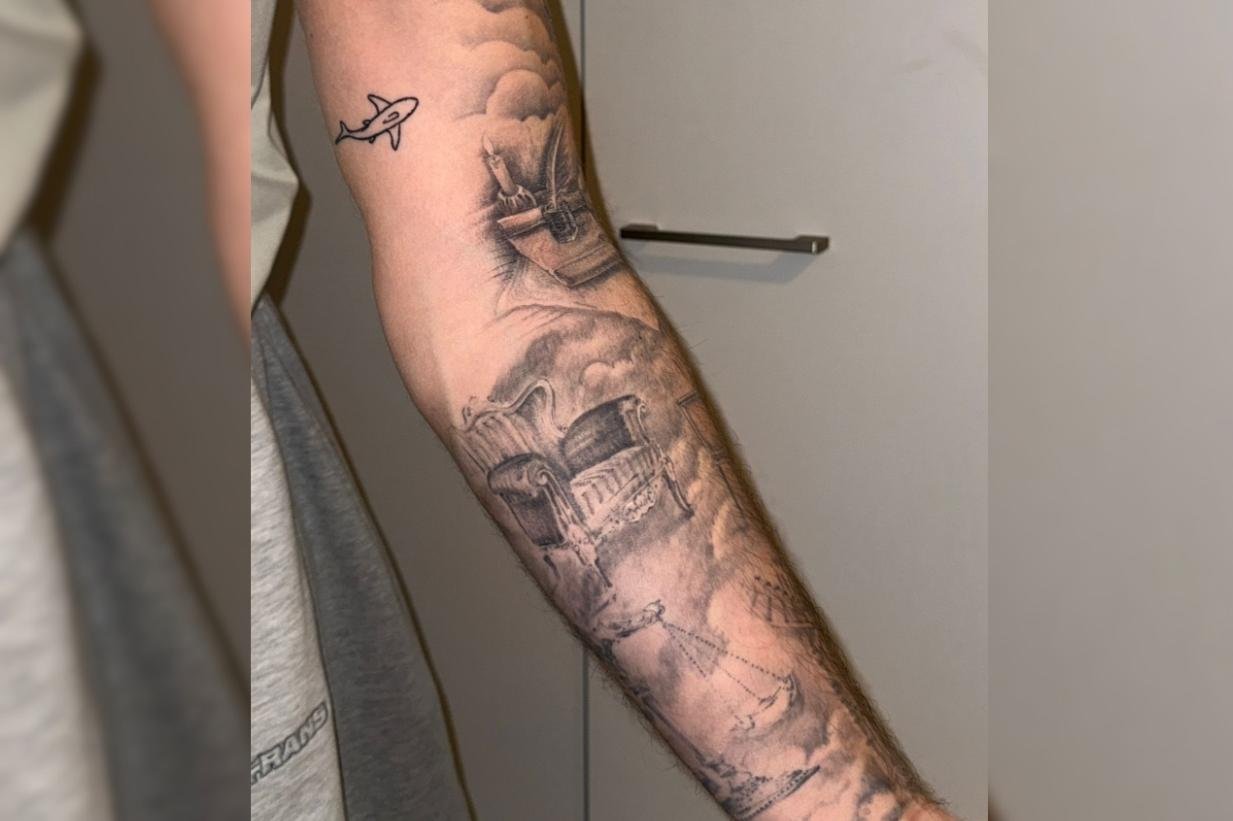
The forearm also demonstrates the importance of viewing angle. A motif can look abstract when the arm is relaxed and become readable when the wrist turns toward the camera. The selected frame preserves that change in perspective. It is distinct from the arm photographs used for the cracked eye and family rose, so it contributes new visual evidence rather than repeating one crop.
For a tattoo guide, the responsible conclusion is modest but useful: Sellaro has multiple narrative and illustrative motifs on the forearms, including the forms visible here. The image does not support a complete list of every small symbol, and the article does not pretend that it does. Good documentation leaves room for details that remain unresolved.
Danilo Sellaro leg tattoos and One Piece references
The leg photograph turns from personal lettering and classical imagery to One Piece references. The visible designs include Whitebeard and Ace on one leg, the Straw Hat skull on the other, and the vertical 3D2Y lettering associated with the series. These are among the clearest examples of popular-culture imagery in the BLICK gallery.
The paired composition is helpful because the two legs use different characters and symbols while belonging to the same fictional world. The heavy black forms stand out against the leg, and the vertical lettering follows the long anatomy naturally. BLICK’s labels supply the character identities, while the photograph supplies the scale and placement.
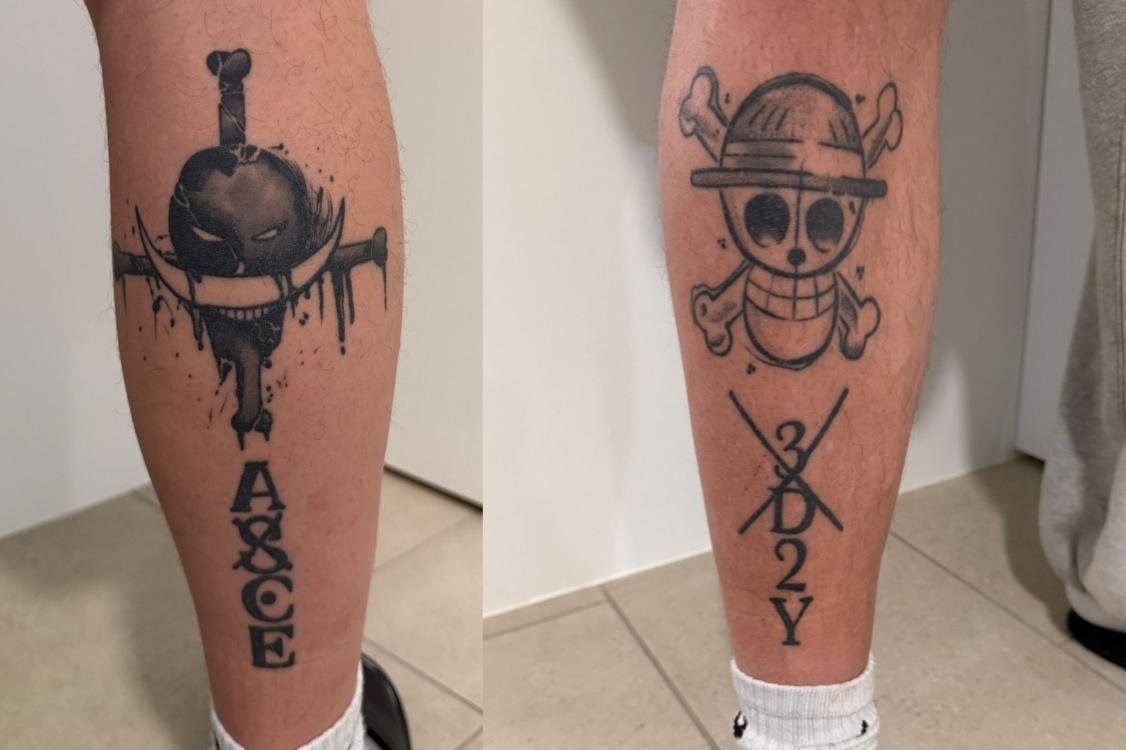
The One Piece pieces also show how a personal collection can move between realistic portraiture and graphic linework. The back and upper arm rely on shading and anatomical contour. The leg tattoos use recognizable silhouettes and lettering that remain readable from farther away. That contrast keeps the full collection from being reduced to one style category.
The gallery includes additional tattoo photographs and alternate views, but the selected set stops after every major body area has a distinct, visually useful original. The aim is coverage, not arbitrary volume. Nine inline tattoo photographs, plus the separate face-visible featured image, document the strongest body-area evidence without padding the page with generic portraits or repeated frames.
What the documented record supports
BLICK’s thirteen-image gallery supports a broad but careful inventory: a large back composition; Justitia, Saturn and related geometric motifs on the lower back; chest lettering, family dates and religious imagery; multiple arm pieces; an Italian neck message with Juventus stars; and One Piece references on the legs. The source also supplies personal context for family, faith, football and popular culture. It does not provide a complete timeline or a separate explanation for every visible mark.
The strongest visual principle is variety within a coherent commitment to body placement. Sellaro uses broad surfaces for classical figures, long planes for text and compact zones for symbols. The result is a collection that changes scale as it moves around the body. A photograph can show that structure even when the meaning of one element remains private or undocumented.
The search was deliberately kept tattoo-first. The same BLICK subject and gallery were checked across full views, close details and direct image variants, while additional BLICK profiles and a separate Instagram identity route were used for corroboration and face visibility. The selected nine tattoo-bearing originals are not generic celebrity portraits, and each has its own section rather than being stacked at the top.
Limits of interpretation
Tattoo documentation is strongest when it distinguishes observation from interpretation. The photographs establish ink, placement and broad forms. BLICK establishes the meanings it explicitly reports. Everything else is described cautiously. That boundary protects the subject from having personal symbols turned into invented certainty and gives readers a more reliable visual reference.
Future photographs may reveal details that the selected gallery leaves hidden, especially on the side body and lower limbs. This article therefore records the searched evidence rather than claiming to be a permanent catalogue. If a later interview identifies another design, the new claim should be added with its own source and its own photograph.
As it stands, the record is unusually rich because it combines identity, context and multiple distinct originals. Danilo Sellaro’s tattoos are not represented by one convenient image; they are documented across the back, chest, arms, neck and legs, with the source’s explanations kept alongside the visuals they actually support.