Olek Balcerowski tattoos are best read as a changing visual system rather than a single list of symbols. The Polish basketball centre has described his collection as a way to express himself outwardly, while his tattoo artist Angela Ospite has explained that the work moves between realism and a newer micro-realism influenced by artists such as Leonardo da Vinci and Michelangelo. That combination makes the photographs unusually useful: they show how a very tall athlete carries detailed work across hands, arms and legs.
The selected originals come from several contexts. A basketball image shows the ink moving with the hands during play. A tattoo-studio photograph documents the scale of the leg and the relationship between artist and client. Other frames come from a Málaga Hoy interview session and show Balcerowski holding basketballs, speaking, or looking directly toward the camera. The featured identity portrait is kept separate from the tattoo evidence, while every inline image below is tattoo-bearing and mapped to the section where it provides its clearest view.
Olek Balcerowski’s tattoo map begins at the hands
The first image is a live-action frame from a Barcelona game. Balcerowski is raising a basketball while another player closes in, and the exposed hand and forearm carry visible black-and-grey work. The movement matters because it shows the tattoos in the posture they occupy during a real match rather than in a deliberately arranged studio pose. Lines cross the hand, small marks sit near the fingers, and the forearm coverage continues under the sleeve.

Hands are the collection’s most immediate visual signature in motion. A close-up can make a tattoo look like a flat graphic, but a game frame shows how joints, grip and wrist angle change the reading. The lines bend around the hand as Balcerowski controls the ball, and the forearm becomes a moving transition between skin and uniform. This is evidence of placement, not a reason to assign a private meaning to every figure.
The frame also establishes an important distinction between visibility and coverage. A tattoo may be obvious in a sleeveless or short-sleeved photograph and partly hidden by a warm-up top in another. That does not mean the design has changed. It means the source captures a different moment, crop and level of exposure. For a reliable reference archive, both conditions should be preserved.
The leg and forearm realism in the tattoo studio
The tattoo-studio photograph gives the clearest sense of scale. Balcerowski sits beside Angela Ospite while she works on another person, and his own legs and arms are exposed enough to show a broad catalogue of realism, linework and geometric details. A circular mark appears around the knee area, while larger shaded compositions run along the thighs and lower legs. The image is valuable because it records the tattoos in the place where they are made, not just the finished result on a red carpet.

The studio frame makes the body read as a long vertical canvas. The leg tattoos are not presented as isolated stickers. They stack along the limb, with open skin, dark outlines and larger illustrated areas creating a sequence that continues beyond any one crop. Ospite’s comments in Málaga Hoy support the broad stylistic description: she separates realism, including animals on the left arm, from a newer micro-realism approach associated with art and geometry.
That source also helps explain why one photograph cannot document every piece. Balcerowski is exceptionally tall, and the artist describes sessions that cover large areas over multiple days. A frame taken inside the studio may show process and scale while still omitting the back, chest or opposite leg. The correct response is to use complementary originals rather than stretch one photograph beyond what it can prove.
The basketball portraits show ink in motion
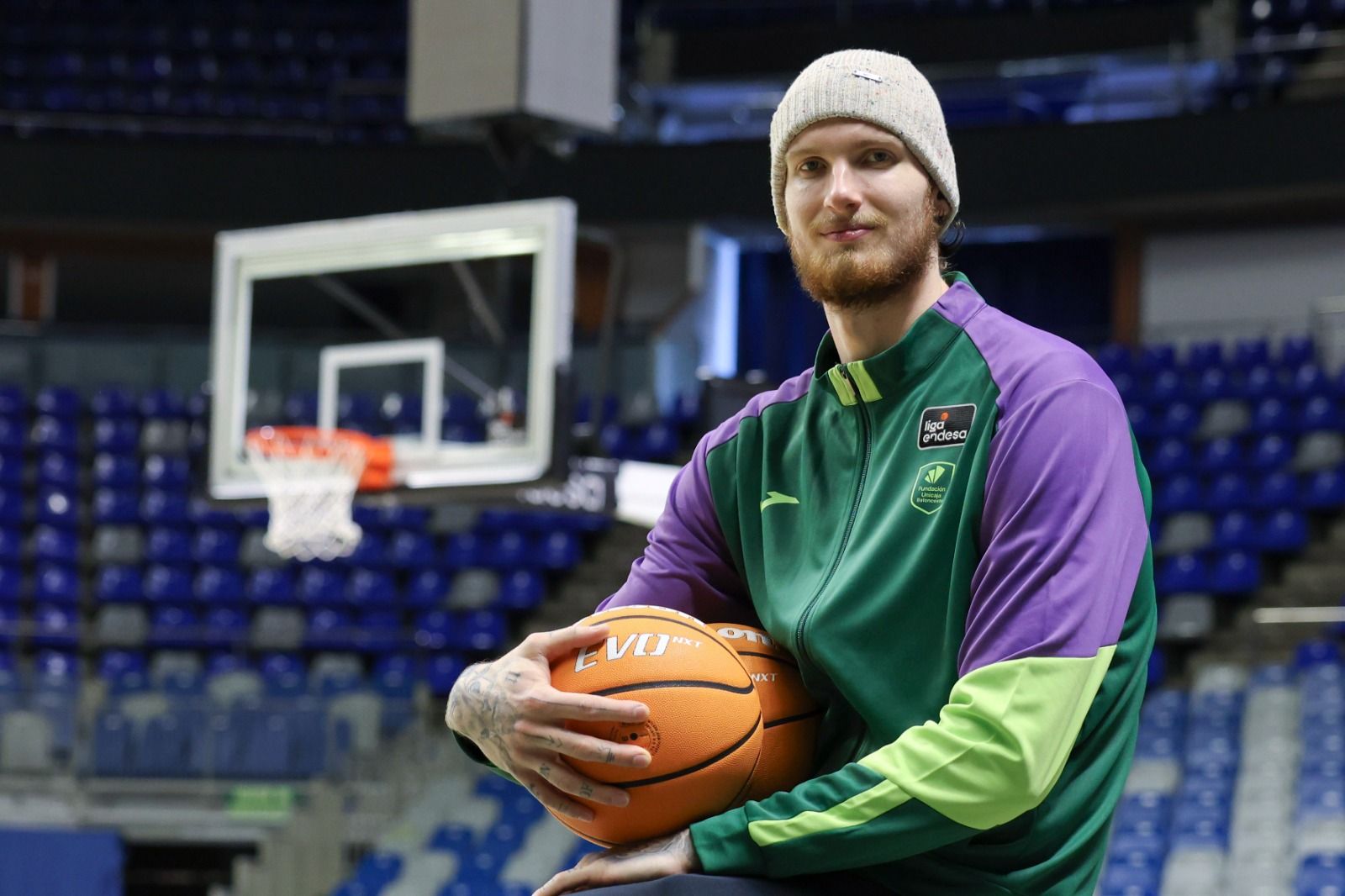
A low-angle Málaga Hoy portrait places Balcerowski beneath the basket with two basketballs in his hands. The face is visible, but the tattoos are the real subject of the crop: both hands sit near the camera, and the forearms angle forward so the linework becomes easy to compare. The green-and-purple training top supplies a strong colour field behind the black-and-grey ink, which keeps the hands visually separate from the gymnasium.

Scale changes when the hands are closer than the torso. Small finger marks that disappear in a full-body image become legible here, while the forearm remains large enough to show how dense coverage is broken by gaps. The composition is also a reminder that athletic equipment can become part of tattoo documentation. The balls frame the hands without hiding their most important visible areas.
The low angle adds another composition detail. A camera below the subject enlarges the hands and makes the basketball hoop feel architectural. It can make the tattoos seem more dominant than they would in ordinary conversation. That is a property of the photograph, not evidence that the athlete’s tattoos are concentrated only on his hands. The gallery and studio sources are needed to widen the map.
The seated interview frame reveals the same hand language at rest
In another Málaga Hoy image, Balcerowski sits in the arena while an interviewer speaks with him. His hands are lower and closer to his lap, so the viewer sees a different arrangement of the same kind of linework. The gesture is conversational rather than athletic. That change makes the ink easier to study as an extension of the hand and wrist instead of as part of a jump, pass or rebound.

Resting hands show how tattoos participate in ordinary gesture. Fingers move while a player explains an answer, and the small marks become part of the visual rhythm of the interview. The source does not provide a private explanation for each design, but it does show how the collection remains visible when the athlete is not posing to display it. Tattoos can function as personal style without becoming a performance of toughness.
The arena background also gives the image a useful sense of identity. Blue seats and the green training uniform establish the basketball setting, while the exposed hands remain the sharpest detail in the foreground. That contrast keeps the section grounded in the source: this is a face-visible interview photograph with tattoo evidence, not a studio flash image or a generic sports portrait.
The double-ball portrait shows both hands together
A front-facing Málaga Hoy portrait brings both tattooed hands into the same composition. Balcerowski holds one basketball on each side of his shoulders, and the fingers wrap around the balls so the markings on both hands can be compared at once. The pose is symmetrical without being identical: the left and right hands sit at different angles, revealing how linework changes when the wrists rotate and the fingers spread.
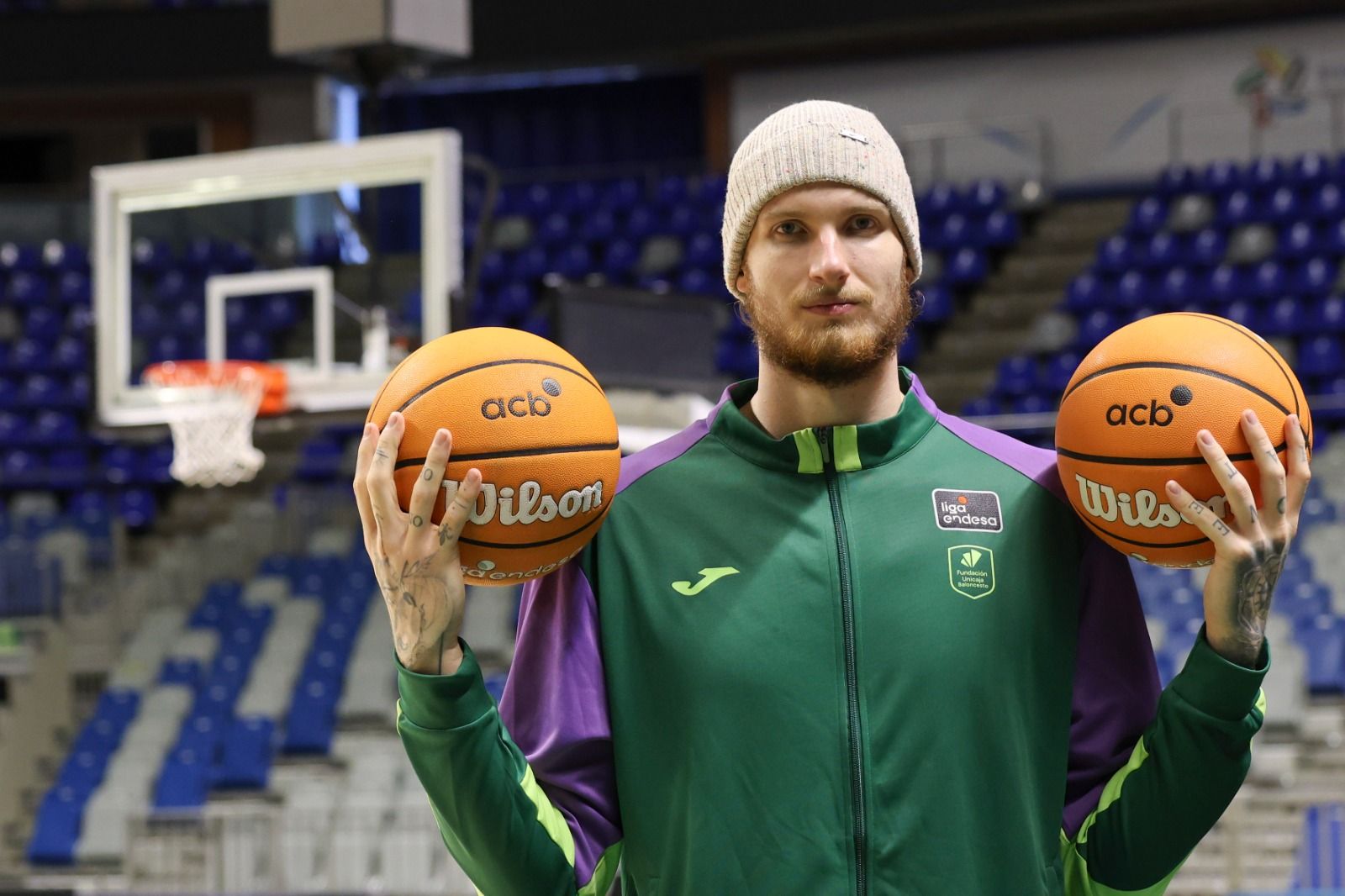
Symmetry helps the eye compare, but it should not imply mirrored designs. The photograph shows two hands together; it does not prove that the tattoos were planned as a matching pair. The useful observation is simpler. Both hands carry substantial visible work, and the marks continue toward the wrists and forearms. The basketballs provide a clear scale reference, while the face keeps the subject easy to identify.
This frame is distinct from the lower-angle portrait even though both were made in the same broader interview setting. The camera height, pose and hand placement change the evidence. That difference is why repeated frames should not be counted casually. A publishable set needs different originals that contribute different views, not multiple exports of one composition.
The close-up portrait separates face visibility from tattoo proof
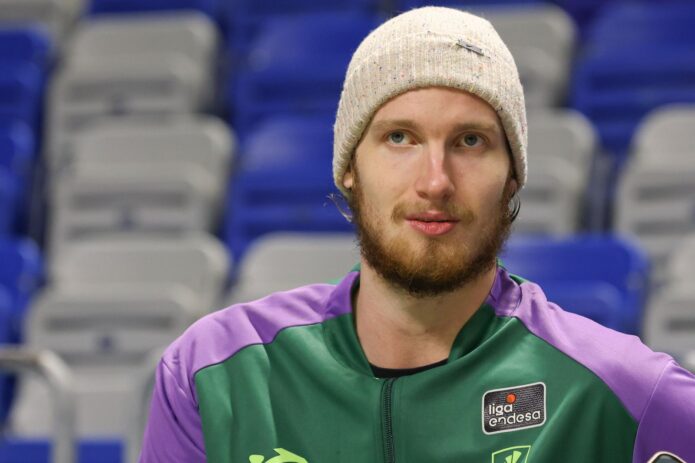
The sixth tattoo-bearing image is a tighter front-facing portrait from the Málaga Hoy gallery. Balcerowski looks directly toward the camera, while the upper edge of the training top and the lower edge of the frame leave the hands mostly out of view. It is still useful as a distinct identity-and-context image when paired with the hand and leg photographs, but it should not be described as showing tattoos that are outside the crop.
Good documentation includes honest limits. The face is clear, the subject is unmistakable and the image belongs to the same documented interview set, but the tattoo evidence is narrower than in the hand portraits. The frame helps establish that the gallery contains several different original poses rather than one repeated file. It also keeps the article from pretending that every useful photograph must show the maximum amount of ink.
In a tattoo archive, a face-visible image can have a role even when it is not the strongest tattoo view. It anchors identity and sequence. The important safeguard is the caption and mapping: this image is not used to claim chest, back or leg details. Those claims are reserved for the studio and action photographs where the relevant areas are actually visible.
How Olek Balcerowski describes the collection
Balcerowski has said that tattoos have always interested him and that the collection helps express who he is from the outside. In an interview reported by Málaga Hoy, he described the work as artistic and connected to the history of different cultures rather than as a set of designs with one simple explanation. In another interview, he said that he prefers to think about the tattoos globally, because their shared style matters more to him than analysing each one in isolation.
Those statements give the reader a safer interpretive framework. The visible evidence supports discussion of realism, animals, geometric micro-realism, hands, legs, linework and scale. The artist’s comments support a broad connection to art, including Renaissance references. Neither source authorises a private biography for every animal, portrait or symbol. Describing what can be seen is more accurate than turning visual motifs into invented stories.
The collection also remains unfinished by Balcerowski’s own account. He has discussed plans for further work on areas such as a leg, chest, back or neck, although he has spoken humorously about negotiating the timing with his partner. That detail matters because a tattoo article is a snapshot. A future source may show new coverage, a healed version of an existing piece or a different style direction. It should be added only after checking the date, identity and originality of the frame.
Reading the photographs as a visual archive
Readers studying Olek Balcerowski tattoos can take tattoo-design observations from the collection without copying its recognisable motifs. First, consider how realism changes across body zones. A forearm can hold a dense image that remains readable from a distance, while a hand needs linework that survives movement and natural creasing. A long leg offers space for a sequence of related pieces, but the composition still needs breathing room between heavy areas.
The most transferable ideas are placement, scale and contrast. Study where a design sits relative to joints, how a dark area balances open skin, and how fine lines behave when the body turns. Compare the action frame with the seated interview image. Compare the tattoo studio with the basketball portraits. The aim is to understand how the same body can present ink differently under movement, clothing, overhead light and close framing.
The separate featured portrait is intentionally not counted as tattoo evidence. It provides a face-visible identity anchor from the official Unicaja source, while the six inline originals carry the tattoo discussion. That separation keeps generic identity material from being mistaken for proof of a design. It also makes the set more useful for future updates: a new tattoo photograph can be added without replacing the identity portrait.
The clearest conclusion from Olek Balcerowski tattoos
Olek Balcerowski tattoos form a large, evolving art collection built around realism, cultural references and a strong interest in visual craft. The game image shows hand and forearm ink under pressure. The studio frame reveals the scale of the leg work and the tattooing environment. The low-angle and seated portraits show the hands in two different states, while the double-ball frame gives a direct comparison of both sides. The close-up portrait adds a distinct face-visible view with carefully limited claims.
Six tattoo-bearing originals provide coverage because each contributes a different angle, pose or context. They are not interchangeable copies, and the featured identity portrait is not presented as tattoo evidence. Together they support a careful reading of placement and style without pretending that public photographs reveal every detail or every private meaning.
The most responsible archive will keep expanding only when new images add genuinely new evidence. A new source should be checked for native dimensions, subject identity, tattoo visibility, source separation and visual duplication. For this set, the evidence is already substantial: the tattoos are visible in motion, at rest, in the studio and in controlled arena portraits, giving readers a much fuller map than a single image ever could.