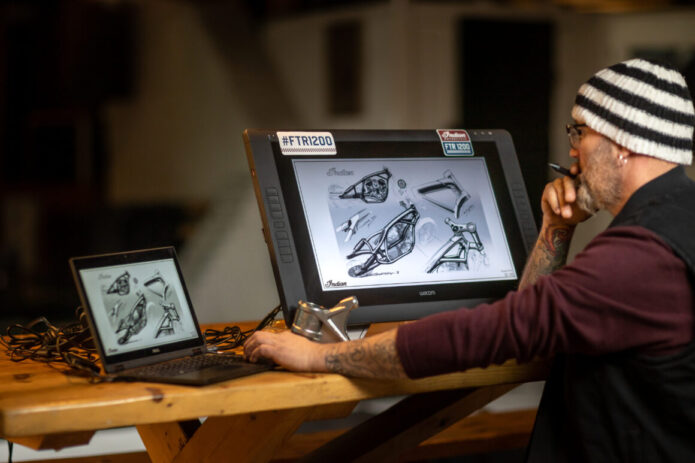
Ola Stenegärd is known internationally as a motorcycle designer, but his Tattoo Life profile documents another long-running visual language: a collection of tattoos built across both arms, the lower neck and the chest. The photographs are unusually useful because they show the ink in several real settings, from a workshop and motorcycle studio to outdoor riding portraits. They also make the scale of his collection easy to understand without relying on a generic fashion photograph.
The strongest evidence comes from Stenegärd himself. In the Tattoo Life interview, he says he began getting tattooed in the early 1980s after meeting heavily tattooed sailor friends and becoming part of the Swedish biker scene. He describes both arms as tattooed, names a Japanese-style tiger and phoenix on his chest, and discusses a blue dragon inspired by Johnny Winter. The photographs provide the visual counterpart to those statements.
Ola Stenegärd and the world of motorcycles
Stenegärd’s professional identity gives the tattoo story its setting. His work in industrial and motorcycle design has taken him through BMW and Indian Motorcycle, while his personal interests reach back to old-school choppers, Japanese tattoo culture and the biker communities he encountered in Sweden. That overlap is visible in the photographs: the tattoos are not separated from his working life, and motorcycles appear as part of the same visual environment.
The images also show why a single portrait would undersell the collection. In one frame, a sleeve is visible beside a motorcycle. In another, both arms are exposed while he works on a bike. A helmeted road photograph shifts attention to linework and color, while the wider workshop image makes his face and posture easier to identify. Each photograph records a different portion of the same long-term body of work.
Ola Stenegärd sleeve beside the Indian motorcycle
The first close view establishes the sleeve as the most immediately visible part of Stenegärd’s collection. The exposed forearm is filled with layered linework and color, and the placement follows the arm rather than sitting as a small isolated emblem. The motorcycle beside him is relevant context because it shows the tattoo in the environment associated with his design career, but the tattoo itself remains the subject of the image.

Stenegärd describes himself as tattooed along both arms, and this frame supports that broader description without pretending to reveal every detail. The sleeve has enough density to suggest years of additions, while the photograph leaves some areas covered by clothing or shadow. That distinction is important. A documented image can establish genuine placement and visible motifs, but it cannot prove a complete inventory when sections of skin are outside the frame.
Ola Stenegärd forearm color and sleeve coverage
The workshop photograph brings the arm closer to the camera. Color becomes easier to read, especially in the forearm where warm reds, yellows and darker outlines create a dense illustrated field. The other arm also carries visible ink, so the frame supports the interview detail that Stenegärd is tattooed along both sleeves rather than having one isolated statement piece.
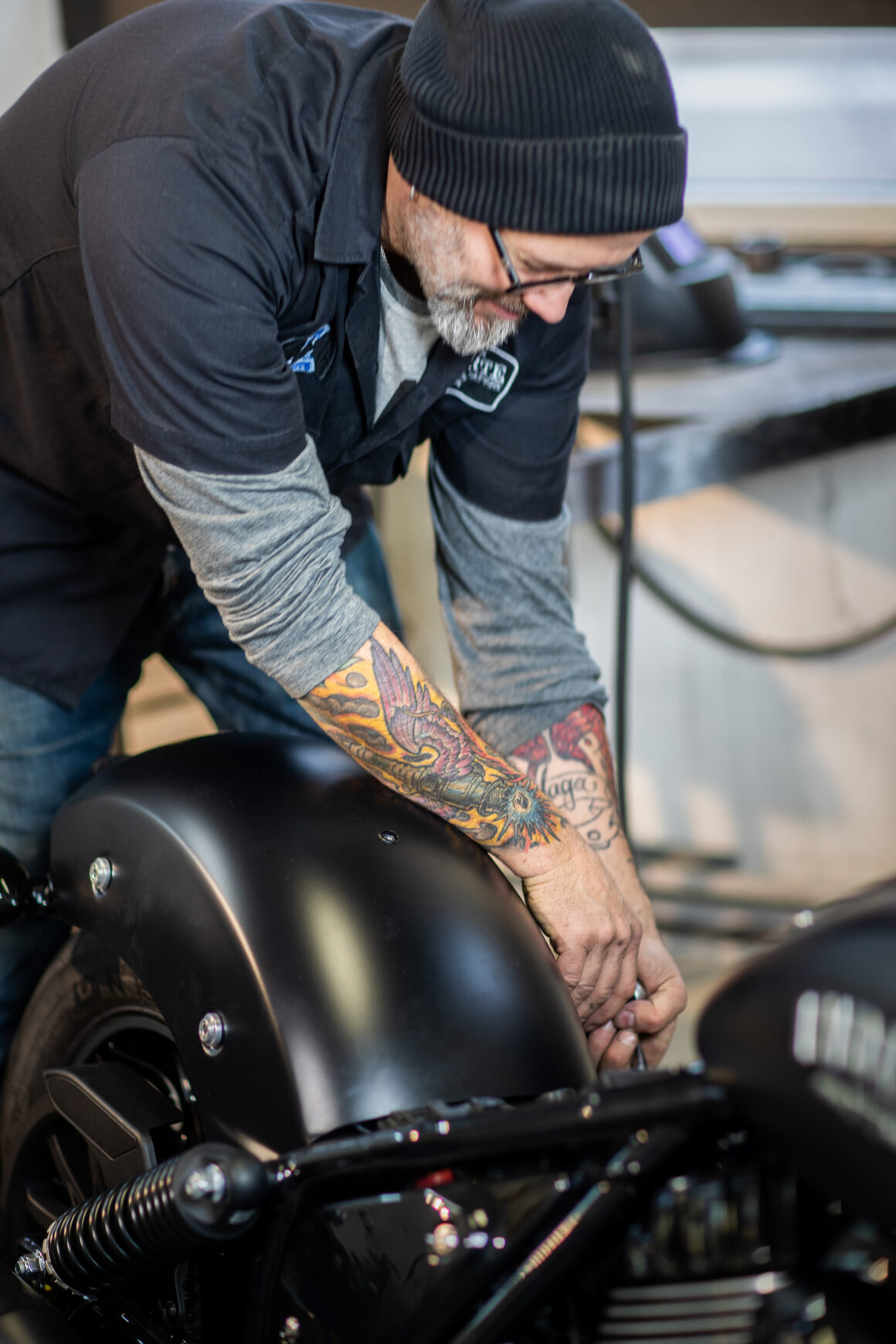
The angle changes the emphasis from motorcycle portrait to tattoo surface. Stenegärd is leaning forward, which bends the arm and compresses the visible shapes, yet the coverage remains clear enough to identify this as a different photograph rather than a repeated crop. It is a useful companion to the first image because it records the same broad subject from another distance and with another pose.
Ola Stenegärd tattooed arm in the workshop
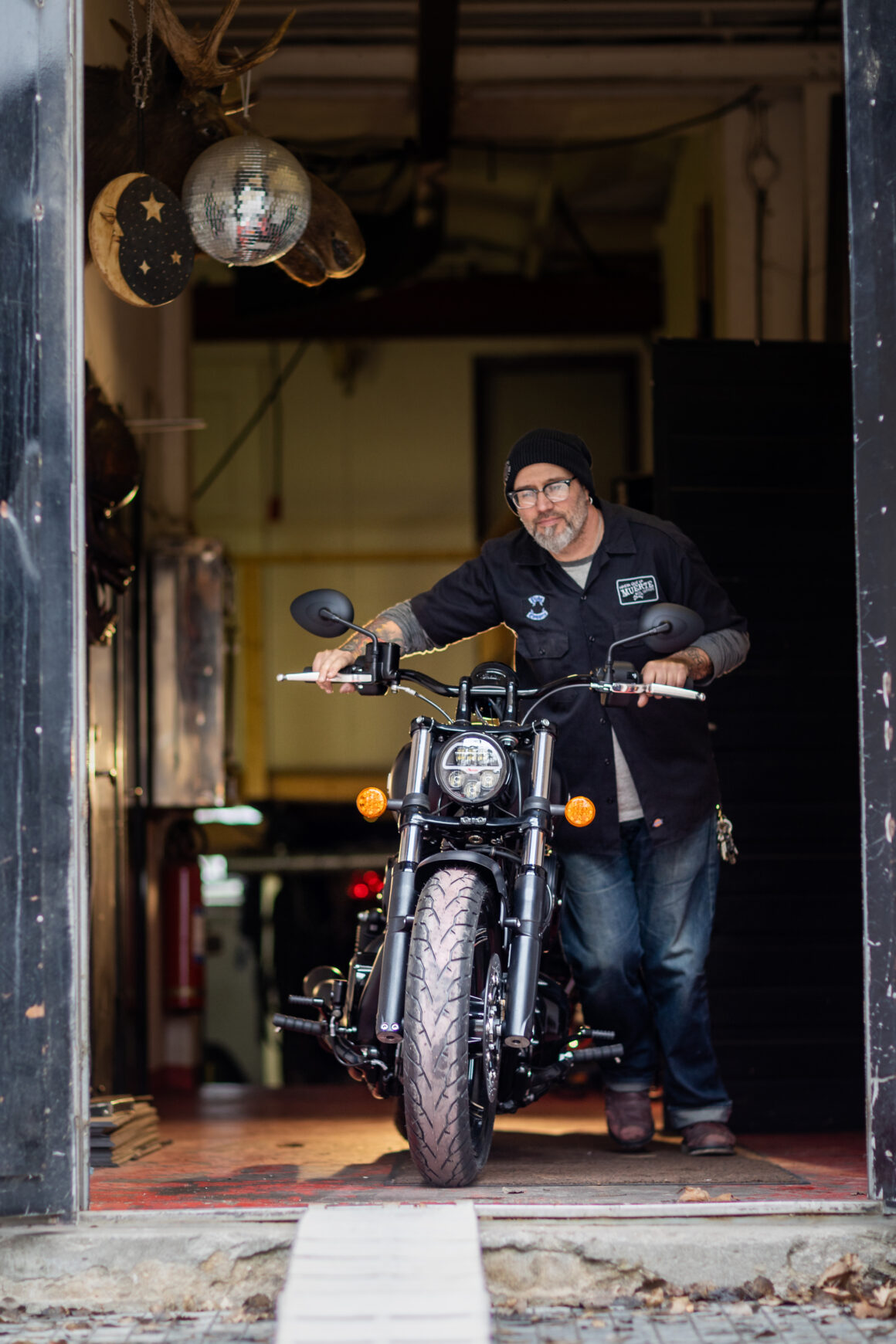
A third view places Stenegärd inside the workshop with a motorcycle in the foreground. His face is visible, but the arm is still exposed enough to show how the tattoo continues around the forearm. The scene also underlines the relationship between his design work and his personal style. The tattoo is not presented as a temporary prop; it appears as part of the person who is designing, building and riding motorcycles.
The tattoo photographs should be read together with Stenegärd’s comments about the early Swedish scene. He recalls sailors and bikers as formative influences, and he speaks about wanting to feel part of that community when he turned eighteen. The image cannot prove a specific date for the tattoo visible on the arm, but it does show the durable connection between his biography, his work and his ink.
Ola Stenegärd tattoos on both arms
The helmeted portrait is especially helpful for comparing the two arms. The lighting is bright and the pose leaves more skin visible, so the collection reads as a pair of sleeves rather than one dominant arm. The linework is mixed with colored areas, and the arrangement looks accumulated over time instead of designed as one single session.
The interview adds specific information that the photograph alone cannot supply. Stenegärd says his chest includes a Japanese-style tiger and phoenix, and he also mentions a blue dragon inspired by Johnny Winter. The photograph supports the overall presence of substantial ink, while the interview supplies the names and placements for those less visible chest pieces. Keeping those roles separate makes the record more reliable.
Ola Stenegärd colored forearm detail
The final close portrait returns to the forearm and gives the color work a different setting. Stenegärd is face-visible beside a motorcycle, with a relaxed expression and the ink clearly exposed. The close distance makes the tattoo look more graphic and more deliberate than it does in the wider workshop frame, although both images show the same underlying fact: his forearms carry extensive, long-established coverage.

This view also helps distinguish tattoo evidence from identity imagery. Stenegärd’s face is present, but the reason to use the photograph in this section is the visible arm. A separate featured portrait is kept outside the inline sequence so that the article does not substitute a generic identity image for a tattoo photograph. The result is a clean visual division between who he is and what the tattoo record actually shows.
What the interview adds beyond the photographs
Stenegärd says his tattoos extend beyond the arms. He identifies a Japanese-style tiger and phoenix on the chest, a lower-neck tattoo and a blue dragon inspired by Johnny Winter. These details broaden the collection beyond the sleeve photographs. They also explain why the collection should not be reduced to motorcycle imagery alone. The personal references include music, Japanese tattoo traditions and the older biker culture that shaped his early interest.
The available photographs do not expose every one of those areas with equal clarity. That is not a weakness in the record; it is a reason to be precise about what is confirmed by interview and what is visually confirmed in the selected images. The chest descriptions come from Stenegärd’s account, while the arms are reinforced by five distinct photographs from the Tattoo Life feature.
How the collection grew from the 1980s
The timeline begins with the early 1980s, when Stenegärd encountered sailors and the Swedish biker scene. He describes getting his first tattoo at eighteen and treating the mark as a way to feel connected to that environment. Over the following decades, the collection grew alongside his work in design, custom motorcycles and international travel.
His comments about the Japanese tattoo scene are also revealing. He says the artist Shige helped bring him back into contact with a tradition he had encountered earlier in life. That makes the tiger, phoenix and dragon references more than a list of motifs. They sit inside a longer conversation between motorcycle culture, Japanese imagery and the way Stenegärd has used his body as a record of those interests.
Why the photographs matter
The five inline photographs are deliberately different. One shows a sleeve beside an Indian motorcycle, another brings both forearms close while Stenegärd works, and the helmeted and outdoor frames create separate views of the arm coverage. The fifth image returns to a close face-visible portrait with the tattoo exposed. Together they give the reader multiple angles without reusing the same frame or filling the article with generic portraits.
They also preserve a useful balance between image and text. The tattoo sections introduce a point, place the relevant photograph, then continue with sourced explanation. That interleaving matters because the photographs are evidence for particular placements, not decorative material stacked above a block of unrelated writing. It keeps the record readable and makes the source of each observation clear. The motorcycle setting adds context, but it never replaces the tattoo evidence.
His professional path
A video interview about Stenegärd’s path to becoming Indian Motorcycle’s design director provides a natural closing context. His public work combines industrial design, custom motorcycles and a long personal relationship with tattoo culture. The video belongs after the visual record, because it adds professional background rather than serving as a substitute for the tattoo photographs.
The most secure summary is straightforward: Ola Stenegärd has tattooed arms, a lower-neck tattoo, and chest pieces that he identifies as a Japanese-style tiger and phoenix, along with a blue dragon inspired by Johnny Winter. He traces his interest to the early 1980s and the Swedish biker scene. The photographs show the arms in multiple distinct settings, while the interview supplies the personal history behind the larger collection. The phrase ink on 2 wheels captures the way those two interests meet without pretending that every tattoo has a public explanation.