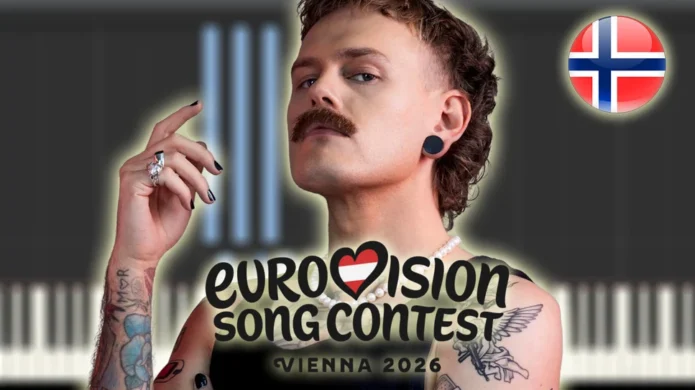
Jonas Lovv’s public tattoo record is unusually clear because the singer appears in multiple published settings with his face and ink visible together.
Jonas Lovv’s chest and shoulder lettering
Jonas Lovv arrived in Norway’s 2026 Eurovision season with a look that is unusually easy to identify. The curled moustache, stretched ears, painted nails and pearl necklace are memorable, but the tattoos do the heavier visual work. They cover both arms and continue over the chest, giving the singer a recognisable silhouette in studio portraits, backstage photographs and live coverage.
The strongest evidence is not a cropped arm found without context. It is a set of published photographs in which Lovv’s face, body and surroundings remain visible together. The Norsk Tipping studio image, The Independent’s rehearsal photograph, a VG performance frame, a VGTV interview still and a Midtsiden backstage photograph all point to the same person and the same broad tattoo record.
Those views do not create a complete catalogue of every mark on Lovv’s skin. They do establish several things safely. He has substantial genuine tattoos on both arms, a large chest composition and visible shoulder lettering. The designs recur across different dates and settings, so the article can describe the ink as a stable part of his public appearance rather than a single unusual styling choice.
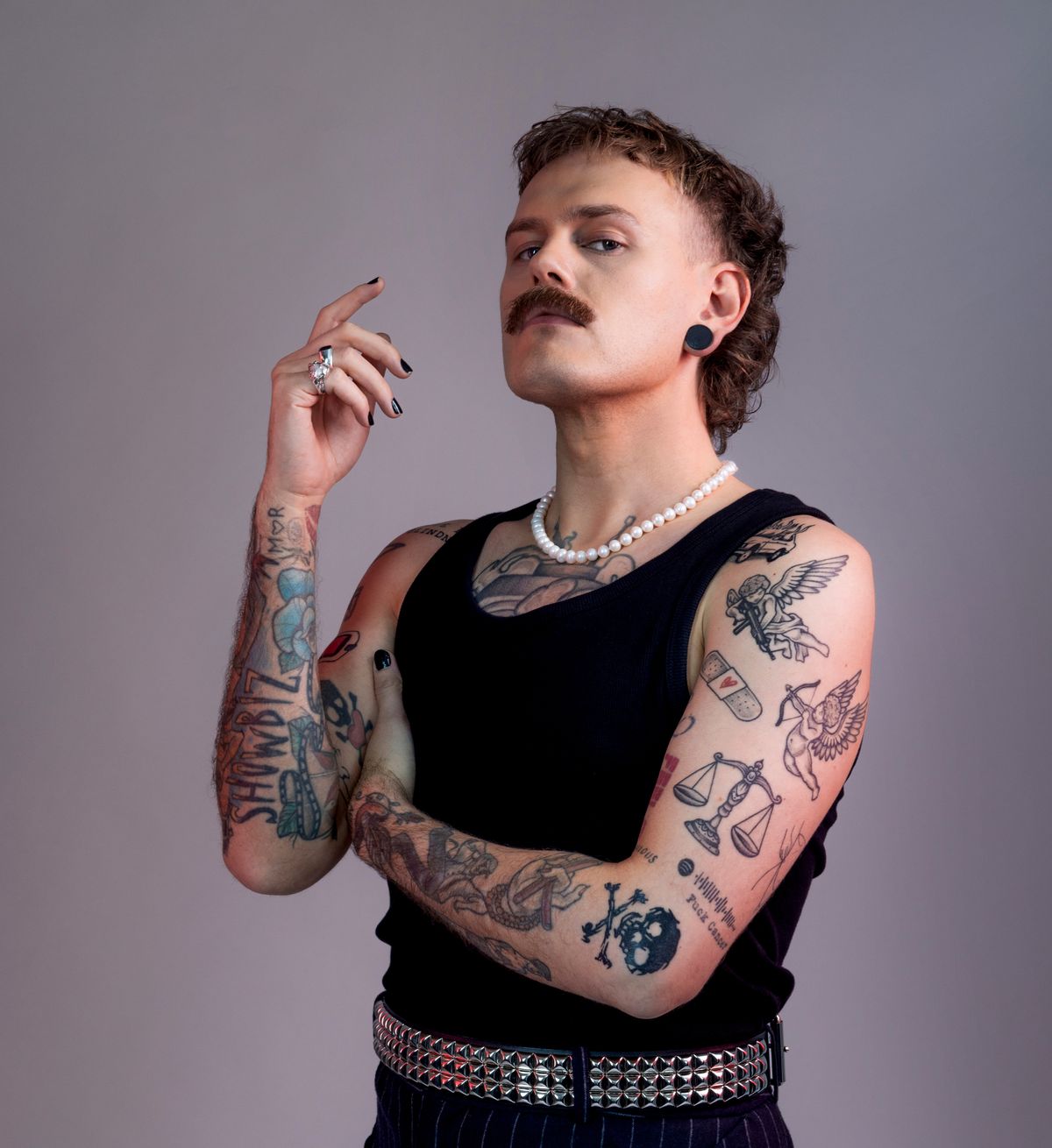
The clearest studio image places the tattoos against a neutral background. Lovv faces the camera while wearing a black tank top, and both arms are exposed from shoulder to wrist. The right side carries several illustrative pieces, including a winged figure, a bandage motif and scales. The left side has dense lettering and coloured elements. The chest is filled with a larger outlined composition that continues below the neckline.
Jonas Lovv’s illustrated arm work
The winged figure on Lovv’s upper arm is one of the easiest motifs to recognise. It appears again in the press material as the singer turns or raises an arm. Nearby, the bandage design has a small red detail that gives the otherwise black linework a bright accent. These are visual descriptions, not claims about private symbolism. The supplied photographs show the shapes, while the sources do not explain an individual meaning for each mark.
The studio photograph also shows how tightly packed the arm work is. Small symbols, outlined objects and lettering sit close together, with limited untouched skin between them. That density matters to the look of the collection. Lovv’s tattoos read as an accumulated sleeve and chest arrangement rather than a single isolated emblem placed on an otherwise bare arm.
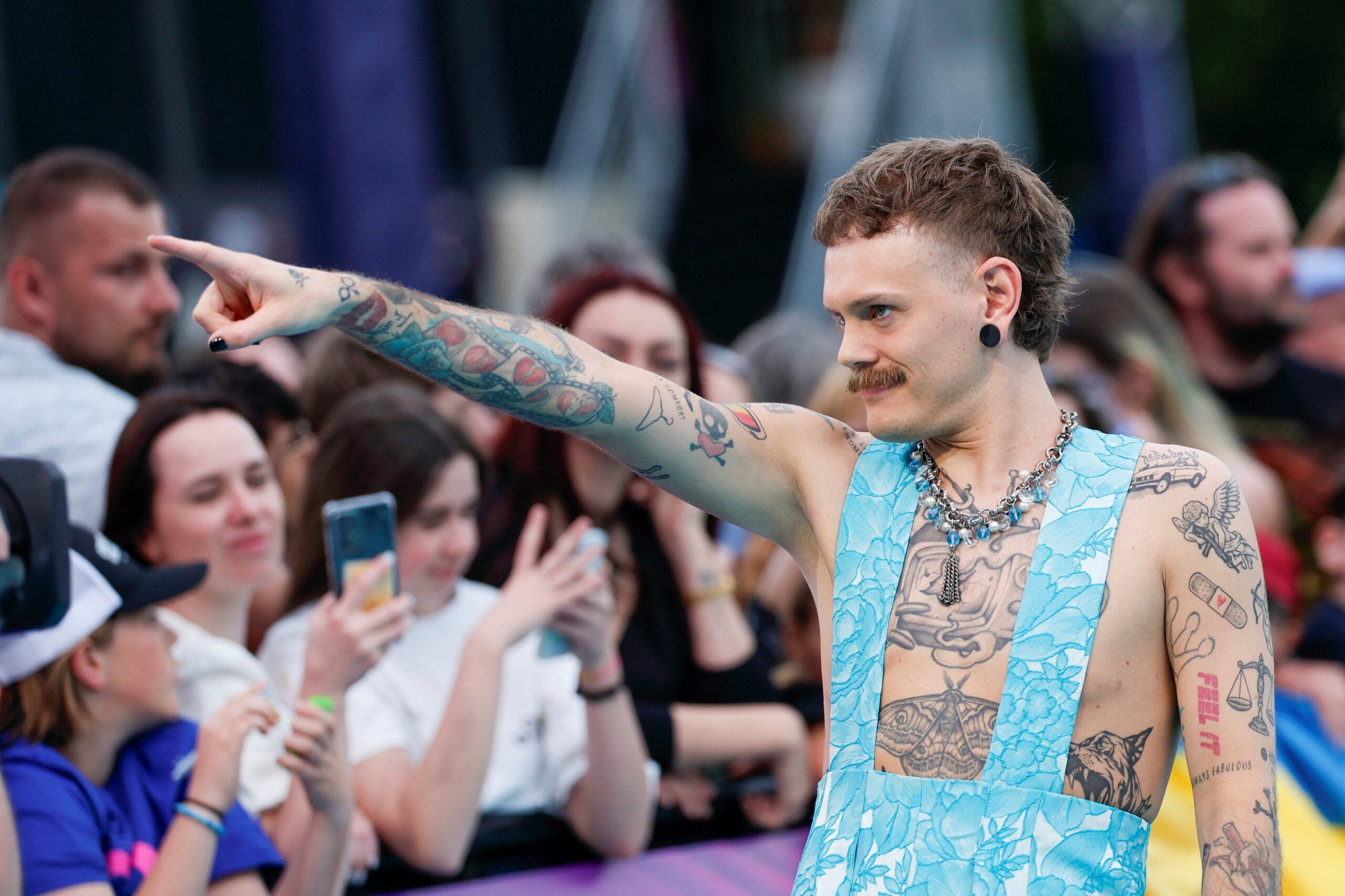
The Independent rehearsal image adds a wider view. Lovv is on stage with one arm extended toward the audience, and the camera catches a mixture of coloured blocks, small symbols and dark outlines along the forearm. His face is in profile, which makes the subject match straightforward. The performance setting also shows that the designs remain visible when the singer is moving, not only when posing for a portrait.
The colours in that frame are useful evidence because they separate different pieces of the sleeve. Reds, blue-green areas and black outlines appear across the forearm, while the upper arm and chest carry larger black work. A single image cannot resolve every design at that distance, but it confirms the scale and continuity of the coverage. It also shows why Lovv’s tattoos became part of the visual story around his Eurovision appearance.
Jonas Lovv’s tattoos in live performance
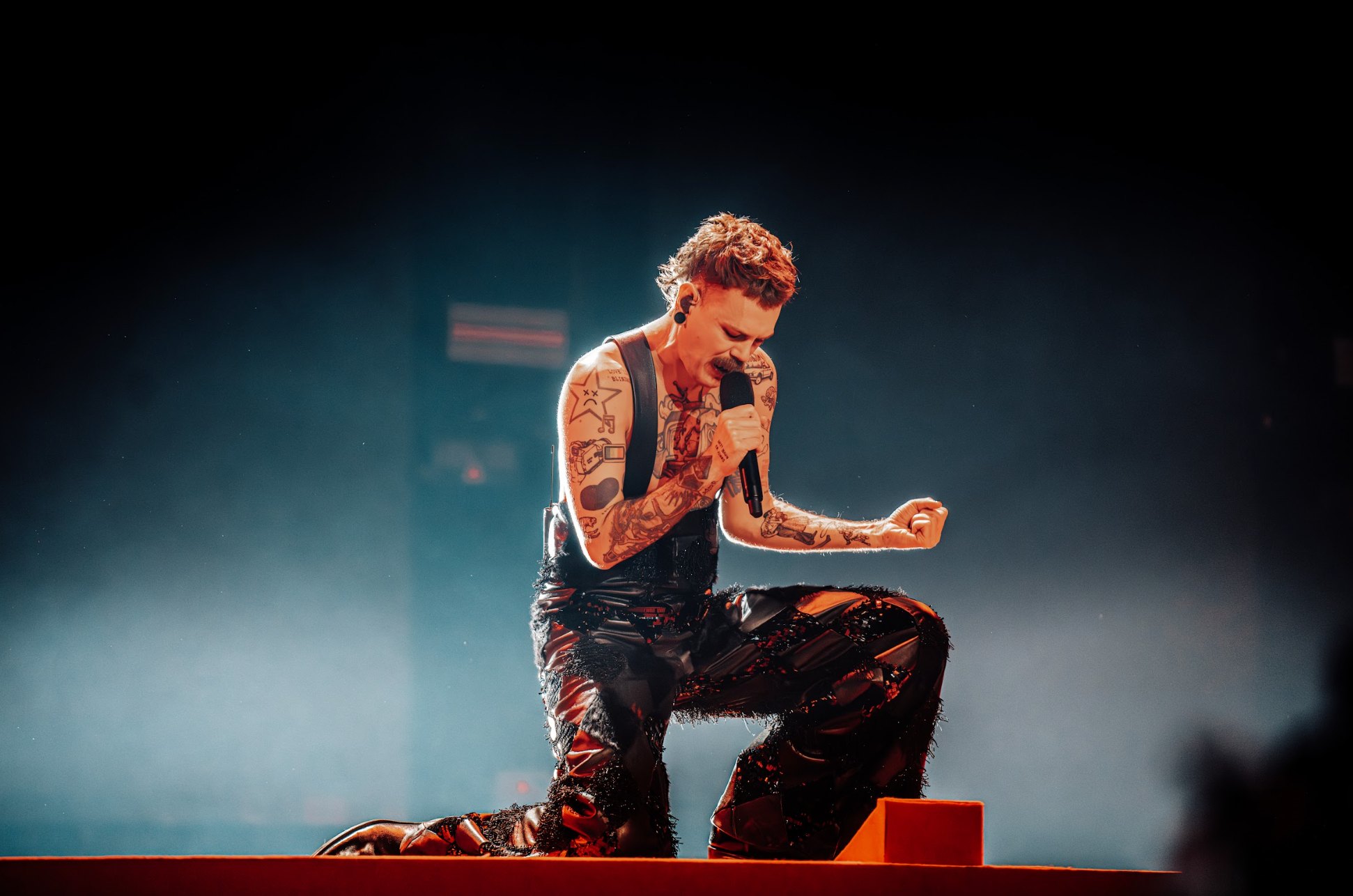
The VG performance photograph offers another angle. Lovv is kneeling with a microphone, his head lowered and his arms exposed under stage lighting. The linework is less evenly lit than in the studio frame, yet the chest and upper-arm tattoos remain clearly visible. The change in pose helps separate genuine recurring ink from a design that might have belonged only to one promotional image.
Performance pictures are especially helpful for identity because the face, voice, clothing and body art appear in one frame. Lovv’s moustache and stretched ear gauges are visible alongside the tattoos. The result is not an anonymous reference photograph. It is a press image of the same performer who won Norway’s national selection with Ya Ya Ya and went on to represent the country in Vienna.
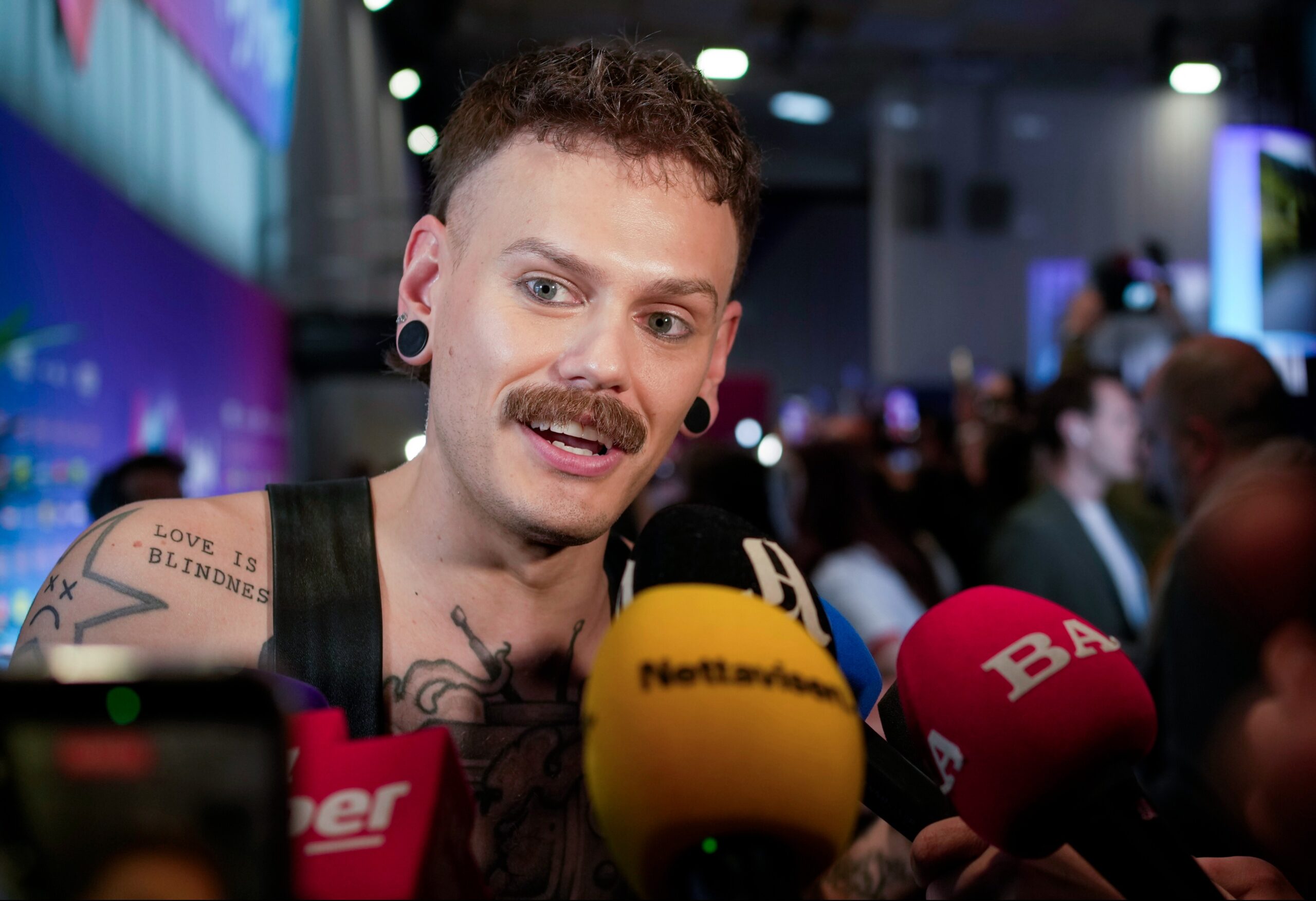
The VGTV interview still brings the phrase LOVE IS BLINDNESS into view on Lovv’s shoulder. The lettering sits above a larger arrow-like shape, and the rest of the chest work is visible below it. Because the source is an interview rather than a fashion shoot, the image is useful for showing how the tattoo appears during ordinary media coverage. The phrase can be reported as text that is visibly readable in the photograph.
The shoulder lettering should not be turned into a biography without a source. The phrase may be important to Lovv, but the sources reviewed here do not supply a verified explanation for when it was inked or who designed it. A careful description says what is visible and identifies the surrounding context. It leaves the private reason open instead of assigning a romantic, musical or personal story that has not been published.
Jonas Lovv’s visible ink in press photographs
The Midtsiden backstage photograph shifts the mood again. Lovv is seated among equipment cases with a dark background behind him. The large chest composition, the winged upper-arm figure and smaller arm designs are all visible. His face remains clear, and the photograph has enough resolution to show that the ink is genuine body art rather than a graphic printed on clothing or a temporary stage effect.
Across the five tattoo photographs, several visual families recur. There is lettering on the shoulder and forearms, a large chest illustration, winged imagery on the upper arm, small object-like designs and patches of colour. Some motifs appear only in one angle, while others return in multiple frames. The article keeps those categories broad because the source set supports a reliable visual record, not a definitive inventory of every line.
The public career context begins before Eurovision. Eurovision and Norwegian coverage identify Lovv as Jonas Lovv Hellesøy, a singer from the Bergen area who became known through The Voice Norway. The 2026 Melodi Grand Prix gave him a national platform, and his win secured the Norwegian ticket to the Eurovision Song Contest in Vienna. The photographs from that period show the tattoos as part of his established style.
The win also explains why the image record is unusually varied. A national selection brings studio portraits, rehearsal photographs, stage frames, interviews and backstage coverage within a short period. Each setting exposes different areas of the same tattooed body. That variety is more informative than five nearly identical selfies because the designs can be checked against changing clothes, poses, lighting and locations.
The recurring motifs across the record

Lovv’s song Ya Ya Ya is another part of the context, but it should not be confused with tattoo evidence. The official lyric video and music video establish his candidate-specific voice and Eurovision entry. They help identify the artist behind the photographs and provide a natural video embed for the page. They do not prove why any particular tattoo was chosen, so the tattoo discussion remains anchored to the inspected images and published reporting.
In interviews around the contest, Lovv has spoken about performance, connection and the atmosphere he wants to create for an audience. The JOY Eurovision podcast describes him as a tattooed Norwegian representative and says the conversation includes the tattoos, fashion and his approach to the spotlight. That is useful context because it confirms that his ink is part of the public conversation, while the photographs supply the visual details.
The Eurovision image record also keeps Lovv’s tattoos tied to a real moment in his career. He was not photographed as an anonymous model for a body-art feature. He was preparing for, performing in and discussing a song that carried Norway’s hopes in the contest. The ink appears in a working artist’s settings: a rehearsal floor, a press line, a stage, a backstage area and a controlled portrait session.
There is a difference between visibility and meaning. The shoulder phrase can be read. The winged figure can be seen. The chest outline and arm coverage can be compared across sources. None of that tells us what Lovv privately associates with every design. The article therefore treats the visual record as primary and uses career interviews for context rather than presenting speculation as a hidden explanation.
From The Voice Norway to Melodi Grand Prix
The photographs also show how Lovv’s style combines permanence with deliberate presentation. Pearls, rings, nail polish, ear gauges and a studded belt change from image to image, while the tattoos stay fixed. The clothes and accessories frame the ink, but they do not create it. The permanent designs remain legible even when the surrounding styling moves from studio to stage.
A face-visible portrait is important for the same reason. The featured image gives readers a clean reference for Lovv’s face, hair and moustache without asking them to identify him from an arm fragment. The tattoo photographs then add body-art detail. The portrait is supplemental context, not a substitute for genuine tattoo evidence, and it is not mapped as showing a new design.
The inspected sources support a measured description of placement. The arms are heavily tattooed from shoulder through forearm. The chest carries a broad central composition that is visible when Lovv wears a tank top or open performance styling. The phrase LOVE IS BLINDNESS sits on the shoulder area in the VGTV frame. Other small designs can be seen, but their exact names and meanings are not established by the available reporting.
What Ya Ya Ya adds to the visual picture
The collection’s visual rhythm is therefore dense rather than minimalist. The viewer notices a series of separate marks, but the overall effect comes from how close they sit to one another. Coloured panels break up black linework. Text runs vertically or horizontally depending on the body area. Larger illustrations provide anchors across the chest and upper arm. These are direct observations from the photographs, not instructions for copying the work.
Lovv’s tattoos also help explain why he photographs differently from one event to the next. A sleeveless portrait gives a full map of both arms. A rehearsal image makes the ink part of movement. A close press frame brings the shoulder phrase forward. A backstage shot makes the chest composition the centre of attention. No single frame is enough on its own, but the set is coherent when read together.
The safest chronology is broad. The tattoos were already visible during the Norwegian selection and remained visible through Eurovision rehearsals, interviews and performances. The sources reviewed here do not establish the exact date of each session, the identity of every tattoo artist or a complete sequence of additions. Keeping that uncertainty visible is better than inventing a timeline from photographs that were published for different purposes.
A reader can still understand the collection without that missing chronology. The images show genuine ink on the same identifiable singer. The Norwegian and international sources establish his career and Eurovision role. The interview material provides a candidate-specific media route. The visible shoulder words and recurring arm motifs create concrete details. The result is a grounded profile of Jonas Lovv’s tattoos, not a speculative story built around them.
Jonas Lovv’s tattoo record is strongest when the body art and the career images are allowed to support one another without being conflated. His arms and chest carry a dense mixture of lettering, figures, symbols and colour. His public rise through The Voice Norway, Melodi Grand Prix and Eurovision explains why so many distinct photographs exist. The inspected frames make the ink verifiable, while the written sources keep the surrounding claims modest and specific.