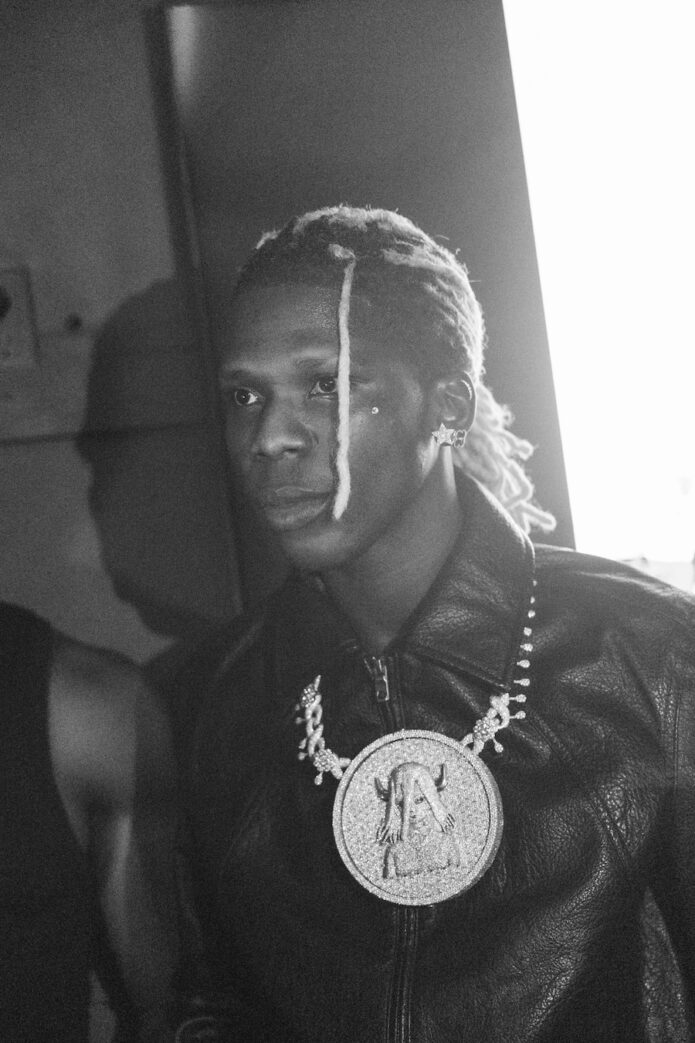
Fireboy DML, born Adedamola Adefolahan, has tattoos across his chest, both arms and neck. Interviews and photographs document the ink, while a report from Notjustok records that the tattoos deeply disappointed his father. Fireboy has described the collection as personal; the available sources identify some of its context but do not explain every design.
Afrobeats Intelligence notes tattoos on both biceps. The Miami Herald, OkayAfrica, ThisDay Style and Flaunt have also covered his public image or photographed the ink. Across those sources, the pieces appear as separate black-and-grey designs rather than one uniform sleeve.
How the collection changed
Fireboy’s tattoos are visible in portraits, music coverage and casual photographs, but no single source provides a complete catalogue or timeline. The images show lines, lettering, small symbols and shaded pieces placed across several parts of his body. Some designs can be distinguished from one another; others are too small or partly obscured to identify.
The collection appears in different styling and settings, so the visible amount of ink varies. A dressed portrait may show only the chest or neck, while an open shirt or uncovered arms reveal more.
Fireboy DML’s chest tattoo
Photos show a dark, compact tattoo high near the centre of Fireboy’s chest. Its placement makes it visible in portraits with an open or low-cut shirt. The photographs show its position and general appearance, but the interviews cited here do not give a detailed reading of every line.

The chest piece sits among finer work visible on his arms. Fireboy has spoken about the personal weight of being tattooed and the disappointment it caused his father. That context is documented; a specific meaning for every part of the chest design is not.
Fireboy DML’s arm tattoos
Afrobeats Intelligence describes tattoos on both biceps, and photographs show ink continuing down the forearms toward the wrists. Lettering, compact figures and shaded designs appear at different scales. The arms are not mirrored: the available views show different arrangements on each side.

The pieces vary in density, with open skin around some and heavier clusters around others. In performance photos, sleeves, light and distance can merge separate marks into a darker field. Fireboy’s comments about his father’s reaction add context to the visibility of the tattoos, but the photos themselves do not establish a meaning for each design.
The bicep tattoo details
The biceps sit between the chest and lower arms, so their tattoos can appear as a link between those areas in portraits. Close images show narrow outlines beside darker fills and heavier contours. The designs remain separate pieces, rather than one seamless sleeve.

Reporting does not name every symbol on the upper arms. The photographs support descriptions of location, density and style, but not an interpretation of figures that Fireboy has not explained publicly.
Fireboy DML’s neck tattoo
The neck tattoo occupies less space than the arm work, but sits close to Fireboy’s face and collar line. The Miami Herald covered the neck ink as part of his changing public image; later photographs show it near the collar. Side views make it easier to see, while hair or clothing can partly hide it.

The photos establish the tattoo’s placement, not a fuller meaning. Its position makes it visible in some portraits even when his arms are covered, adding a small mark near the face to the larger chest-and-arm coverage.
The tattoos documented in photographs
Portraits show the chest design beneath an open striped shirt, while full-length and seated images reveal differences in arm coverage and smaller marks around the wrists. No one photograph captures everything that the interviews and other images document.

The chest, biceps, forearms, wrists and neck all appear in the record. Some marks are easy to see at portrait scale; others need a closer image. Clothing, pose and camera distance account for much of the difference between photographs.
A documented record over time
Notjustok reports that Fireboy’s tattoos disappointed his father. That account gives a specific family context to the choice, without making every tattoo’s meaning public.
His 2020 song “Tattoo” uses tattoo imagery as a romantic metaphor. It is separate from the reporting on permanent ink across his chest, arms and neck. Keeping the song and the physical tattoos distinct avoids treating a lyric as an explanation of a design.
The record is a collection of documented pieces and personal comments, not a full catalogue. Interviews provide some context, and photographs show the placement and breadth of the ink. The meaning of designs not discussed by Fireboy remains unconfirmed.
Sources: Notjustok’s report on Fireboy DML’s tattoos; Afrobeats Intelligence’s artist profile; the Miami Herald interview; OkayAfrica’s Fireboy DML profile; ThisDay Style’s Fireboy DML feature; Flaunt’s portrait source.