
Vingo’s tattoos are presented as a connected visual record rather than a collection of isolated marks. In GQ Japan’s “Tattoo Tour”, the BAD HOP rapper moves between his arms, chest, neck and face while explaining the family references, shared crew imagery and personal milestones carried by the work. The film’s close views make the collection unusually easy to read: a broad black-and-grey sleeve, a crowded chest composition, small face symbols and lettering all belong to the same heavily layered style.
The available footage also gives the tattoos a clear chronology. Vingo identifies early pieces, points to images connected with relatives and BAD HOP, and discusses chest work added after a live performance. That context matters because the collection is not presented as one finished mural. It is a sequence of decisions that gradually filled the visible skin around older pieces. The result is dense, mostly black-and-grey body art with occasional high-contrast lettering and small areas of colour.
The 2023 video record
The strongest surviving record is the GQ Japan video released in November 2023. It is a first-person tour, so the camera repeatedly changes distance and angle as Vingo identifies the designs. The close-ups are particularly useful for separating the left-arm work from the chest and neck pieces. They also establish that the tattoos were being discussed as part of Vingo’s own history, not as graphics created for a music video or a temporary styling choice.
Vingo appears in a dark buttoned shirt for several of the explanatory shots, then the production cuts to much tighter views of exposed skin. Those changes reveal how far the tattoos extend. His arms are heavily occupied, the chest is built around large illustrative panels, and the neck and forehead carry compact symbols and words. The visual record is therefore broader than a single sleeve portrait.
The left-arm family motifs

Vingo’s left arm reads as a layered sleeve built from shaded figures, ornamental contours and smaller symbols. In the close view, the artwork is packed tightly enough that individual outlines overlap with older black shading. The effect is closer to a collage than to a single uninterrupted illustration. GQ Japan’s description specifically identifies family motifs on the left arm, giving the sleeve a documented personal connection rather than leaving its subject matter entirely to visual guesswork.
The linework is strongest around the larger forms. Dark regions create a visual backbone while lighter skin breaks keep the sleeve from becoming a single solid block. A hand and wrist view shows the way the artwork continues toward the lower arm, where the smaller marks sit beside heavier shaded sections. This contrast between compact symbols and large illustrated passages is one of the collection’s defining features.
The chest composition and central portrait
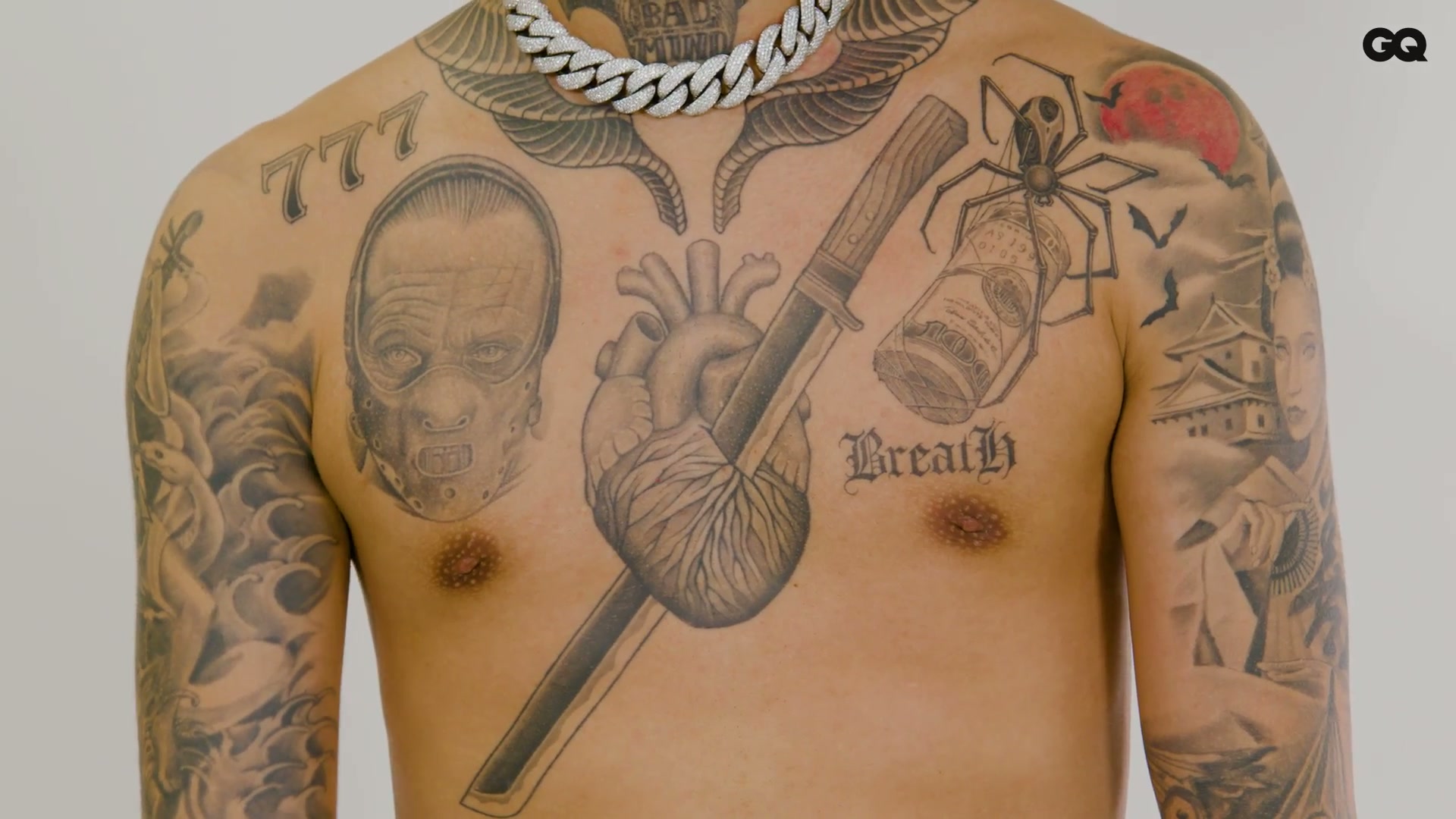
The chest is the most immediately legible part of Vingo’s tattoo collection. The central area contains a large portrait-like figure with a rounded head and mechanical or mask-like details, while the surrounding panels add instruments, wings, numbers and other dark illustrative forms. The composition is not symmetrical in a formal sense, but the chest works as one visual field because the surrounding lines and shading keep the pieces close together.
The word “Breath” is visible across the right side of the chest, positioned beneath the larger central artwork. Above it, a bold 777 marking sits near the shoulder line. The chest also carries a prominent sword and a large rounded object that Vingo discusses during the video. Their proportions make the area feel more like a narrative panel than a set of small decorative tattoos.
The chest work is also tied to a later point in Vingo’s career. The GQ Japan description notes a design on the chest that was tattooed after a live show. That detail gives the large composition a time marker within his tattoo history. It is not simply a static image of a completed torso; it documents a piece added in relation to performance and the period when BAD HOP was approaching its Tokyo Dome finale.
The right-arm sleeve and dark linework
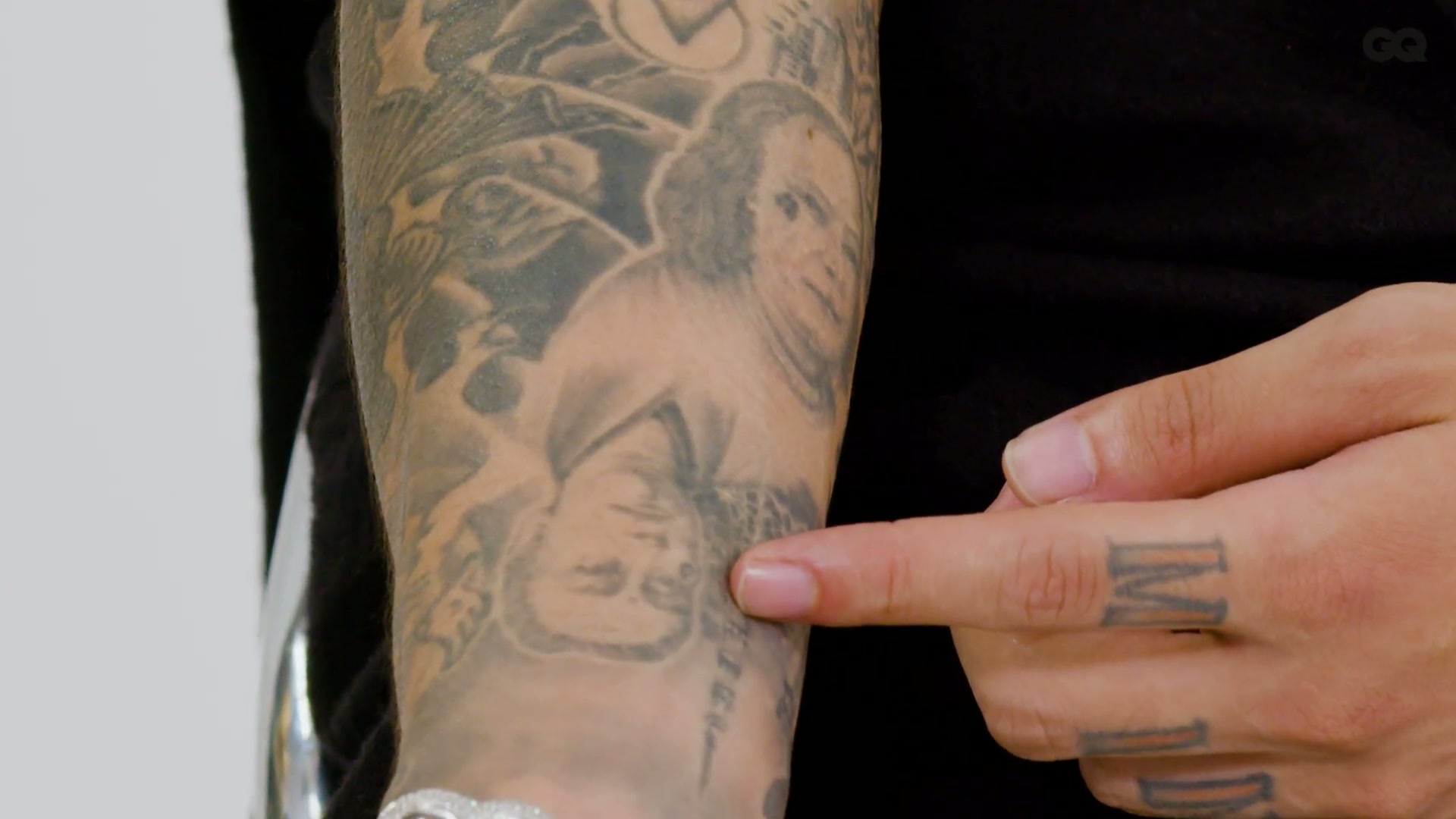
Vingo’s right arm has a different visual rhythm from the chest. The close-up shows portraits, faces and ornamental shading compressed into a sleeve that moves from the upper arm toward the elbow and forearm. The designs are darker and more tightly packed in the central passage, with lighter gaps around the edges allowing the separate forms to remain visible.
One detail visible in the footage is the way Vingo uses his finger to identify a particular section of the sleeve. That gesture places the camera beside the artwork instead of treating the arm as background decoration. The visible faces and rounded forms are consequently easier to distinguish, while the surrounding black areas explain how the sleeve has been expanded over time.
The sleeve’s style also links it to the chest. Both areas rely on bold outlines, portrait-like figures and dense shading, but the arm has a more vertical flow. The chest spreads outward from a central image, whereas the arm carries a sequence of designs around a narrower surface. Together they make Vingo’s upper body look deliberately continuous without erasing the separate stories attached to the individual tattoos.
The face and neck tattoo details
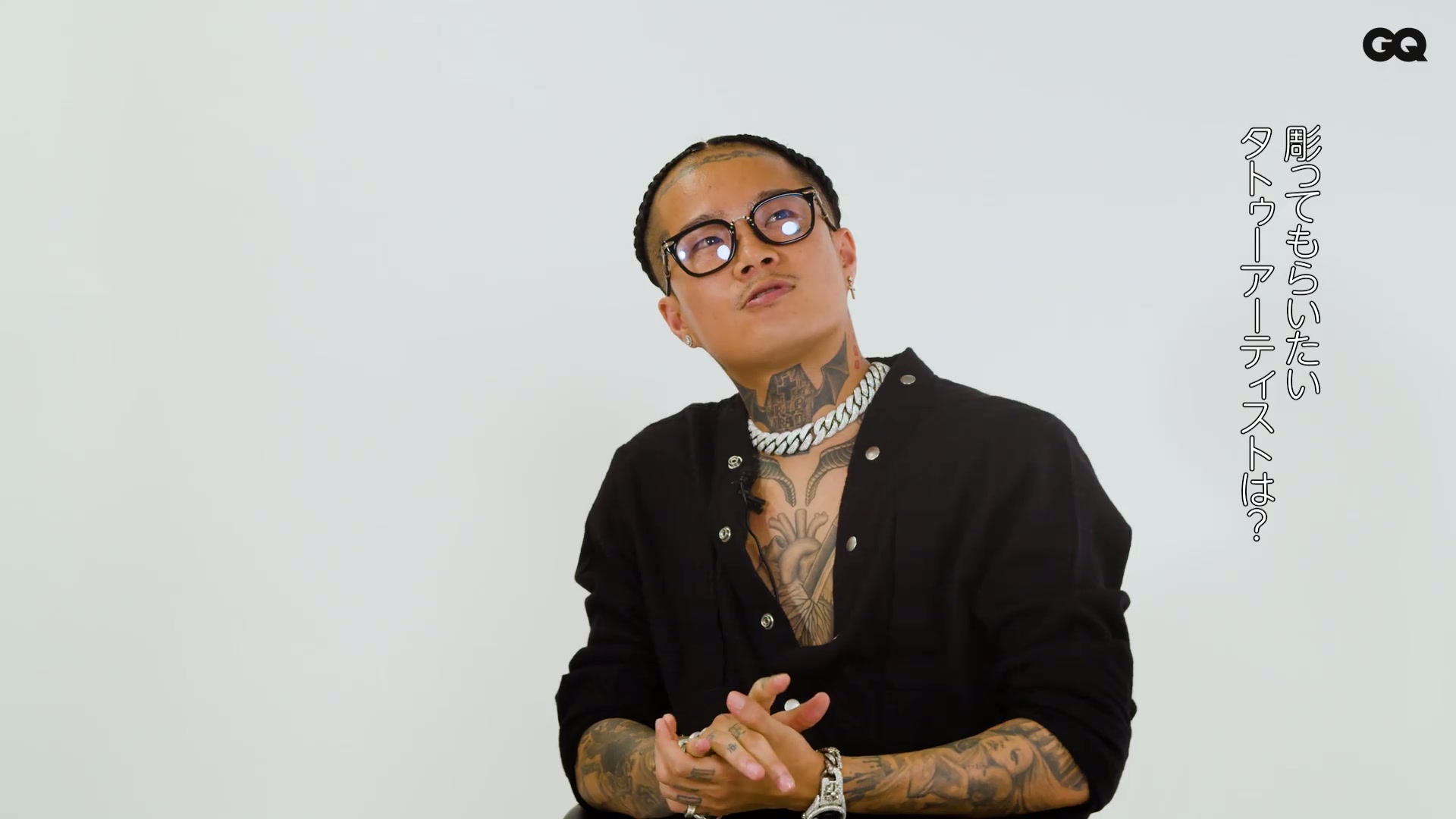
Vingo’s smaller tattoos become especially visible when the video moves toward his face and neck. The forehead carries compact script-like lettering, and the area beside the eye contains a small dark symbol. On the neck, several black shapes and fine lines sit under the jaw and beside the collar area. These pieces are much smaller than the chest portrait, yet they change the way the collection is read because they extend the tattoo language into the most visible parts of his identity.
The face marks are not presented as a separate phase from the sleeve. They share the same preference for black ink and compact graphic shapes. The small butterfly-like marks beside the face, the forehead lettering and the neck symbols create a narrow band of detail around the head. In the close footage, that band remains legible even when the larger arm tattoos are outside the frame.
Vingo’s glasses, braided hair and heavy chain are often visible in the explanatory shots, but the tattoos remain distinct from those styling elements. The forehead lettering stays fixed above the frames, while the neck work appears below the chain. That separation is useful in the visual record because it confirms the placement of the smaller tattoos rather than confusing them with jewellery or costume details.
The 777 mark and smaller symbols

The 777 tattoo near Vingo’s upper chest is one of the clearest pieces in the GQ Japan footage. Its large outlined numerals sit above the chest portrait and stand out because the characters are more open than the surrounding shaded artwork. The number works as a graphic anchor at the top of the torso, balancing the heavier illustrative forms below.
Other small symbols appear around the collar, neck and upper arms. Some are readable as compact icons, while others remain too small or partially covered to identify with certainty. The responsible description is therefore visual rather than speculative: the film documents their positions and shapes, but it does not assign a meaning to every mark. The collection’s density makes that distinction important because many details sit beside one another in the same frame.
The smaller pieces also show how Vingo’s tattoo history has accumulated. A compact mark can occupy a gap beside a much larger portrait, and later shading can make an older outline appear integrated into a new panel. The visible result is a body map in which scale changes repeatedly, from the tiny face symbols to the broad chest and sleeve passages.
Vingo’s visual language
Across the documented images, three traits keep returning: heavy black-and-grey shading, portrait-driven imagery and words used as anchors. The chest uses the largest readable composition, the arms carry the most continuous coverage, and the face and neck supply the smallest marks. That distribution makes the collection easy to recognise even when only one area is visible.
The contrast between open numerals and dense illustrated forms is another recurring feature. The 777 marking and the word “Breath” are clear at a distance, while the surrounding portraits and objects reward closer inspection. Vingo’s tattoos therefore alternate between instantly legible text and detail that only appears in close-up footage.
Meaning is documented most securely where Vingo or the GQ Japan description connects a design to family, shared BAD HOP imagery or a particular live-performance moment. Other interpretations remain visual observations. The video does not provide a confirmed explanation for every face, object or symbol, so the collection is best understood through the placements and relationships the footage actually shows.
What the documented footage establishes
The GQ Japan Tattoo Tour establishes that Vingo has a substantial collection spanning both arms, the chest, the neck and the face. It records family-related motifs on the left arm, a large chest composition added in the context of live performance, the 777 mark, the word “Breath”, small face symbols and a dense sleeve of portraits and shaded forms. The accompanying Japanese description also confirms that some designs connect to BAD HOP members and family.
It does not establish a complete catalogue of every tattoo Vingo has received. Some areas are covered by clothing or filmed only briefly, and the video moves between explanation and close-up rather than providing a numbered inventory. The documented record is still substantial because the camera shows multiple placements at native high-definition quality and gives Vingo space to identify the personal history behind selected pieces.
Vingo’s tattoos are consequently best read as a living archive of family, crew identity, performance history and visual experimentation. The sleeves and chest provide the large-scale structure; the face, neck, lettering and numerals provide the compact markers. Together they form one of the most recognisable tattooed silhouettes in the BAD HOP circle.