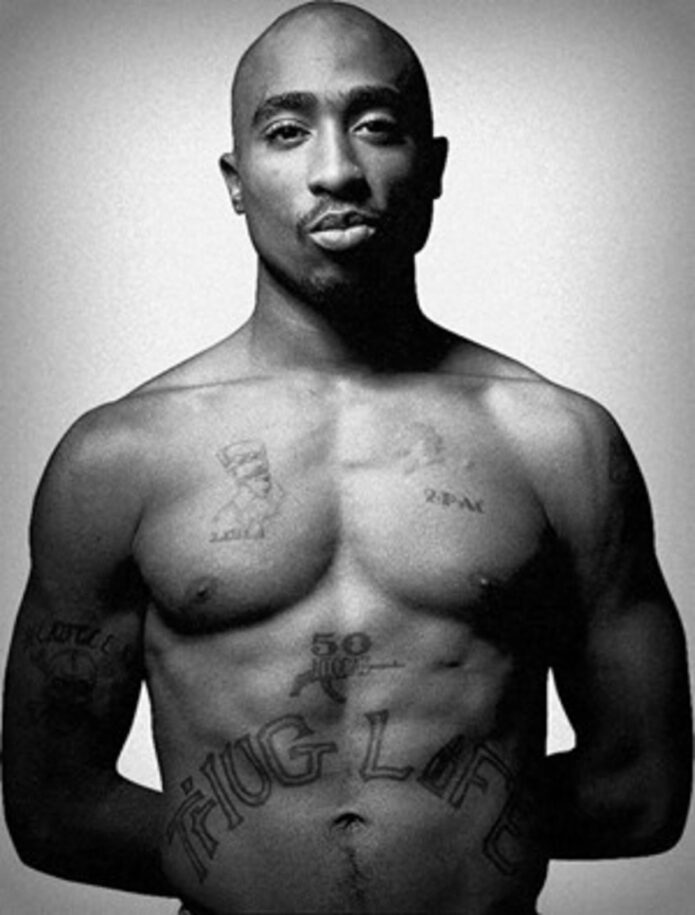
Tupac Shakur’s tattoos were part of his public image. The Thug Life lettering across his stomach, the cross on his back, Makaveli on his neck and the Heartless design on his arm are easy to pick out in photographs, though each has a different scale and feel.
The photos show where the tattoos sit and what they look like. Some meanings have been widely reported; others remain unconfirmed. I’ll stick to what the images and published accounts support instead of assigning a story to every mark.
The five article photos show different views: Tupac’s back, his face and arm, a close view of his chest and arms, a front portrait and a separate torso shot. The featured portrait is a separate image, so each photo has its own purpose.
Tupac’s back tattoo cross carries the heaviest visual weight
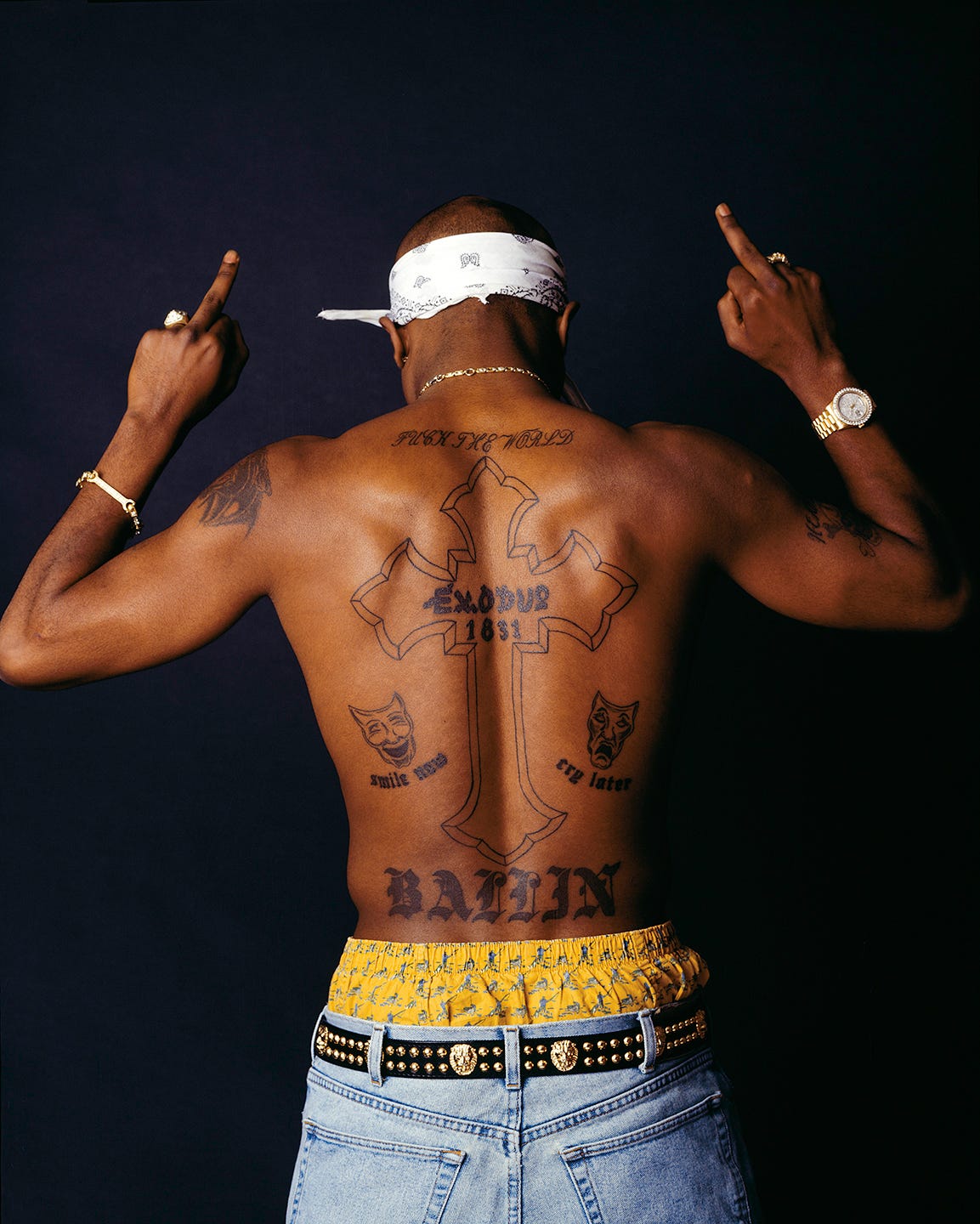
The large cross on Tupac’s back fills most of the space between his shoulders and waist. Its outline leaves the inside relatively open, and the words Exodus 1831 run through the center. Around it, lettering and small drawings turn the cross into part of a larger design.
The Chi Modu photograph shows the full layout. Tupac stands with his back to the camera and his shoulders turned slightly toward it. “Fuck the World” stretches across his shoulders, “Ballin” sits near his waist, and theater masks flank the cross. The words “smile now and cry later” appear below the masks.
The arrangement reads from top to bottom: shoulder lettering, the long cross, the masks and lower lettering. The spine gives the composition a natural center, while the smaller details keep the sides from feeling empty.
A back piece this large needs room for its separate parts. Here, the cross, phrases and masks have space around them, so the design can be read as a whole. Anyone planning a large back tattoo can use the photograph to study how the elements follow the body before focusing on individual symbols.
Makaveli and Heartless tattoos make the neck and arm read together
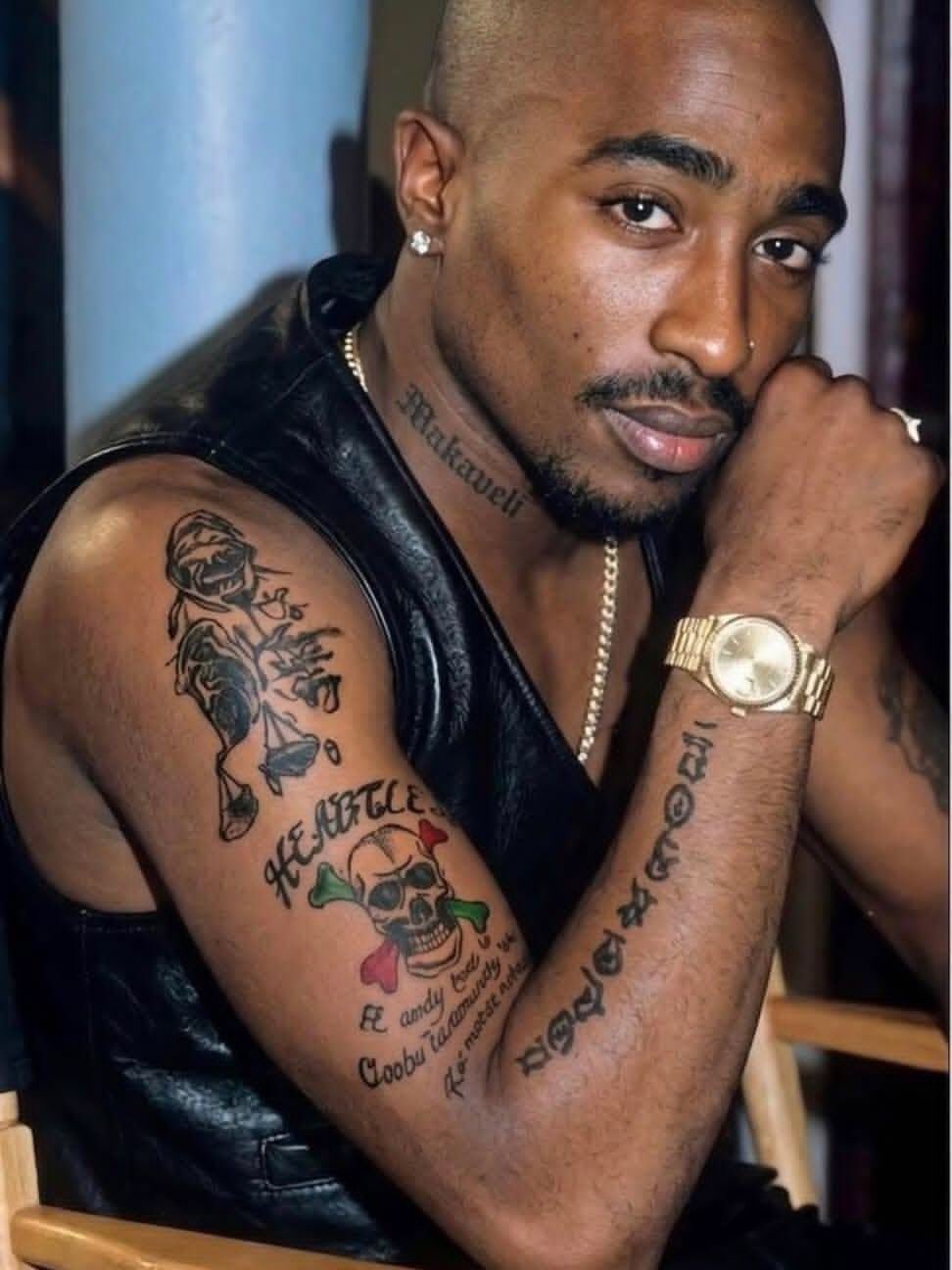
A face-and-arm photograph catches details that can disappear in a full-body shot. “Makaveli” runs along Tupac’s neck. On his upper arm, the Heartless skull sits among lettering, flowers and smaller marks. Together, the tattoos create a visible line from the jaw to the bicep.
The neck piece uses a narrow strip of skin. Its lettering follows the side of the neck instead of spreading across the whole area. The arm design has more going on: a skull and crossed bones, decorative shapes, color and script share the space.
The two placements have different textures. Makaveli is dark lettering against a slim area of skin; the arm has rounded shapes and more open space between its elements. That gives the arm ink a collected look instead of making it read as one solid band.
The photograph shows the names and shapes clearly, but it doesn’t explain every mark. There’s no need to guess at those stories to describe the design. The neck lettering is immediately visible, while the arm reveals more detail when you look closer.
The chest and arm tattoos show how many ideas share one canvas
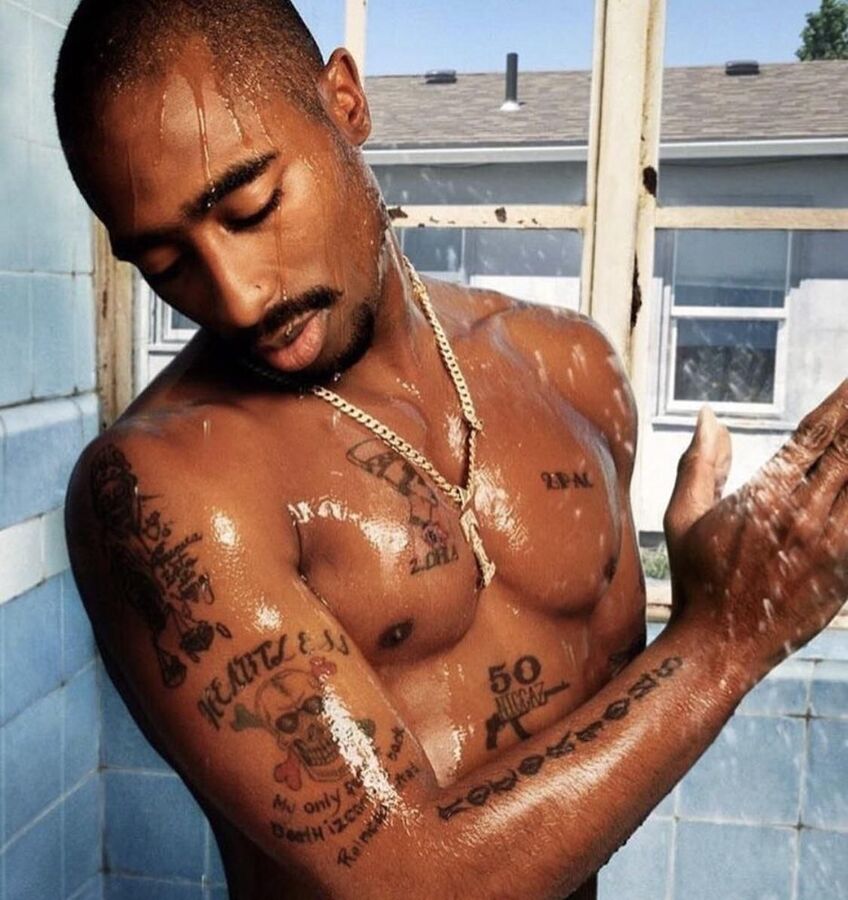
This color photograph, taken in a shower setting, shows several tattoos across Tupac’s upper body. “2PAC” and a Nefertiti portrait sit on his chest beside smaller marks. His arm has the Heartless skull, script and other symbols. The close view makes the lines easier to see than they are in a distant performance photo.
The Nefertiti portrait gives the chest a focal image, while “2PAC” is a simpler piece of lettering on the opposite side. One side is built around a face; the other around a name. They share the same area without repeating the same treatment.
On the arm, the skull and flowers form a compact image, with script beneath them. The pieces don’t have to be read as a single sleeve. They look like separate choices added over time, each fitting beside the existing ink.
A collection can hold together without every tattoo sharing the same subject or line weight. In these photos, the common ground is placement and contrast, with enough open skin to keep the images distinct. Lettering, portraits and symbols sit side by side without being forced into one style.
The Thug Life tattoo turns the stomach into a statement piece
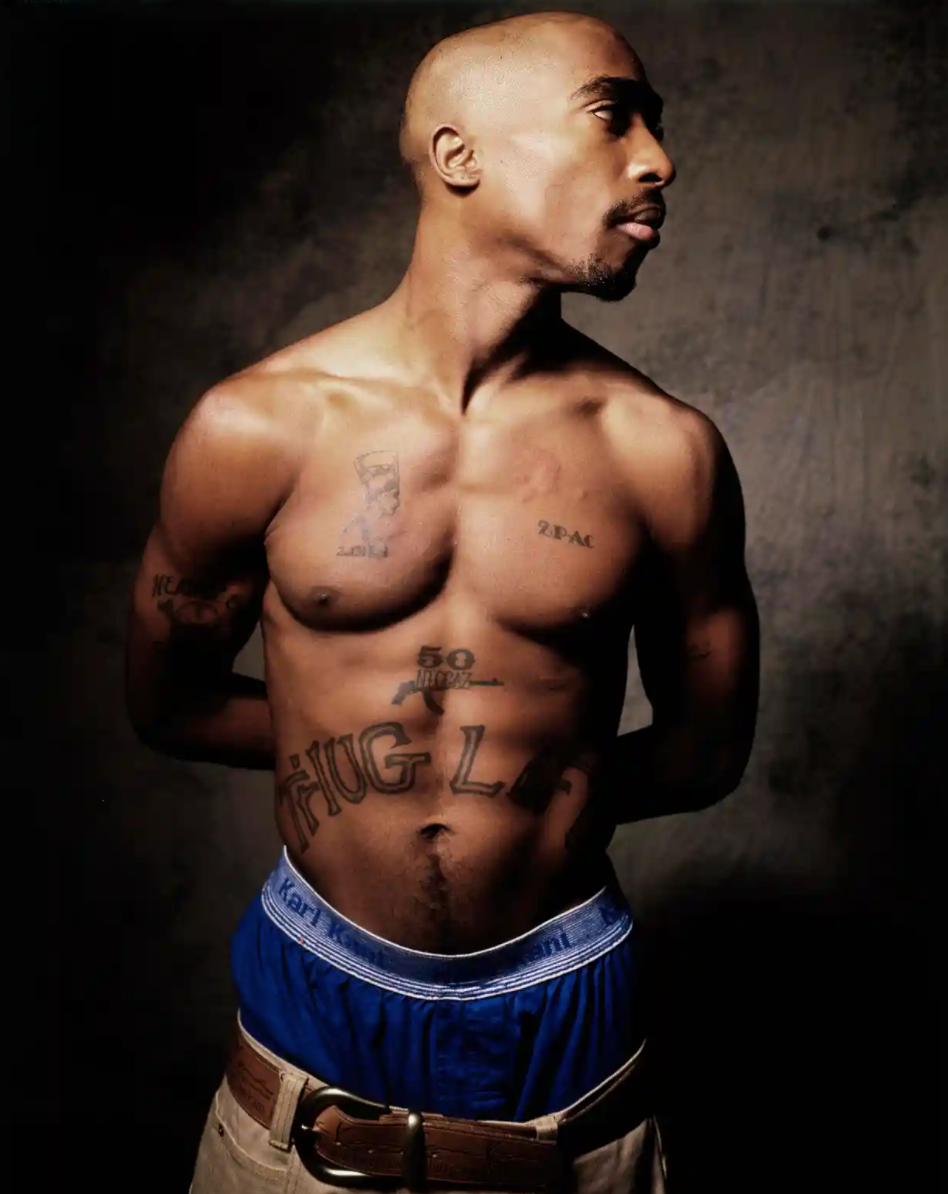
The large “Thug Life” lettering across Tupac’s stomach is the clearest statement in this front view. The outlined letters curve with his abdomen. Above them are the smaller “50 Niggaz” mark and the chest tattoos, so the lettering anchors the lower half of the composition.
The phrase was closely tied to Tupac’s music, public identity and writing about social conditions. It is often discussed as an acronym. In the photograph, its size and placement are clear even before considering those associations: it can be read from a distance and becomes part of his silhouette when he performs without a shirt.
The outline style leaves skin visible inside the letters instead of filling them in as a solid black block. The baseline curves across the abdomen, following the body rather than sitting like a straight banner. Both choices help the large design stay readable as the body moves.
The photograph is useful for studying the relationship between size, placement and legibility. A phrase across the stomach needs enough space to follow the body’s curve. Here, the broad lettering has room to do that.
The torso tattoo view connects 50 Niggaz to the larger Thug Life design
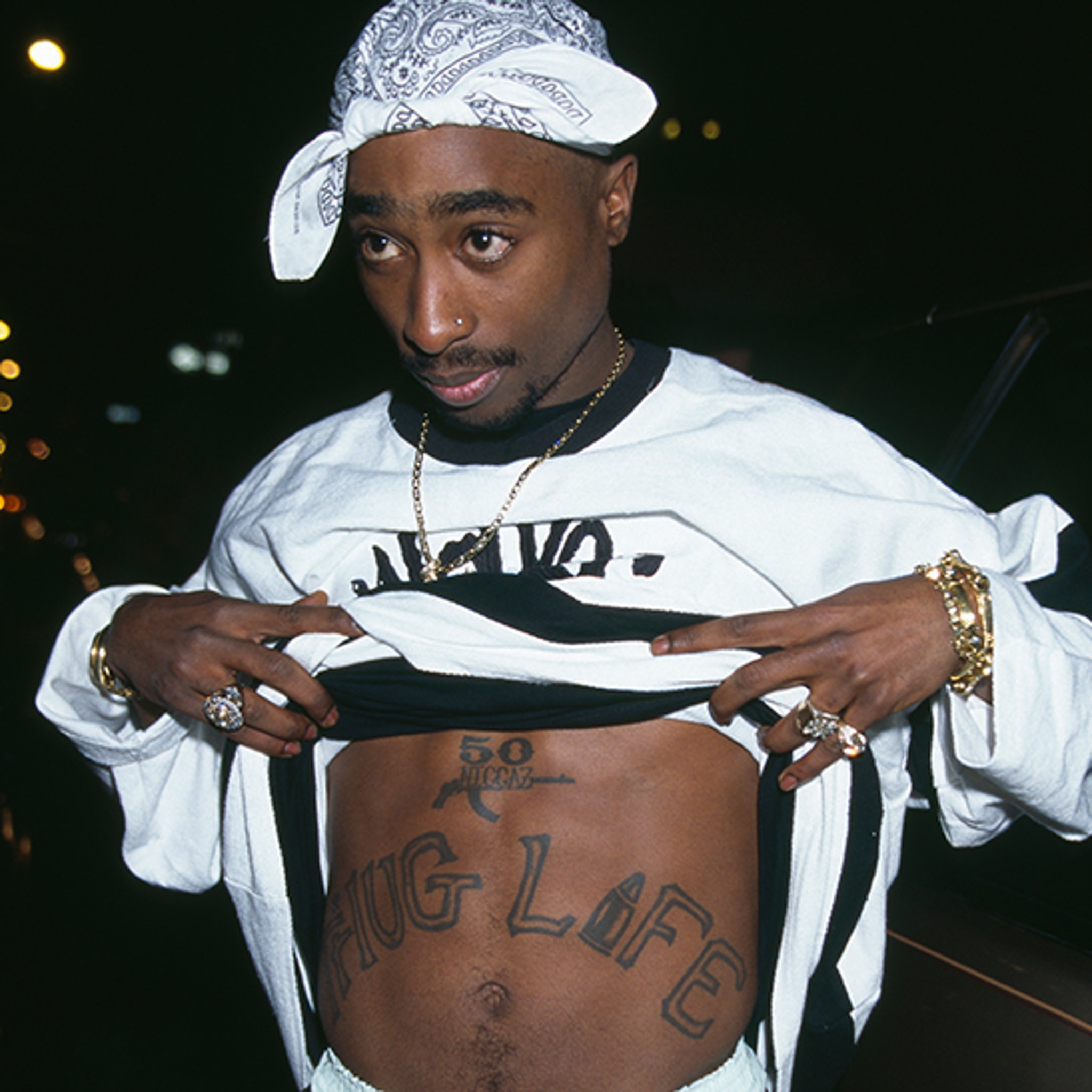
This nighttime torso photo gives another view of the front tattoos. Tupac lifts his shirt to show the “50 Niggaz” mark above the larger “Thug Life” lettering. The first sits higher and takes up less space; the second spreads across his stomach.
The shirt, chain and hands remain in frame, but the words are still easy to read. The image shows the tattoos in a casual pose rather than a clean studio view, with clothing partly covering the body.
“50 Niggaz” reads as a compact emblem with a small graphic element. “Thug Life” stretches across the abdomen and draws the eye from side to side. Their different scales let each mark occupy its own space.
Seen alongside the other photos, this frame helps explain why the collection is recognizable. Large placements make the words and symbols visible, while smaller pieces fill nearby areas. It’s a group of tattoos tied to identity, music and belief, rather than one matching sleeve.
The contrast between public statements and smaller details runs through the collection. “Thug Life” can be read from a distance. “Makaveli” sits close to the face, and the cross and theater masks form one scene across the back. The Nefertiti portrait and chest lettering add more detail to the front.
Photographs can confirm placement and visible lettering; they can’t settle every meaning. Published tattoo coverage discusses the main pieces in connection with Tupac’s music, beliefs and public life. Smaller marks are less certain, so they’re best described by what can actually be seen.
The back is the clearest example of a design built across a large area. The cross runs down the center, masks sit at its sides, and words above and below frame it. The shapes follow the body without needing perfect symmetry.
The front uses scale differently. “2PAC” is small on the chest, while the Nefertiti portrait carries more detail. The “50 Niggaz” mark sits above “Thug Life,” which spreads across the lower torso. Each piece has a separate area.
The arm photos show a collection that doesn’t rely on a matching sleeve. The Heartless skull, flowers and script each keep their own shape, and Makaveli remains separate on the neck. That leaves room for tattoos to accumulate over time.
Lettering appears on the neck, shoulders, back, arms, chest and stomach, but it changes to suit each spot. Smaller areas use compact words; the abdomen carries wide outlined letters. The photos make a practical point about text tattoos: scale the lettering to the body area.
A face portrait alone can’t show how the cross sits across the back or how “Thug Life” curves over the stomach. These five images give those placements room to be seen, and each adds a different view instead of repeating the same portrait.
If you’re looking at Tupac Shakur’s tattoos for ideas, study the placement before the symbols. Decide whether words need to be readable across a room or are meant for a closer look. Leave space around a large piece, and sketch the full flow of a back design before adding its smaller details.
For more musician ink with clear placement photos, see the site’s musician tattoo guides. Keep confirmed stories separate from guesses when you use any celebrity tattoo as a reference.