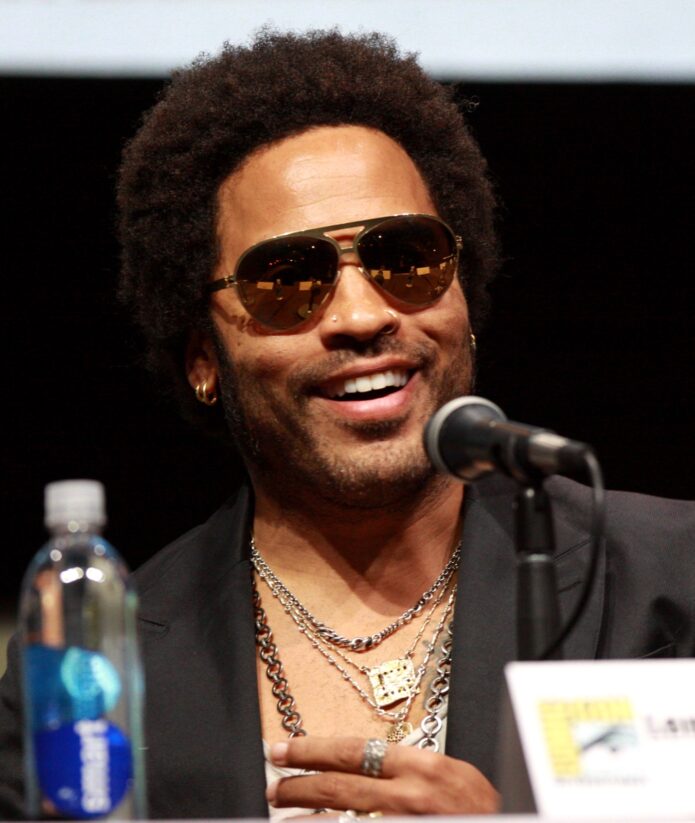
Lenny Kravitz’s tattoos are easiest to read as a collection of different scales: one large image that travels across his upper body, a cross he has discussed in terms of faith, a forearm inscription, and smaller marks on his hands and arms. The photographs are uneven. Some designs are clear in portraits; others are known mainly through published tattoo inventories. Kravitz has explained the arrow cross himself, but that does not mean every symbol has a confirmed personal story. This guide keeps what he has said separate from what the pictures merely show.
The dragon follows the shape of Kravitz’s chest and left arm
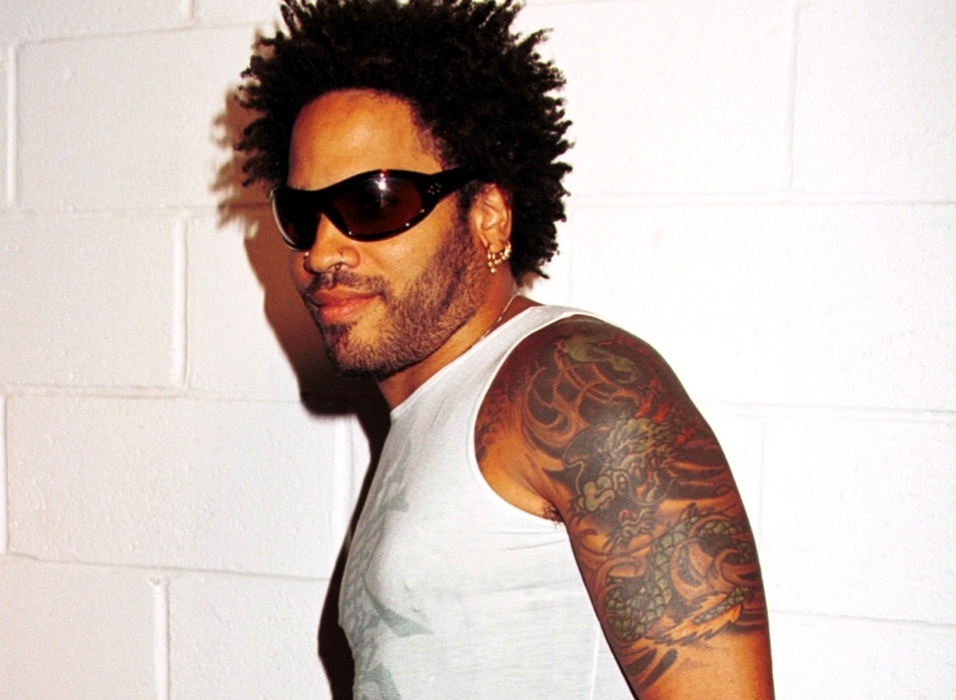
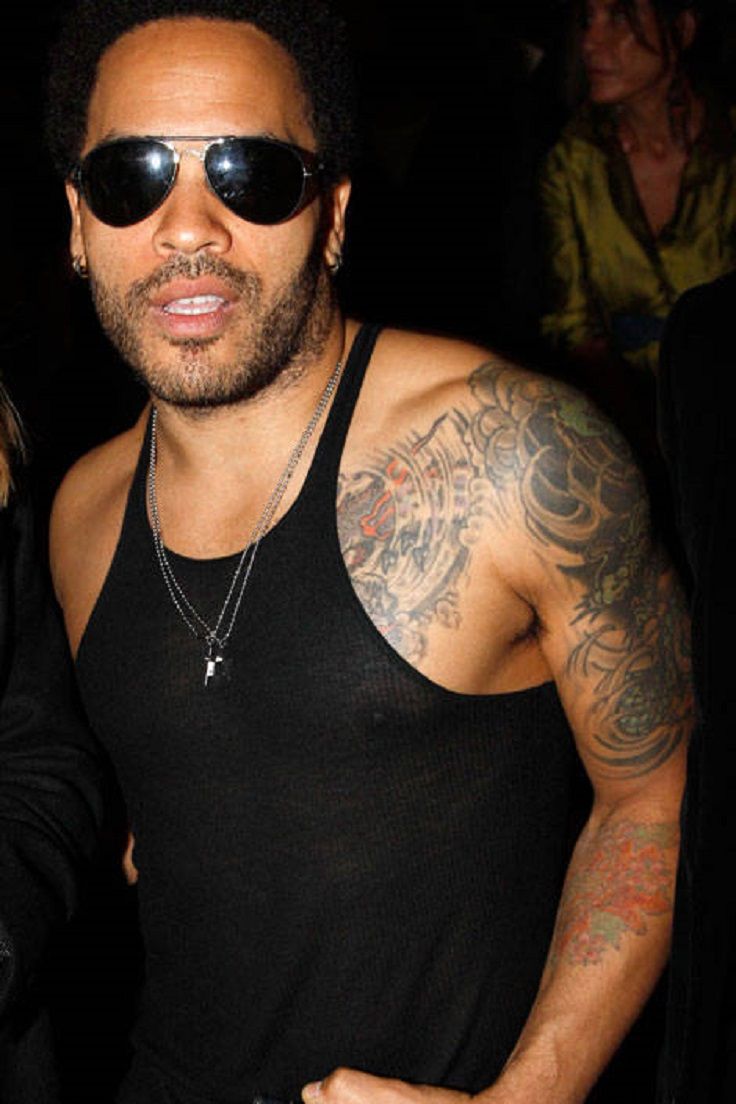
The largest design in Kravitz’s documented collection is a dragon extending across the left side of his chest, shoulder and upper arm. It is not a small shoulder emblem: the body of the figure follows the contours of his upper body, so a narrow crop can make it look like several unrelated fragments. A wider portrait gives a better sense of how the image moves from chest to arm. That scale is part of the tattoo’s effect. It reads as a connected composition when his shoulder is bare, but stage clothing and straps often hide sections of it.
Published close-ups describe a largely black-and-grey dragon with touches of red and surrounding movement that resembles wind, clouds, water or smoke. Those details make the piece feel more like a scene than a single outlined creature. The exact style label varies between tattoo catalogues, so “Japanese-inspired” is best treated as a visual description rather than a confirmed account from Kravitz. The image supports the placement and broad design; it does not establish a private meaning.
Some tattoo inventories also list another dragon motif near the chest. That should not be folded into the large left-side piece without a photograph showing the connection. Repeated imagery does not prove that two designs were made together, or that one is an extension of the other. Kravitz has not supplied a public explanation for every part of the dragon work, so its size, line and placement are firmer ground than claims about protection, ancestry or symbolism.
A colourful flower grouping on the inside of his left forearm is also reported in tattoo references. They identify several blooms, sometimes described as lilies and daisies, but the available broad portraits do not make every flower easy to distinguish. It is a separate, smaller patch of colour, not simply decoration around the dragon. Its placement makes it easier to glimpse when Kravitz turns his arm toward the camera, although stage lighting can flatten the colour and make separate petals run together. The flowers also change the balance of the collection: beside the dragon’s dark, sweeping lines, they offer a compact area of brighter colour. That contrast is visible; a specific personal meaning for each flower is not. Without a sharp close-up, naming every bloom as certain or assigning a symbolism to the bouquet would go beyond what the image can establish.
The arrow cross grew from a drawing and a conversation about faith
Kravitz has spoken directly about an arrow cross, giving this design a clearer story than most of the smaller marks. In a Robb Report interview, he recalled sketching the idea on a paper plate. He did not begin with a complete symbolic plan; he thought the drawing might make a good tattoo, then described its meaning through his faith. The arrows point outward in different directions, and he connected them with Christ consciousness moving in all directions. That makes the direction of the lines central to the design: the points do not simply decorate a cross-shaped outline, they give it a sense of movement away from its centre. Kravitz’s account links that visual choice to belief, rather than to a date, relationship or tour. The interview does not settle every question about when the tattoo was completed or who applied it, so those details should stay open.
That explanation matters because it comes from the person wearing the tattoo. The cross is not just a generic religious symbol in his account: its radiating geometry is part of the idea. Still, it should not be confused with every other cross in a secondary tattoo list. A separate catalogue describes a black-and-grey cross made from small triangular shapes near the right upper arm. The interview’s arrow design and that catalogue entry may be different pieces; the public record does not clearly establish that they are the same tattoo. Keeping them distinct avoids turning two visual descriptions into one unsupported story.
The arrow cross also does not explain the whole collection. Kravitz has large figurative work, direct lettering and small hand tattoos alongside it. His account gives this particular design a religious interpretation; it is not evidence that every animal, flower or mark on his body carries the same message.
“Free at Last” stands out for its plain, readable lettering
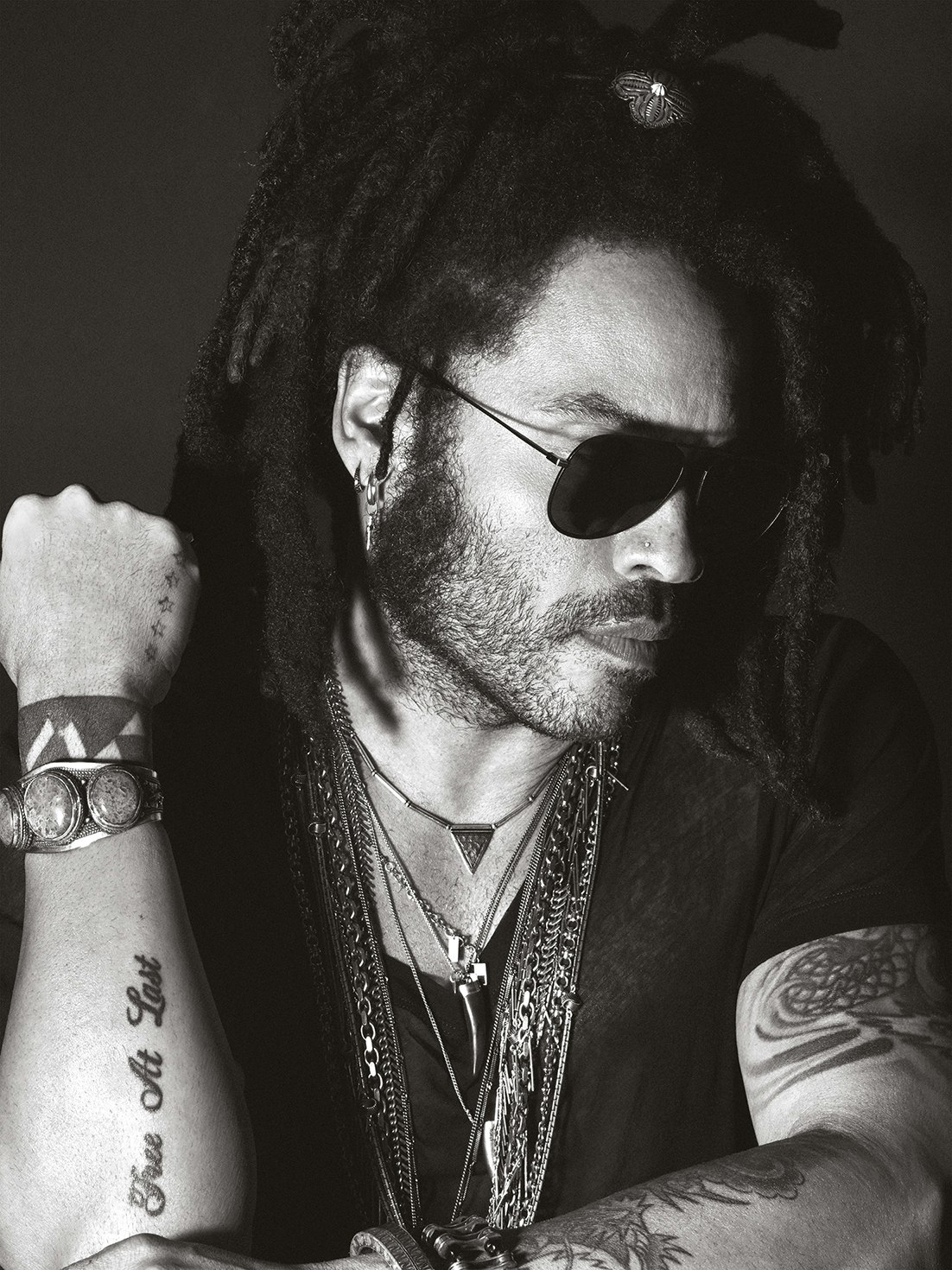
The words Free at Last are among the most legible tattoos in published portraits of Kravitz. The script sits on his forearm, where it can be seen in photographs of him holding a microphone or wearing sleeveless clothing. Unlike the dragon, which needs room for the eye to follow its shape, this tattoo communicates through a short line of text. Its placement makes the words part of an ordinary gesture: his arm can turn the phrase toward the camera without the pose being built around the tattoo.
The phrase invites a personal reading, but the sources reviewed for this guide do not pin it to one specific event. It is safer to describe what is visible and leave the private occasion open. The lettering is clear; an assumed backstory is not. That restraint does not make the tattoo less interesting. It lets the wording remain what Kravitz chose to put on his skin without assigning him an explanation he has not given. In photographs, the phrase reads at a glance, which is unusual among the collection’s smaller marks. It is text rather than an illustration, and its impact depends on the short wording and the open forearm placement. The uploaded portrait is useful because the letters can be read without mistaking them for a sleeve graphic or a clothing detail. It documents the visible phrase, not the private moment behind it.
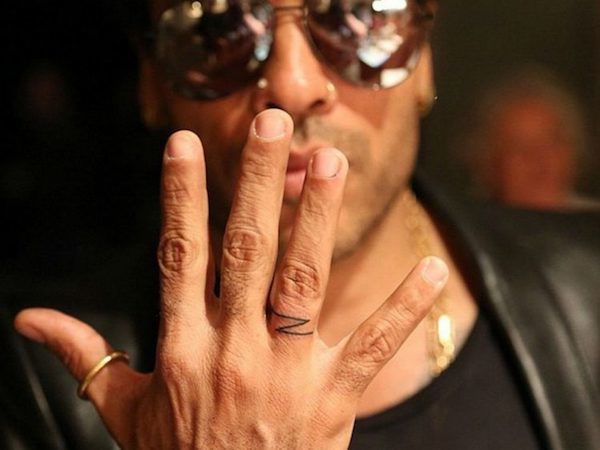
Several smaller designs are reported in tattoo inventories, though the available images vary in quality. A “Z” on a finger of his right hand is commonly identified as the initial of his daughter, Zoë. Its scale is part of its character: it is a small personal mark, not a large hand composition, and it can disappear in photographs where his fingers are curled around a microphone. The family connection is widely reported, but the letter itself is the firm visual detail.
Other catalogues list stars across both hands and a band around the right wrist. The star marks are described as small repeated shapes on the sides of the hands; a single wide shot rarely shows both hands sharply enough to confirm a precise count. The wrist band is a different kind of design, following the wrist like a narrow cuff rather than reading as a separate picture. These are tiny marks whose apparent number and exact shape can be hard to verify in performance photography; they should not be enlarged into elaborate symbolism on the strength of a distant shot. The published descriptions are useful for building an inventory, but they do not replace close photographs for checking every point, line or edge.
One inventory also records a face on the right forearm. A reader comment on that catalogue speculates that it may depict Kravitz’s mother, Roxie Roker, but that identification is not confirmed by Kravitz in the material reviewed here. The responsible description is a face tattoo, with the identity left uncertain. A portrait can invite recognition, especially when the wearer is known to have family tattoos, but resemblance alone is not proof of who is shown. The catalogue does not provide a first-person explanation that resolves the question. The same caution applies to the small cross-and-triangle design: its placement and form can be reported, while its personal meaning remains unconfirmed. In other words, the collection includes at least one design that can be named by subject without confidently naming its subject.
Back lettering is reported, but its photograph record is thin
More than one written account reports a large inscription across Kravitz’s back reading My Heart Belongs to Jesus Christ. The words fit the religious language he has discussed publicly, but the tattoo’s wording and his explanation should not be conflated: the phrase is documented in reporting, while the exact circumstances of choosing it are not established by the interview about the arrow cross. The available image search did not produce a clear, verifiable photograph of this specific back piece. For that reason, this section keeps the documented description in words rather than using a generic shirtless portrait or a photograph of the wrong tattoo. Written accounts associate the inscription with Kravitz’s Christian faith, but the photo record is too thin to assess the lettering style, exact scale or how far it spans his upper back. Those are visual details, not safe guesses. It is also worth keeping the back words separate from the arrow cross: both use Christian language, but only the cross has the direct explanation about the drawing and its radiating arrows described above. The inscription is therefore part of the documented tattoo list, while its visual treatment and personal circumstances remain less fully recorded.
Taken together, the tattoos show several different approaches rather than one uniform sleeve or one single theme. The dragon is expansive and follows the body; the flower grouping adds colour; “Free at Last” is direct and readable; and the arrow cross carries a first-person explanation tied to faith. The hand and wrist marks are smaller, while the back inscription is reported but difficult to inspect visually. The useful distinction throughout is simple: a photograph can show a design and where it sits, while only a reliable account can establish what Kravitz says it means.