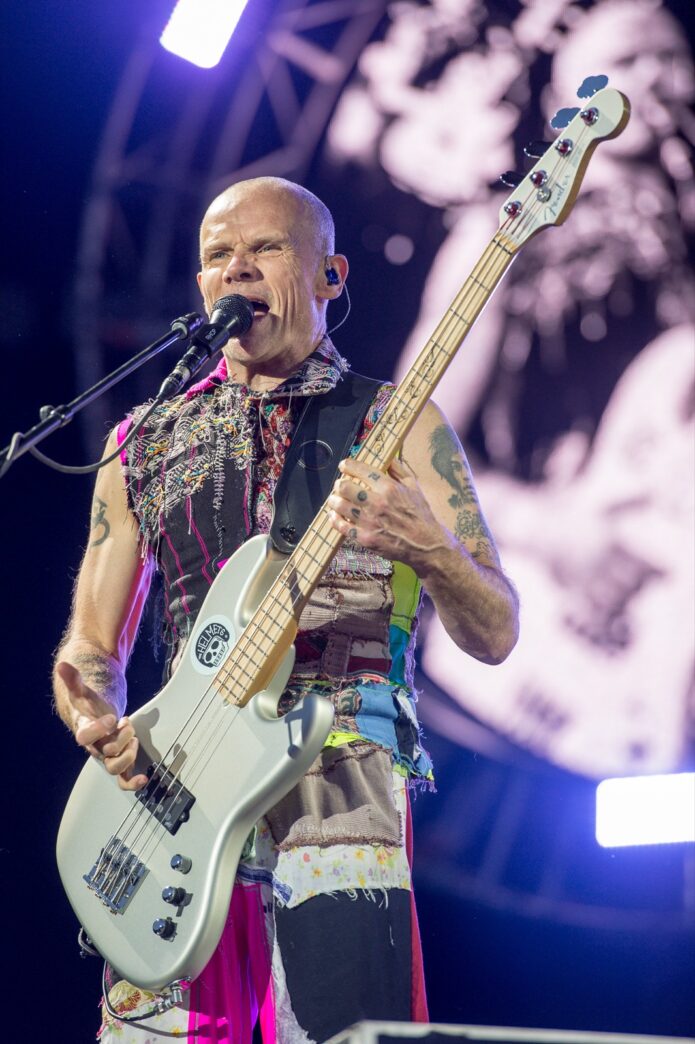
Flea’s tattoos have been added across a long career, so the collection reads less like a planned sleeve and more like a life in snapshots. A Jimi Hendrix portrait dates to 1981, before the Red Hot Chili Peppers became the band the world knows. Decades later, Flea added a black bear to his chest and explained why the animal mattered to him. Photographs also show a large back design, a Celtic-style spiral and a line of elephants. Those last pieces are visually striking, but Flea has not publicly supplied an equally clear story for each one. The useful distinction is simple: his own explanation tells us what a tattoo means to him; a photograph tells us what it looks like and where it sits.
The black bear on Flea’s chest carries a story he shared himself
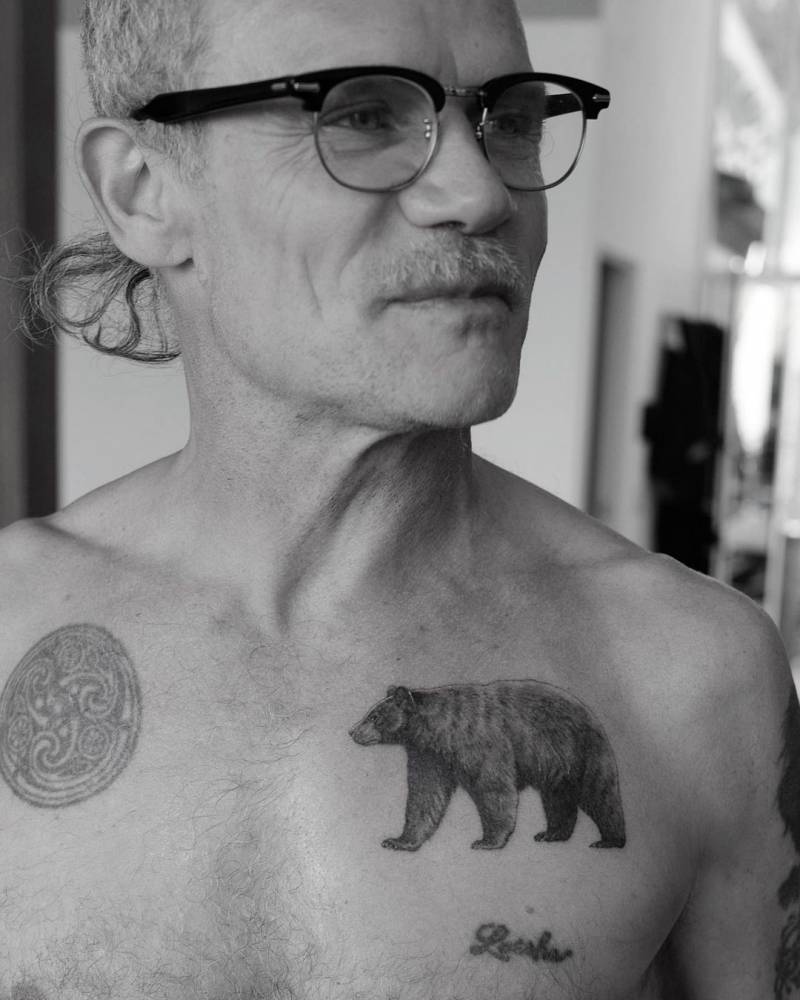
Flea unveiled the black bear on his chest in June 2021 and credited tattoo artist Dr. Woo. The image shows a compact, finely shaded animal rather than a large traditional bear built from heavy outlines. Its scale makes the placement matter: on the chest, it sits in a part of the body Flea can see himself, but it is not an oversized centerpiece. The artist’s close-up lets readers make out the bear’s shape and texture without mistaking it for a generic animal symbol.
Flea’s explanation is unusually direct. In a post described by Hauraki, he said bears had been a constant presence in his life and associated them with “bravery, strength and protection”, along with defending personal boundaries. He also connected the animal to the forest and the earth. Those are his associations, not a claim that every bear tattoo carries the same meaning.
He mentioned people close to him whose names include Bear, too. That detail makes the tattoo feel personal without reducing it to a single dedication. The animal can bring together affection for bears, qualities Flea values and people in his family circle. He never presents one of those as the only explanation. It is more accurate to leave the layers together than to pick one and call it the answer.
The bear stands apart from the older pieces in another way: we have a clear account from the person wearing it and a named artist. For many of Flea’s earlier tattoos, the available record is a photograph or a short catalogue description. Those sources can document a design, but they cannot fill in a private story Flea has not told.
Flea got the Jimi Hendrix portrait on his left arm in 1981

The Hendrix portrait on Flea’s left upper arm is the clearest early marker in his tattoo history. Flea recalled getting it in 1981, when he was 19. He told the story in a Rolling Stone interview excerpted by Ultimate Classic Rock: he heard people talking about a talented tattooist in town, decided he wanted Hendrix’s face and went ahead. The decision was quick; it was not described as a long-planned design project.
The family reaction is part of the memory. Flea recalled his mother or stepfather asking him to think about the lasting psychological effect of tattoos. That question stayed with the story, but it did not turn the piece into a simple rebellion anecdote. Flea was a teenager making a permanent tribute to a musician whose playing mattered to him. The best account keeps both parts: the sudden choice and the admiration behind it.
The portrait is often described as a left-bicep or upper-arm tattoo, and archival photographs show it clearly enough to identify. An older image description at Getty Images places Hendrix above a line of elephants on Flea’s left arm. That helps explain why pictures sometimes make the portrait and elephants look like one design. They sit close together, but they are distinct elements: Hendrix is the face tribute; the elephants form their own procession around the arm.
The date gives the portrait context. The Chili Peppers formed in 1982, so this tattoo predates the band’s first album and the scale of Flea’s later fame. It belongs to the young musician’s own map of influences, not to the band’s later visual branding. Hendrix is a personal musical reference, and Flea’s account is enough to establish that without assigning extra symbolism to the portrait.
The large back tattoo is clear in photographs, but its meaning is not
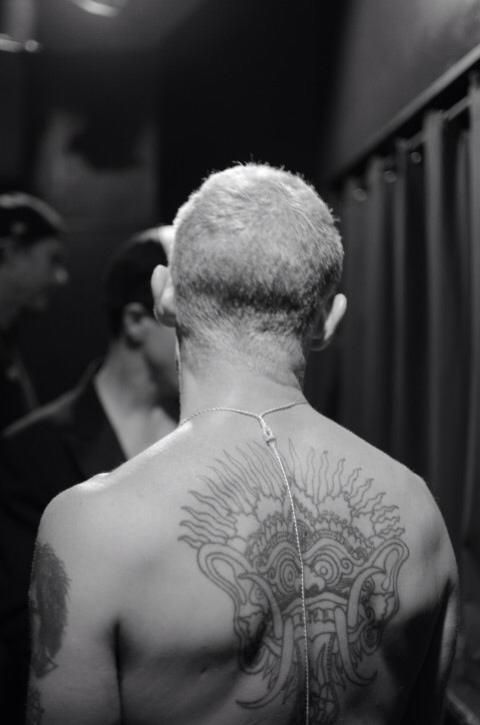
Flea’s back carries a broad, dark composition centered high between the shoulder blades. In the available photograph, the design has a face-like central area, layered ornamental shapes and lines that fan upward and outward. It covers far more space than the chest bear and reads as a single large piece rather than a small mark surrounded by open skin. The image is monochrome, which makes its outlines easy to follow but leaves fine shading less distinct.
That is about as far as the evidence goes. The sources used for this guide do not include a reliable first-person explanation of the back tattoo’s name, artist, date or intended symbolism. It is tempting to attach a spiritual label to a face framed by radiating lines, but appearance alone cannot confirm one. So this section describes the composition and placement and leaves the private meaning open.
The back is also the hardest area to track through ordinary performance photography. Flea is usually photographed from the front or side, often moving and holding a bass. A shirtless back view is unusual, and lighting can flatten the design or make it look darker than it is. That is why the image here matters: it gives a direct view of the tattoo’s scale and layout. It does not turn a visual record into an interview.
The distinction is not a hedge; it keeps the article honest. The bear and Hendrix portrait have explanations tied to Flea’s own words. The back piece is documented by what can be seen. Readers can still appreciate the design without being told a story that no source has established.
A Celtic-style spiral and elephant figures widen the picture
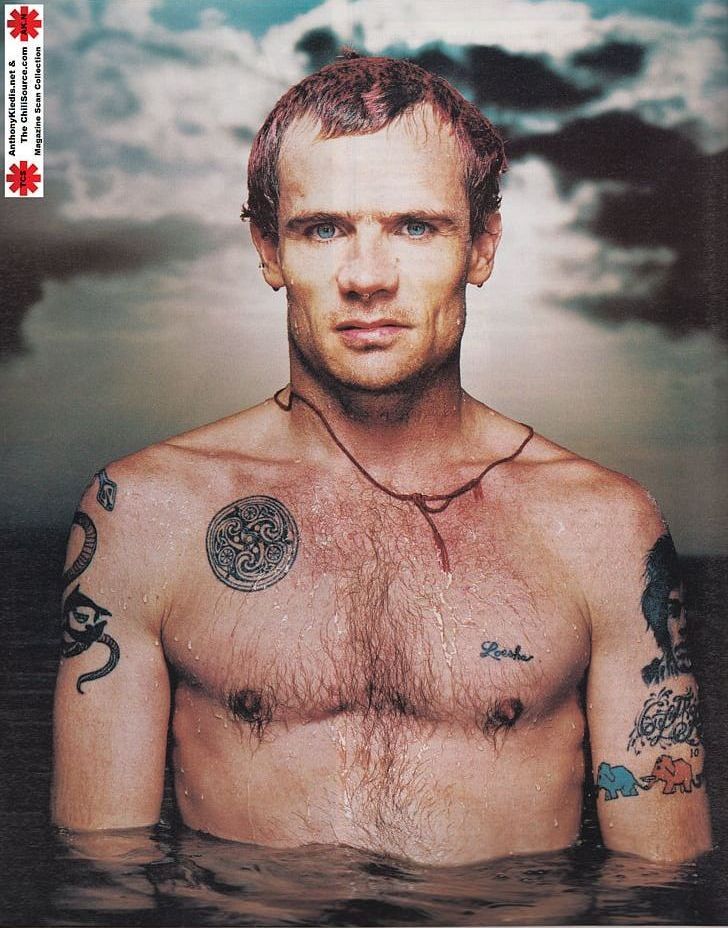
A separate portrait shows a Celtic-style spiral on Flea’s right chest and small, colourful elephant figures on his left arm. The spiral is a tight circular pattern, visually different from the bear’s realistic shading and the Hendrix portrait’s face. The elephants are more playful: a row of compact figures that follows the arm rather than one large animal occupying the whole space. A portrait published by Composers Breakfast Club makes the chest and arm placement visible together.
The elephant line is also part of the historical photograph record. Getty’s archival description of the Hendrix portrait notes the elephants above and around the image on Flea’s arm. Seen in that context, the group is not just decoration added to a later stage look; it was already part of his visible tattoo map in the early years. The sources do not give a confirmed personal meaning for each elephant, so the article does not assign one.
The spiral is sometimes described as Celtic-inspired, a visual label rather than a claim about Flea’s heritage or beliefs. Its curves and repeated shapes make that comparison understandable, but no interview located for this guide explains why he chose it. The same restraint applies to the small figures: their colour, scale and placement are visible; their private story is not.
Taken together, these designs show why a complete tattoo map needs more than a count. The bear is a later piece with a first-person explanation. Hendrix connects to a specific musical influence and a year. The elephants and spiral are identifiable through photographs, while the back piece remains a large visual statement with no confirmed interpretation. Flea’s tattoos do not need one grand theme to make sense. Their details—and the different levels of evidence behind them—are the story.
What the photographs and interviews establish
The strongest confirmed details are Flea’s 1981 Hendrix portrait, the chest bear by Dr. Woo and the explanation he gave for that animal. Photographs add the back composition, chest spiral and elephant figures to the record. They let readers see where those pieces sit and how they differ; they do not grant permission to invent a meaning for every mark.