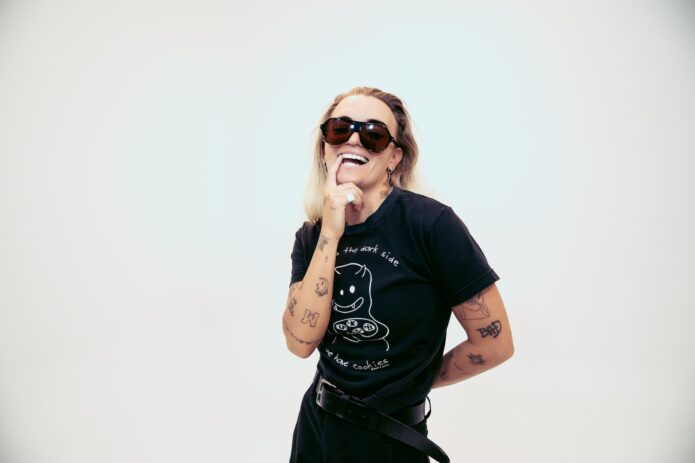
G Flip’s tattoos don’t look like they came from one master plan, and that’s part of the appeal. The Australian drummer and singer has built the collection out of small memories, jokes, music references and designs picked up along the way. Some are neat little line drawings. Others are words that only make sense once G explains the story behind them.
In a 2025 interview with Us Weekly, G described the tattoos as “little moments and memories here and there.” That is a much better way to approach the collection than trying to force every design into one deep theme. The tattoos cover both arms, run onto the hands and include lettering across the back, but the stories stay grounded in ordinary things: a favourite Melbourne venue, a grandmother, drumming, friends and a song that mattered.
Forum sits above the wrist as a love letter to Melbourne gigs

The word “forum” sits just above G Flip’s left wrist. It refers to the Forum Theatre in Melbourne, a venue G calls a favourite. The placement makes sense because the tattoo sits close to the hand used to play drums, while the lettering itself stays simple enough to read quickly.
The word is small enough to disappear in a loose sleeve, but it becomes obvious when the wrist turns toward the camera. That placement suits the story: the tattoo is tied to a real music room, not a vague idea of performing. The lettering also has the slightly worn, hand-drawn feel that runs through several of G Flip’s smaller pieces.
This is not a generic city-name tattoo. G has connected it to nights spent playing and watching shows in Melbourne, so the place becomes a piece of working history. The Forum is part of the route that turned music from an interest into a life. A small word above the wrist can carry that kind of weight without needing a huge illustration around it.
The wrist lettering belongs to the musician’s working hand

Photographs show how much the placement changes when G is holding sticks or lifting an arm on stage. The wrist bends, the lettering shifts and the surrounding small marks become easier or harder to see depending on the light. That is why a clean arm photograph is more useful here than a distant performance shot.
The design is also a good example of G Flip’s relaxed approach to ink. It is legible, personal and tied to a real place, but it does not pretend to be a grand emblem. The tattoo works because the memory behind it is specific.
Drum love, hearts and the tattoos that came from playing

G Flip has described several tattoos as direct nods to drumming. There are small heart shapes and a drum-love reference among the arm designs, along with other fine-line symbols that are easier to spot in a close portrait. Drums were G’s first instrument and remain the centre of the stage identity, so these pieces feel less like branding than little reminders of what came first.
The drum-related marks are easy to read alongside G Flip’s career because they are not decorative filler. They point back to the instrument that shaped the live shows, the timing, and the physical side of the music. Photographs show the ink crossing the arms in separate groups, so it is better to describe each visible design than to call the whole collection one sleeve.
One story is especially good because it involves G’s nana. G said their grandmother was placed up on a level like a queen, and part of the tattoo was done while G was performing. Holding still with one arm while singing and playing is exactly the kind of slightly chaotic story that suits the collection. The tattoo is about family, but the memory also includes the awkwardness of getting it done in the middle of a show.
Music appears as small symbols rather than one huge sleeve

The arms are busy without looking locked into one style. A lightning bolt can sit beside a flower, a smiling face or a short word. Some outlines are deliberately plain, which lets the designs read like notes in a sketchbook. The collection feels accumulated rather than commissioned all at once.
That matters when reading photographs. A long sleeve can make small pieces look like filler, but G’s smaller marks often have their own story. The right description is to name what is visible, give the reported context and leave the unconfirmed symbols alone. The pictures show a lot of ink; the interviews explain why certain marks stayed.
The Leon Bridges lyric runs across G Flip’s back

One of the largest text pieces is a lyric from Leon Bridges’ song “River”, tattooed across G Flip’s back. A back tattoo naturally changes the balance of the collection. Most of the small arm pieces are visible while G is talking or playing. The lyric only appears when the body turns away from the camera, which makes it feel more like a private line that happens to be permanently visible.
A back inscription needs a wider photograph than a wrist tattoo. The lettering follows the shape of the body, and the surrounding skin changes how much of the line can be read in any one frame. The useful detail here is the placement and the credited lyric, while the broader emotional interpretation should stay close to what G Flip has actually shared.
G has talked about the words as part of the emotional memory behind the song. The lettering gives the back a clear horizontal shape, but it still sits comfortably beside the looser arm drawings. It is not trying to turn the whole body into a single mural. It is one strong sentence surrounded by a lot of smaller moments.
Back lettering needs a different kind of photograph

A front portrait cannot prove what the back tattoo looks like. It might show the edge of the lettering near a shoulder, but it cannot establish the full line or its position. The clearest evidence comes from a rear or three-quarter photograph where the words can be read without guessing at the missing letters.
The lyric also shows why tattoo meaning should come from the person who wears it. A reader might interpret any song text as a relationship message or a statement about sadness. G’s explanation gives the piece a firmer context, while the photograph confirms the size and placement.
“I love you,” 1961 and the smaller tattoos that make the arms feel lived-in
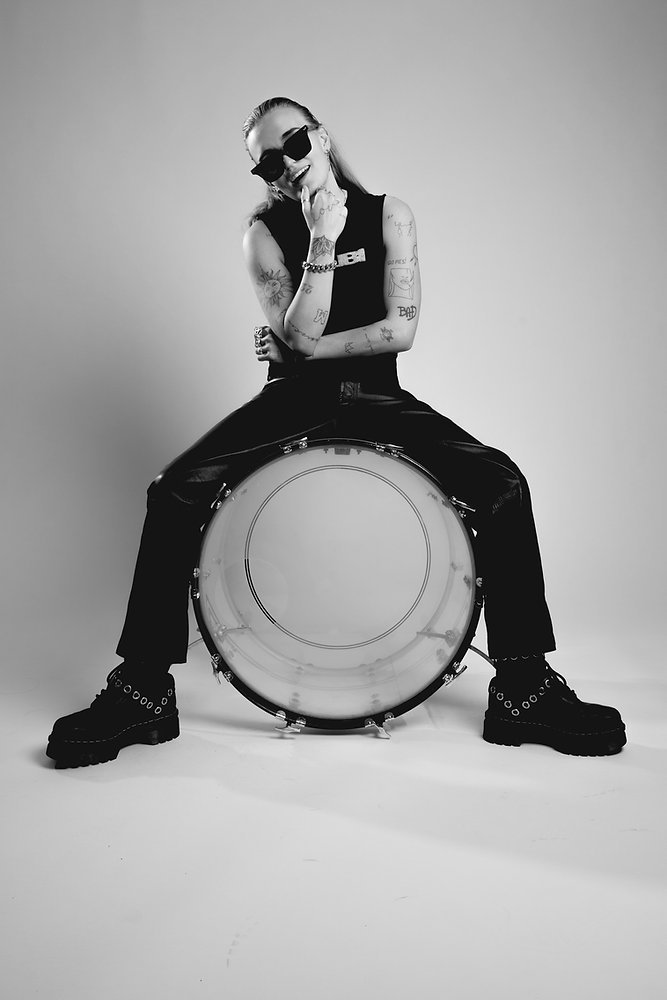
Some of the most noticeable small tattoos are the words “I love you” and the number “1961”. They sit among simple drawings and symbols on the arms, so they can disappear when hair or clothing crosses the skin. Unlike a large back lyric, these marks are seen in ordinary portraits and casual photographs.
The smaller pieces are where the collection feels most personal. A date, a short phrase or a tiny drawing can sit beside a much larger design without competing with it. They also change the way the arms look in photographs: a concert shot may show only a few marks, while a sleeveless portrait reveals a much fuller group of fine lines, lettering and symbols.
The number has been photographed clearly, but its complete personal explanation is not as well documented as the Forum story. That is fine. A tattoo can be worth recording because it is visible without pretending to know the private reason it was chosen. The same goes for the many small drawings spread over the forearms.
The collection keeps changing because the stories keep changing
G Flip’s tattoos are not a fixed checklist. New pieces arrive through tours, friendships, songs and small decisions made in the moment. Some marks are tidy, some are deliberately playful and some carry a story that only becomes clear when G talks about it. Even the tattoos done on stage become part of that running diary.
That is also why the best photographs are not always the most glamorous ones. A rehearsal room, a festival portrait or a drum-session frame can show a different part of the arms and wrists. The pictures should be read together, with each one doing a specific job. One can make the lettering legible, another can show the shape of a symbol, and another can reveal how the smaller pieces sit beside the larger work. None of them needs to be stretched into a bigger claim than the image supports.
Put together, the collection moves from the Forum wrist lettering to the drum references, from the Leon Bridges lyric on the back to the small words and symbols on the arms. The designs do not need to match. They match in a different way: each one records a person, place, song or moment that G Flip wanted to keep close.
That mix is what keeps the collection interesting: some tattoos are loud, some are tiny, and the meaning is clearest when the design and the photograph are considered together.