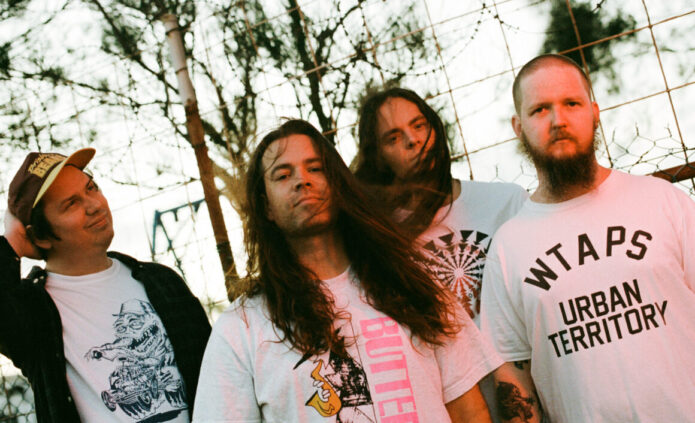
Luke Henery is the bassist and photographer associated with Brisbane alternative rock band Violent Soho, and his tattoo record is unusually well documented because he discussed it directly with Tattoo Life. The available photographs are useful for a simple reason: they show the ink on his body rather than relying on a generic stage portrait. His collection is a working archive of art references, touring memories and personal symbols, spread across both arms, the chest and the torso.
The strongest source is a 2020 Tattoo Life interview in which Henery describes when his interest began, the artists and references behind his sleeve, and the memories he keeps on his other arm. The photographs from that interview give the visual record a clear anchor. They also show why a single image would be misleading: the same collection changes dramatically when he is photographed in a shirt, shirtless, on stage or in a wider band frame.
Luke Henery and Violent Soho
Henery has been part of Violent Soho’s long Brisbane-to-international story since the band formed in 2004. The group’s biography places him on bass and backing vocals, while the Tattoo Life interview places the beginning of his tattoo interest close to that early period. Those details matter together because they explain why his tattoos are often photographed in rehearsal rooms, backstage spaces and performance settings rather than in a formal studio catalogue.
His collection is not presented as one finished sleeve with a single theme. Instead, it is described as an accumulation of favourite artwork, travel memories and small personal references. That makes the visual evidence more interesting than a simple count. The body photographs show large black shapes, detailed illustrative forms and areas that have been filled over time, with the arms carrying the most immediately readable concentration.
Luke Henery left sleeve and Dürer-inspired arm work
The left arm is the clearest example of Henery’s art-history influence. In the Tattoo Life interview, he identifies the sleeve as a Dürer-based mash-up developed with Brisbane artist Rachi Brains, also known as Rachel Park, at Black Throne Tattoo. He says the project grew slowly from his first tattoo and that some figures were modified to connect the imagery with personal experiences.
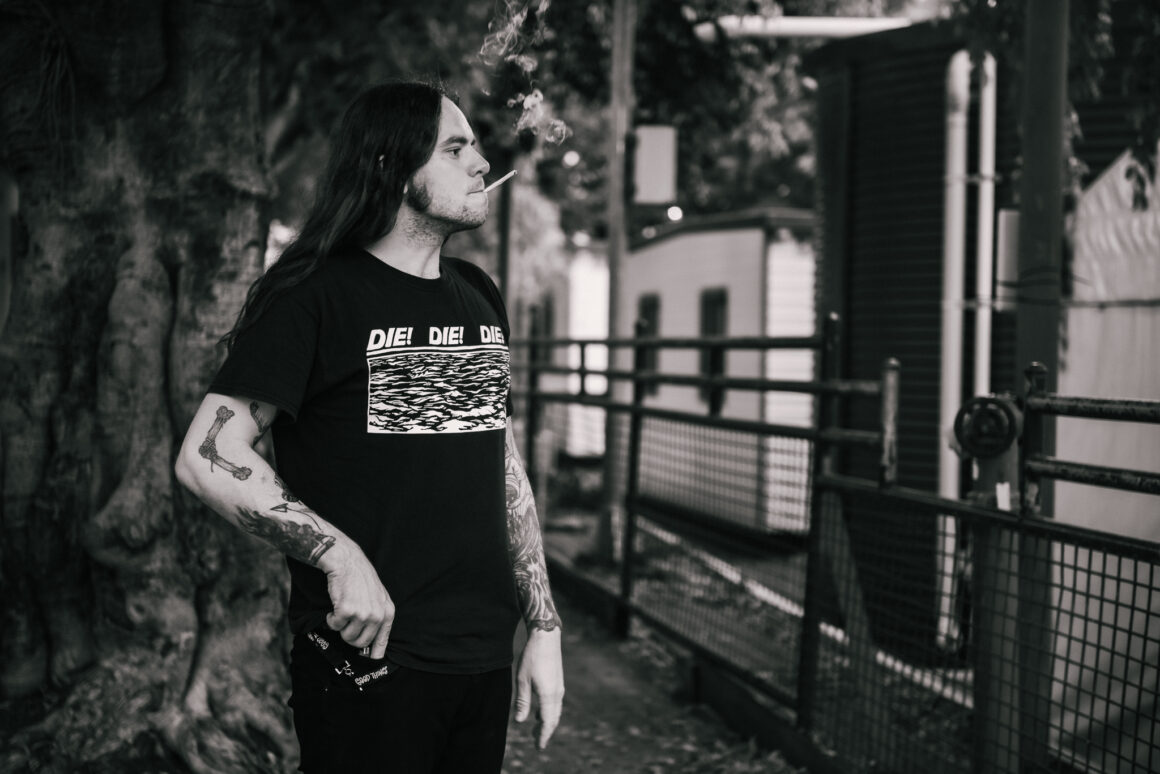
The black-and-white photograph makes that description tangible. The sleeve reads as layered etching-inspired work rather than a set of isolated icons. Fine lines and darker masses sit close together, so the arm has the visual density of an illustrated page. The photograph also shows why the sleeve should not be reduced to one symbol: the interest is in the combination of figures, texture and the way separate references were allowed to accumulate.
Luke Henery chest wing and central torso tattoos
A separate photograph shows the chest as a broad composition built around dark wings and central body imagery. The forms spread across the pectoral area and continue down the torso, creating a strong horizontal-to-vertical movement. The scale is important. This is not a small accent that disappears under clothing; it is one of the collection’s defining visual masses.
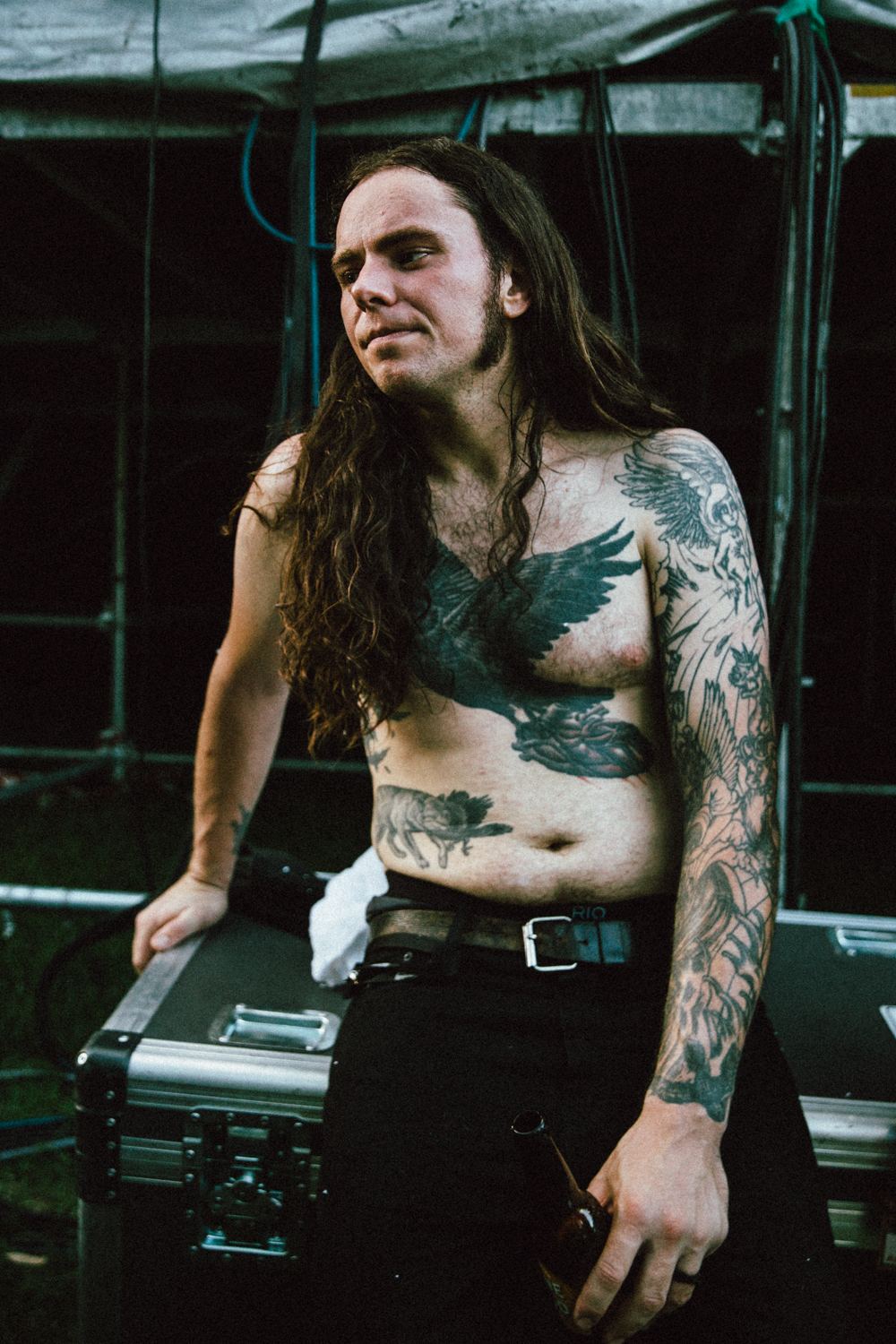
The chest view also gives useful context for the surrounding work. The body is not divided into neat, empty panels. Blackwork, linework and older pieces sit close together, and the overlap makes the overall image feel more like a continuously developing surface. It is safest to describe what the photograph shows rather than invent a symbolic explanation for every line. Henery’s own interview provides detailed background for the arms, but it does not assign a private meaning to each chest shape.
Luke Henery chest, side and lower torso blackwork
The lower-angle photograph changes the reading again. Hair, lighting and posture partially interrupt the chest, while the side and lower torso reveal additional dark forms that are less obvious in a straight-on portrait. Several pieces appear to connect visually, but the image does not justify naming every shape as a separate tattoo. It does establish that the collection extends beyond the most famous sleeve view.
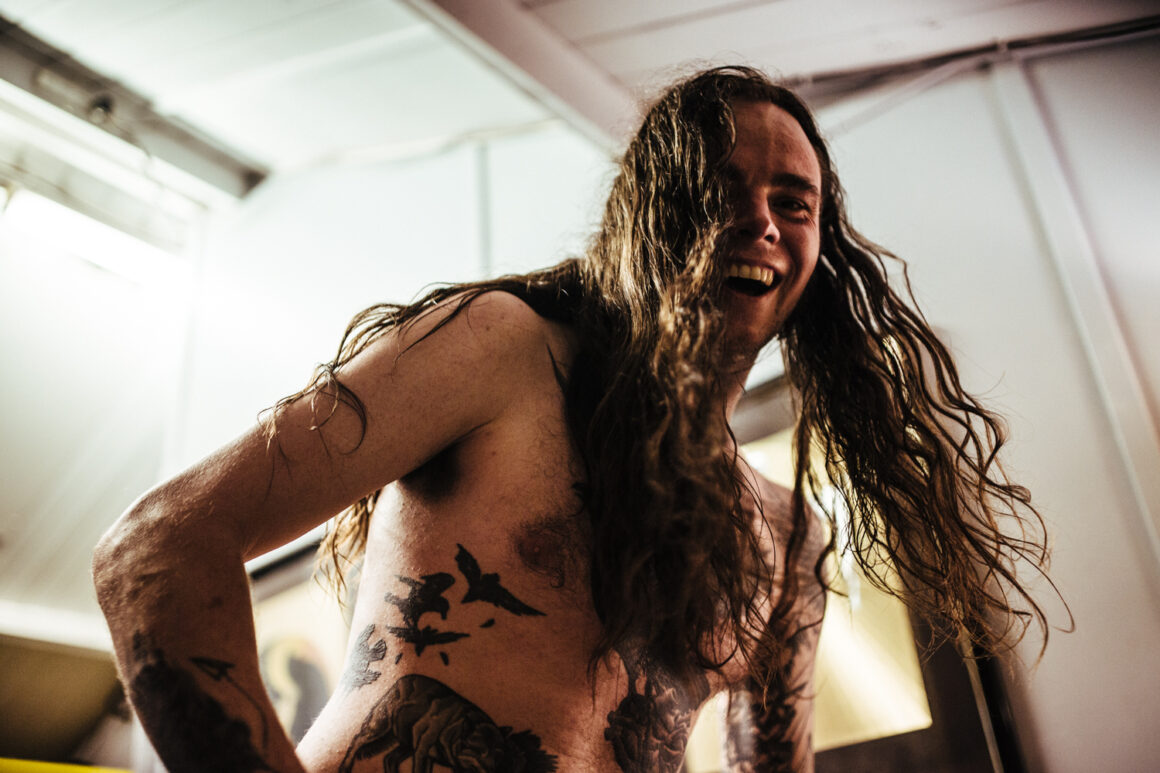
This is one reason dates and viewpoints matter in tattoo coverage. A photograph can make a piece look larger, smaller or more connected depending on the angle. Henery’s work benefits from being compared across distinct images because the viewer can separate the stable placement of the ink from the changing posture of the musician. The result is a more careful record of the body art and less pressure to force a single definitive diagram from one frame.
Luke Henery forearm tattoos in a live performance view
The live photograph brings the arms back into focus. With Henery holding a bass, both forearms are exposed and the density of the sleeve work is easier to see in a performance context. The image is valuable because the tattoos remain visible while he is doing the work that made him recognizable to a large audience. They are not being presented as a costume detail added for a photo shoot.

The stage view also supports Henery’s distinction between the two arms. The left side carries the concentrated Dürer-related sleeve, while the right arm is described in the interview as a place for touring memories and experiences. That division is a useful organizing principle, although the photographs should still be treated as snapshots of an evolving collection rather than a final inventory.
Luke Henery arm tattoos in the wider band photograph
The wider band photograph is less intimate, yet it adds a different kind of evidence. Henery is identifiable at the edge of the group, and the exposed arm shows that the tattoo record remains legible even when the camera is documenting the whole band. A wide frame is not a substitute for a close-up, but it helps connect the body art to the working life around it.
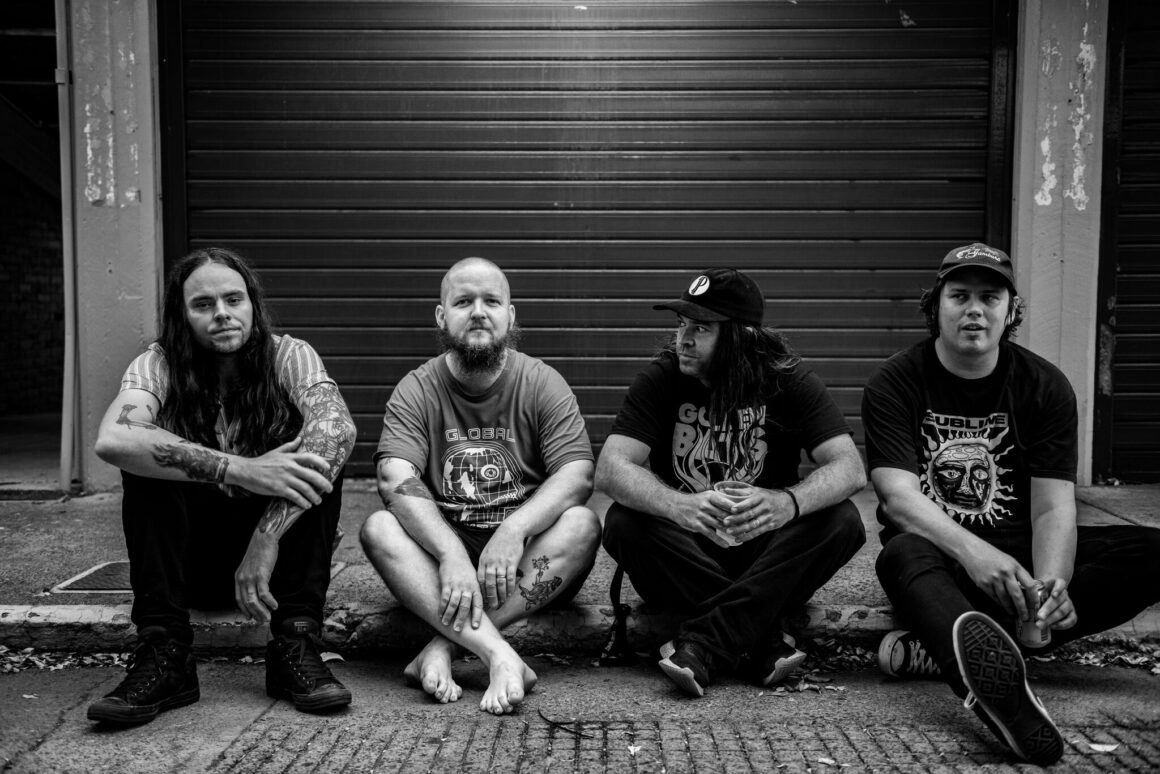
Placed beside the close and mid-range views, this image helps guard against overreading any one angle. The arm coverage is consistent across the photographs, while the surrounding scene changes from backstage to stage to street. That consistency is what makes the collection feel documented. The article can therefore distinguish confirmed visual details from interpretations that are not stated by Henery or visible with enough clarity.
How the collection developed over time
Henery describes his tattoo interest as beginning not too long after 2004, when he was spending time with friends from Slain Of Myself who loved tattoos. He also connects his first major direction to an admiration for Albrecht Dürer’s etching work. Those comments show a deliberate starting point, but the rest of the interview describes a collection that kept absorbing new experiences rather than following one rigid plan.
The right arm is especially tied to memory. Henery says he tried to reserve it for touring or personal associations, including the van Violent Soho used around Australia and a fantail bird for his grandfather. The interview also mentions imagery connected to the band The Scandal. These details give the visible photographs a narrative frame without requiring guesses about pieces that are not identified in the record.
Why the photographs matter
The five tattoo photographs work as a sequence rather than a pile of interchangeable pictures. The sleeve view explains the Dürer influence; the shirtless images show the chest and torso; the stage photograph connects the arms to performance; and the wide group frame supplies a separate distance and setting. Each image contributes a different piece of evidence, and each is placed beside the section that discusses what it can actually show.
That structure is important for a tattoo record because visual similarity can be deceptive. Two photographs from the same shoot may look like different assets while showing the same frame, and a generic celebrity portrait can be mistaken for tattoo evidence if its purpose is not clearly separated. Here the body images come from distinct photographs and the featured identity portrait is kept separate from the inline tattoo sequence.
Luke Henery video context
Violent Soho’s video history provides a final piece of context for the collection. The band’s documented work includes the official Neighbour Neighbour video and later projects connected with the group’s touring and recording history. Henery’s tattoos appear in photographs made around that working life, which is why the record feels connected to music, travel and the visual culture of the band rather than detached from it.
The most defensible conclusion is also the simplest: Luke Henery has a substantial, visibly documented collection, with the left sleeve, the chest and the right-arm memory pieces forming the clearest anchors. The photographs support those observations. They do not prove a complete count, a fixed completion date or an explanation for every mark. As the images and interview show, the record is best understood as an evolving body of art with a strong Dürer influence and a personal touring history.
There is also a useful distinction between the photographed record and a complete personal catalogue. Henery can identify the concepts that matter to him, yet the camera does not reveal every covered area in every year. The images therefore work best as dated windows into the collection. They preserve the scale, placement and repeated visual language of the ink while leaving room for later additions, changes in coverage and details that only Henery or his artists could confirm.
Related documented tattoo coverage: Grazi Massafera Tattoos: New Jaguar and Tiger Ink in Photos.
One thought on “Luke Henery Tattoos: Dürer-Inspired Sleeve, Touring Memories and Chest Ink”