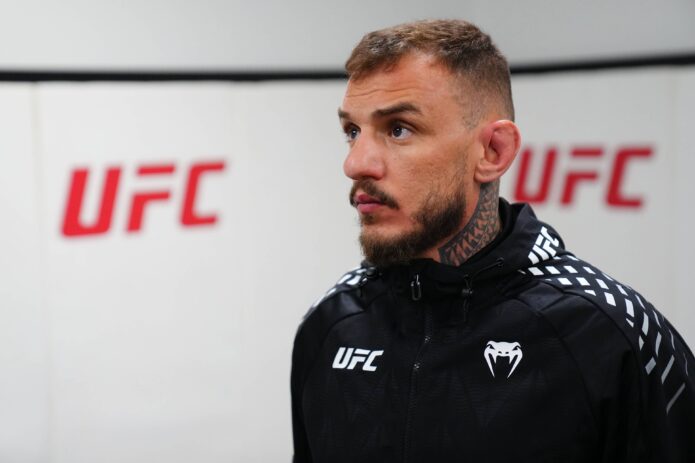
Renato Moicano is easy to recognize before the opening bell. The Brazilian lightweight carries a large Polynesian-inspired tattoo collection across his chest, shoulders, neck and arms, and the work becomes part of his outline whenever he raises his hands. It is not a single emblem placed for a quick reveal. The coverage has a rhythm, with dense black structure near the torso and more movement around the upper body. Looking at the images together makes the design easier to understand because each setting reveals a different relationship between the ink, his posture and the demands of competition.
Moicano’s tattoos read as a connected composition. The chest carries the visual weight, the shoulder and neck areas extend that weight upward, and the arms give the design a wider frame. A weigh-in photograph can show scale, while an action image shows how the lines move when his body turns. The collection is best understood through several photographs rather than a single close-up, because each view supplies evidence about placement without forcing a guess about details the camera does not show.
The chest centerpiece gives the collection its structure
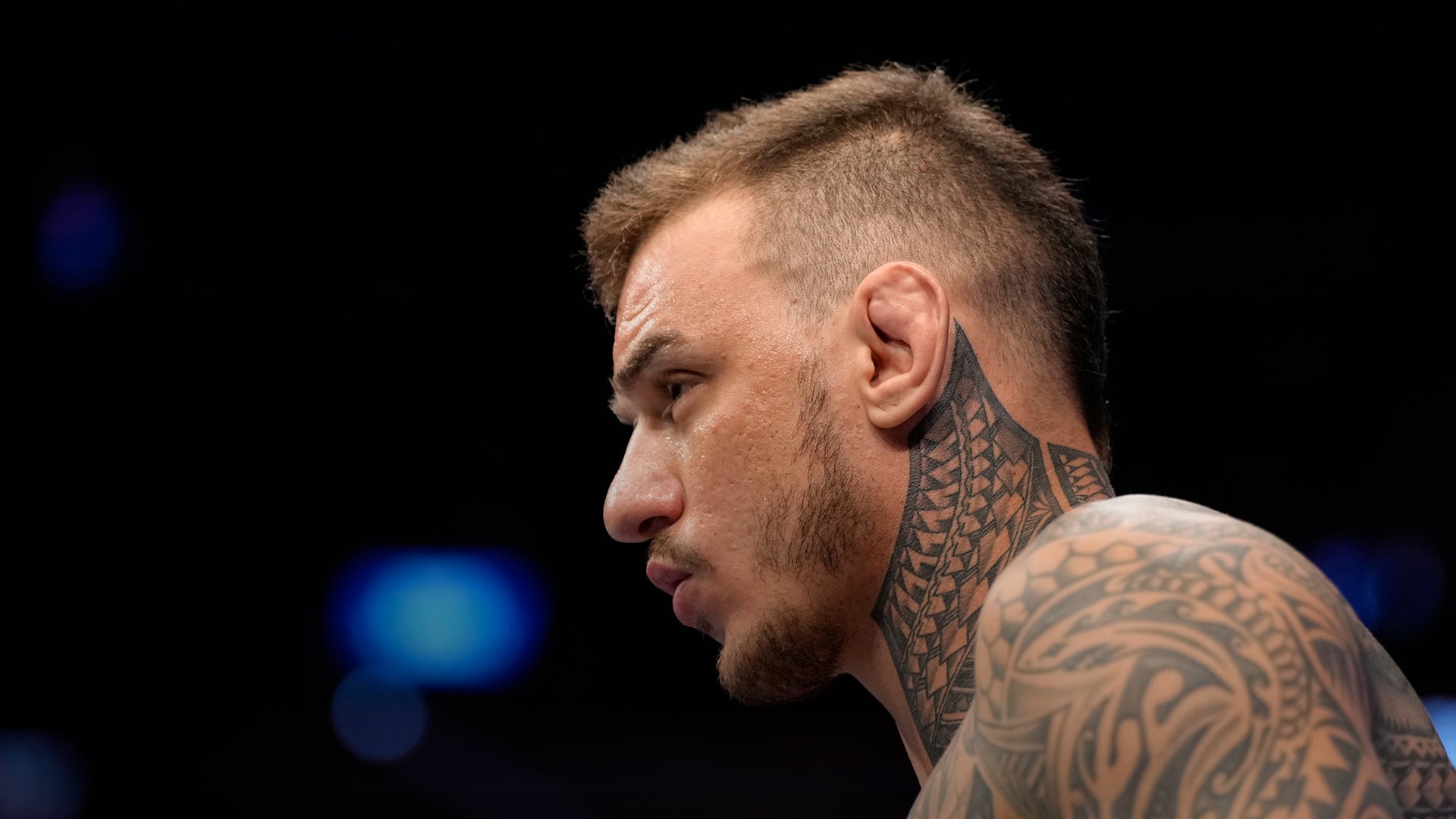
The clearest chest view comes from a UFC side-profile close-up. It shows dark, angular forms spreading from the upper chest toward the shoulder and neck. The geometry feels layered rather than flat, with shapes close to the centerline and others breaking outward along the body’s curve. That placement explains why the tattoo remains visible when Moicano turns his torso during a fight or faces a camera at an angle.
The image also shows the work using natural landmarks. The collarbone and shoulder create boundaries, but the composition does not stop sharply at either one. Instead, the forms use the curve of the upper body as part of their structure. The chest can look compact in a straight-on portrait and much larger in a three-quarter view, even though the underlying balance stays consistent.
The central chest field is the collection’s anchor. Dark shapes provide a visual center, while the edges soften as they approach the shoulder. That transition gives the composition room to move. It reads as body-shaped work rather than a graphic pasted onto a flat surface, and the surrounding zones become easier to understand when this center remains in view.
Personal context without overclaiming
Moicano has discussed tattoos and personal stories in a Lionheart Lounge interview recorded at El Clasico Tattoo. The conversation gives useful human context without assigning a precise meaning to every visible shape. It places the fighter in a tattoo-focused setting, but it does not turn every mark into a confirmed symbol or supply a complete catalogue of dates and artists. The careful reading is simple: his relationship with tattooing is documented, while some design interpretations remain visual observations.
That distinction keeps the description grounded. Published interviews can establish that a person chose to be tattooed and preserve the language used when discussing the experience. Photographs establish location, density and scale. Neither source type automatically explains every line. Moicano’s collection rewards restraint because the photographs show a substantial composition, yet the available captions do not provide a complete legend for each motif.
The interview also separates biography from decoration. Moicano speaks as a fighter with a distinctive public persona, but the tattoos are not merely an accessory attached to that persona. They appear in quiet portraits, official weigh-ins and moments of movement. That range gives the collection continuity even when lighting, distance and posture change.
The neck and shoulders frame the face
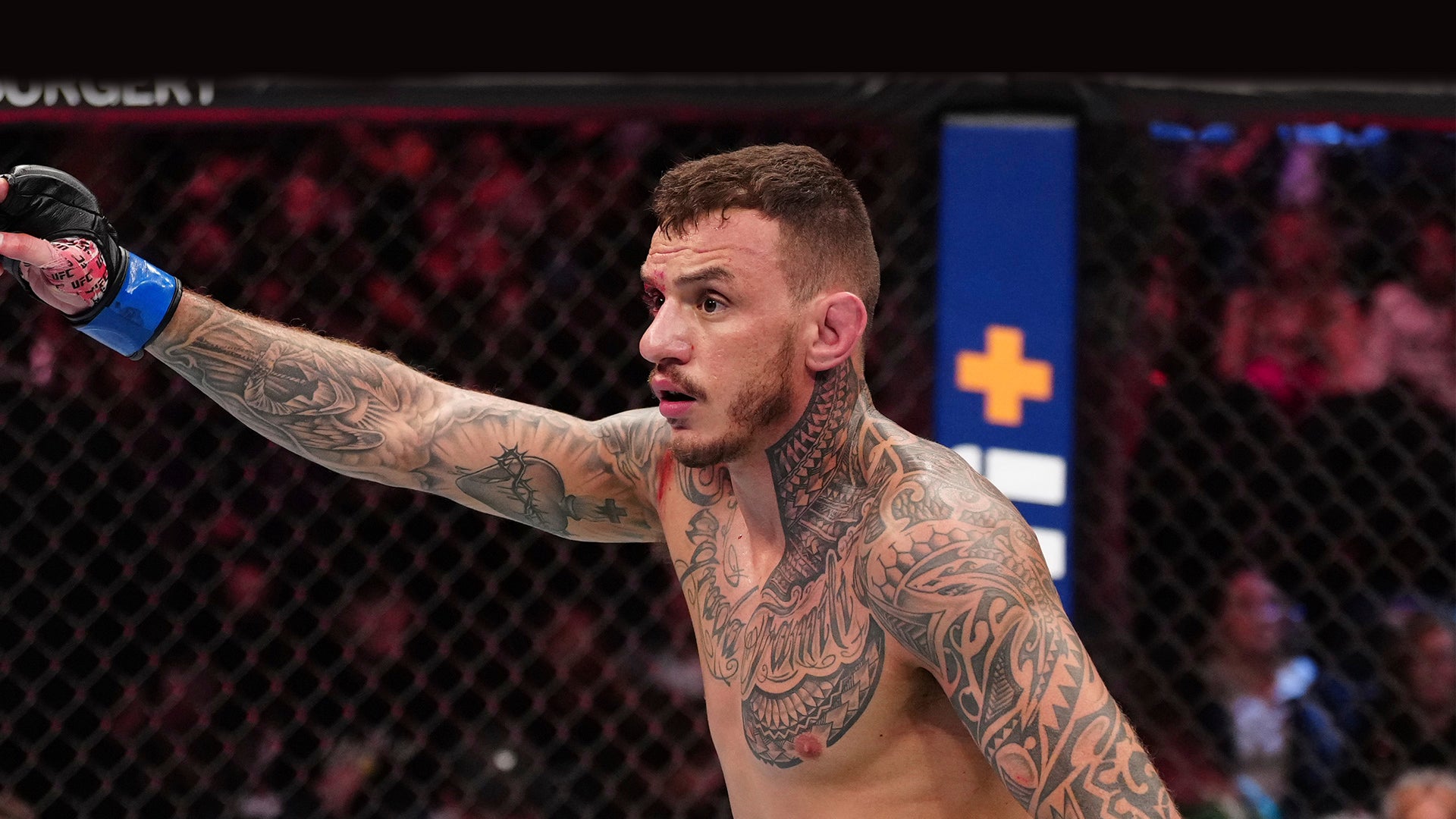
An action photograph reveals how the upper edge of the collection changes the way Moicano’s face is framed. The neck and shoulder work create a dark border around the head and upper torso, especially when he lifts his chin or turns toward the crowd. It does not feel like an isolated sticker-like detail. The eye moves from the central torso into the side of the neck and across the shoulder.
The movement is easiest to see in a celebration image. Sweat, arena light and a raised arm introduce visual noise, yet the tattoo remains legible because its broad shapes are strong. When the shoulder rolls forward, one part disappears while another becomes prominent. The collection changes emphasis with motion without losing its overall identity.
The neck placement changes the silhouette. A design stopping at the collarbone would read as a chest piece; the extension upward makes it part of Moicano’s recognizable fighting image. Chest, shoulder and neck belong to the same visual conversation even when a photograph captures only two areas clearly.
Arm sleeves complete the fighter silhouette
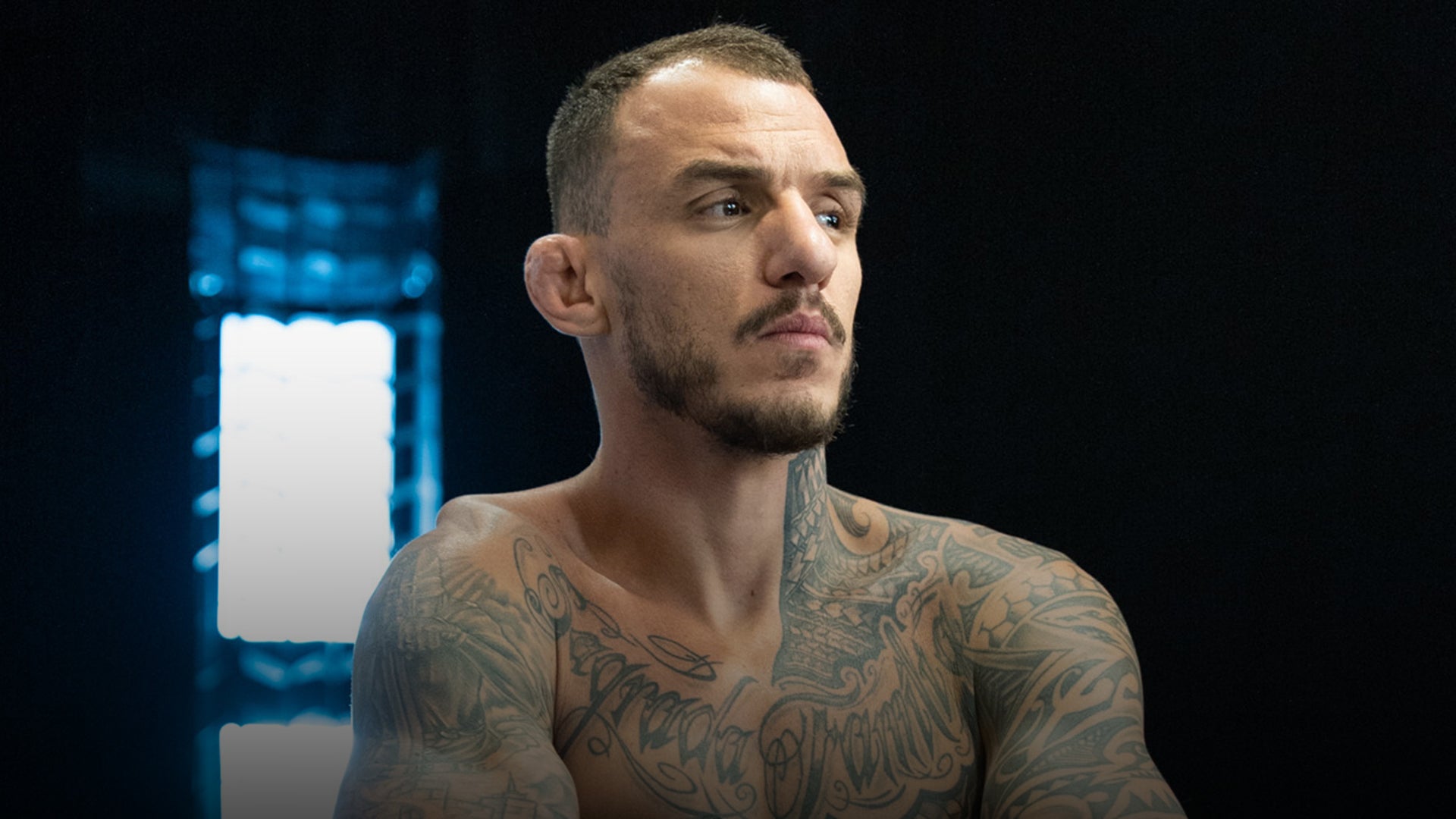
A UFC media-day portrait gives the clearest look at the arm coverage. The arms add vertical structure to the heavier chest and shoulder mass, creating a frame that stays visible when Moicano stands square to the camera. In a relaxed portrait, the arms make the composition feel broad and deliberate. In a fight image, they become active surfaces, appearing and disappearing as the guard changes.
The arm work should not be called a perfectly uniform sleeve when the photograph does not support that claim. Visible areas vary in density, and lighting can hide sections near the inner arm. What the images do establish is a strong extension from the upper torso downward. The eye can travel from chest to shoulder and then down the arm, giving the collection an intentional sense of reach.
The media-day setting clarifies continuity. Even lighting and a composed stance let the viewer compare the arms with the neck and chest without arena distractions. The tattoos are not identical panels repeated around the body; they are related areas that share a dark graphic vocabulary while responding to different curves and proportions.
Tattooed weigh-in photographs reveal the full scale
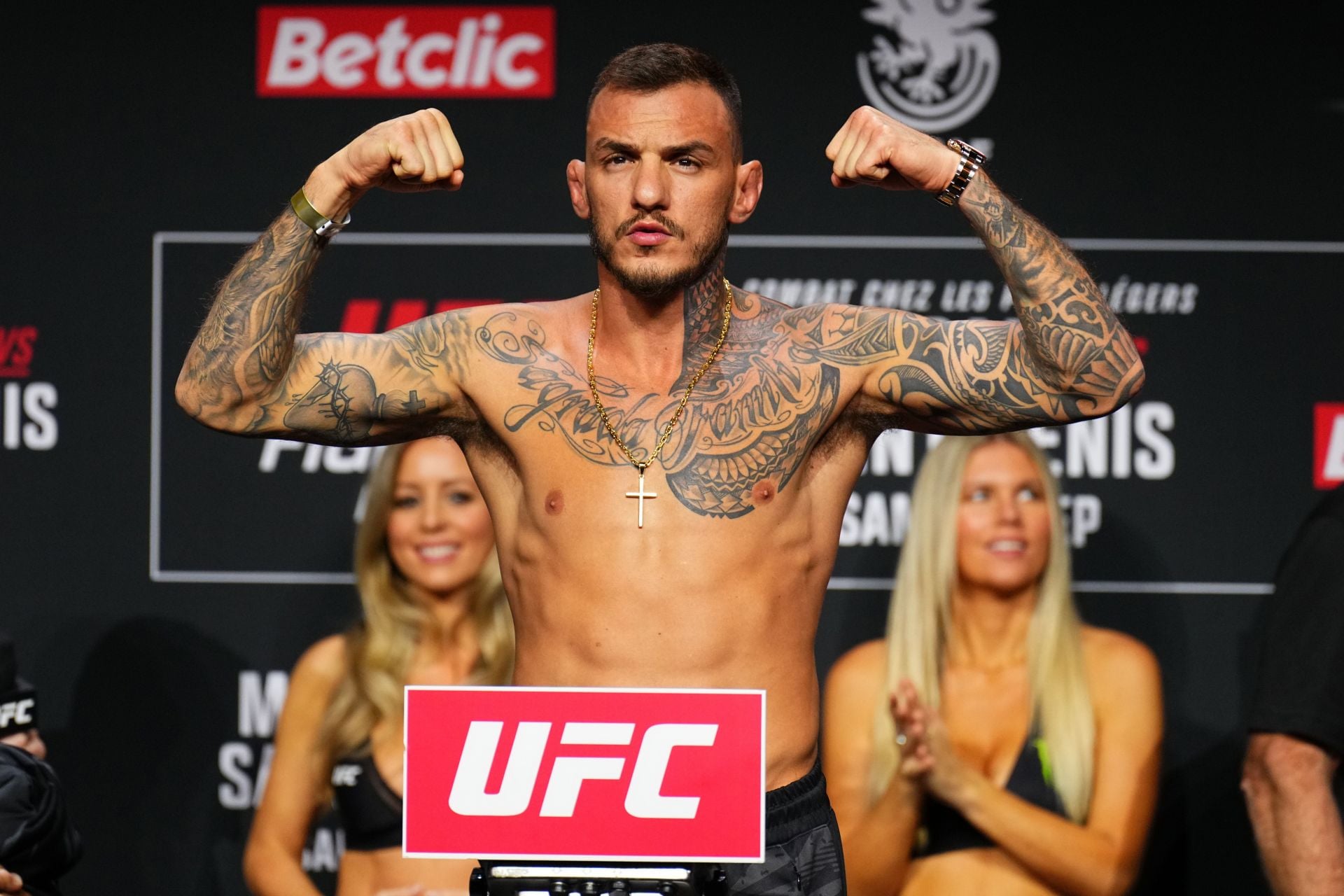
The UFC 311 weigh-in photograph supplies a different kind of evidence. It places Moicano in a public setting where the camera is farther away and the body is presented as a whole. Chest, neck and arms appear at once, making coverage easier to judge than it is in a crop. The collection is not limited to the central chest area; it extends across the upper body and remains coherent at a distance.
A wide image prevents a common mistake: treating the most prominent patch as the entire tattoo. Close-ups magnify the center and can make surrounding work feel secondary. At the weigh-in, proportions are clearer. Central forms anchor the view, while the arms and shoulders widen the composition. The body becomes the frame, and the design reads as a connected field rather than unrelated moments.
Lighting changes apparent texture. Strong overhead light can flatten dark areas, while a side angle can make edges look more sculptural. These differences do not necessarily indicate new work. They often result from distance, angle and contrast, so comparing the UFC view with the close-up is more reliable than drawing conclusions from one photograph.
A later tattoo weigh-in shows the ink evolving
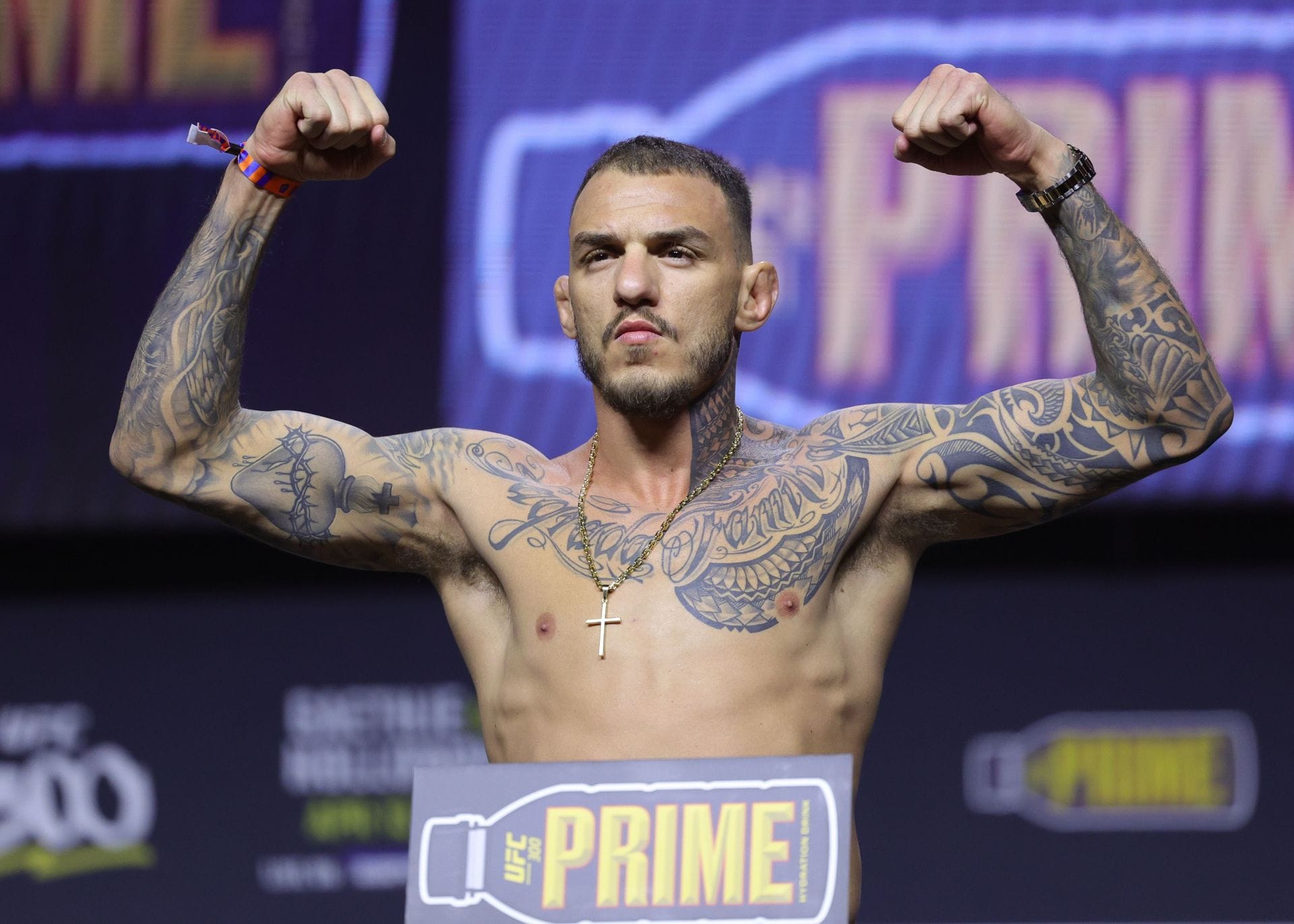
A later Sportskeeda weigh-in image adds a second date and a different regional source. It shows the same general coverage under another lighting setup, useful for separating stable placement from temporary photographic effects. Chest and shoulders carry the strongest mass, while the arms maintain the outer frame. The repeat appearance across dates supports the conclusion that the composition is a sustained part of Moicano’s look.
The later photograph still deserves care. It is not a complete catalogue, and a camera angle may conceal small details. Its value is comparative. When broad shapes return in a new setting, they provide confidence about major zones and reduce the temptation to treat every shadow as a new design element. Athletic posture changes the balance: a turned torso makes one shoulder dominant, while a squared stance distributes attention more evenly.
The selected photographs show scale, continuity and movement. The chest gives the eye a center. Shoulders and neck carry that center upward. Arms extend it outward and downward. Each zone has its own visibility, but the zones work as one composition whenever Moicano is photographed from a useful distance.
How the visual language works in motion
Moicano’s tattoo collection is most legible across changing situations. A profile portrait emphasizes the chest and the upward reach toward the neck. An action frame brings out the shoulder and the way the lines shift with the torso. A media-day photograph clarifies the arm coverage. Weigh-in images supply scale and show how the design holds together when the entire body is visible. None of these views replaces the others.
The result is a tattoo identity that feels athletic without being reduced to sports branding. The work belongs to Moicano’s body first, while the fighter’s movement gives it a changing presentation. That is why the collection remains recognizable in a still portrait, a crowded arena and a formal weigh-in. Its strongest feature is not one isolated symbol but the way multiple areas share proportion, density and direction.
The most responsible conclusion is simple. The photographs document a substantial Polynesian-inspired composition across the chest, neck, shoulders and arms. The interview adds personal context, but it does not justify invented meanings. The visual record supports confident statements about location and scale, while finer interpretations should remain open unless Moicano or a documented tattoo source supplies them.
“The work belongs to Moicano’s body first.”