
Damiano David’s tattoos are part of his stage identity, but they are not all there for the same reason. Some point straight back to Måneskin. Others are private jokes, old ideas, anime references or pieces he has never fully explained. That mix is what makes the collection worth slowing down for. The big chest lettering is easy to spot. The smaller marks around it need a much closer look.
He also talks about the tattoos in a way that feels pretty relaxed. In one interview he admits that the heart around his nipple came out crooked, then says he likes it anyway. He has spoken about the pain of the ribs and the long session needed for the back. Elsewhere, coverage has picked out a childhood school theme, a manga character and words tied to the band’s early career. The safest guide keeps those confirmed stories separate from fan guesses.
Il ballo della vita chest tattoo is the collection’s loudest headline

The most recognisable piece is the large Il ballo della vita lettering across Damiano’s upper chest. The phrase is the title of Måneskin’s first album, released in 2018, so the tattoo is tied directly to the band’s breakthrough period. It is not a vague piece of Italian lettering that fans have translated after the fact. The connection to the album is documented, and Damiano has described the tattoo as one of the designs people know best.
Its placement does a lot of the visual work. The letters stretch across the chest and sit where an open shirt or bare stage outfit will reveal them immediately. Unlike a small wrist symbol, this one reads from a distance. It also works with Damiano’s performance style because the words stay visible while he moves, sings and turns toward the crowd.
The phrase translates roughly as “the dance of life,” but the important point is the album connection. The tattoo carries the band’s first chapter with it. Damiano has said that fans have copied the design, which gives the lettering an extra layer of responsibility. It is no longer just a private reminder of a record; it has become one of the visual signs people associate with Måneskin.
There are other marks around the chest, including the small crooked heart near the nipple and additional linework. Those pieces should not be swallowed by the headline tattoo. The album words are a bold block of text. The heart is a smaller, messier story from a group session. They share the same area, but they have different origins and should be described as separate entries.
The tattoo has also changed how Damiano’s solo image is read. He is now promoting music outside the band as well, but the lettering still points to the group that made him famous. It does not erase the solo work. It shows that his body art carries more than one era at once.
Damiano David’s back tattoo turns the Icarus idea into a full-body image
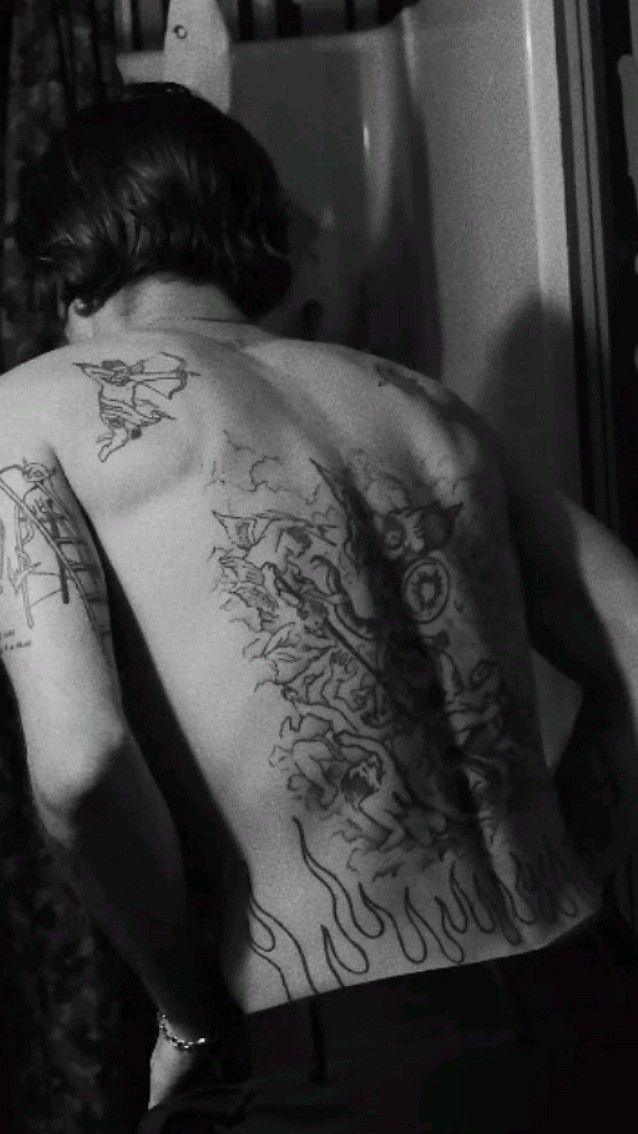
His back piece is much harder to understand from an ordinary concert photograph. It covers a large area and becomes most visible when he is shirtless or leaning forward for a camera. Coverage links the wings on his back and hip with the myth of Icarus, a figure associated with ambition, flight and the danger of going too far. That reference is reported, but the entire composition should not be assigned a detailed meaning that Damiano has not personally explained.
The scale is the main fact. This is not a tiny pair of wings tucked behind the shoulder. The tattoo takes up the back and uses dense dark shapes that move with the spine and shoulder blades. In a soft image, the separate forms collapse into one black area. A sharper photograph shows why the piece needs its own section rather than being mentioned as an afterthought.
Damiano has said the back session took more than twelve hours, which gives readers a useful sense of the commitment involved. Long sessions also explain why a back tattoo can look unfinished in one photograph and much more developed in another. The work may have been completed in stages, or different lighting may reveal different parts of the same design.
The Icarus association fits the way Damiano talks about music and performance, but it is still better to keep the wording measured. The wings are visible. The myth reference is documented. The private emotional meaning behind every line is not. That distinction lets the image carry the drama without turning it into a made-up confession.
It also sits apart from the very public chest lettering. The chest says the album title in plain language. The back is more symbolic and less immediately readable. Together they show the range of his tattoo choices: direct words in one place, a large mythic image in another.
The Eren Jaeger anime tattoo brings a different kind of drama to his arm

One of Damiano’s clearest newer additions is the Eren Jaeger tattoo on his upper arm. The design shows the character from Attack on Titan in both human and Titan forms, which gives the piece a built-in contrast. It is not just a logo or a small reference for fans to decode. The tattoo uses the character’s changing forms as the image itself.
Italian coverage connects the tattoo with a session by artist Gabriele Anakin at Wisdomless Club. Damiano revealed the work after a trip to Japan, and the timing makes the anime connection easy to understand. The tattoo is a record of an interest he wanted to keep close, but the image does not need an invented explanation about exactly what every part represents.
The upper-arm placement gives the design room to breathe. A character portrait needs more space than a tiny word, especially when the artist is showing two versions of the same figure. The black linework can be read more clearly when the arm is lifted or turned toward the camera. In a stage photograph, the tattoo may be hidden by a sleeve, jewellery or strong coloured lighting.
This piece also shows that Damiano’s collection is not limited to rock symbols or traditional portrait ideas. He has room for a modern manga reference beside album lettering, mythological imagery and small personal marks. That variety feels deliberate even when the tattoos were added at different times.
The safest description is the simplest one: Eren Jaeger, shown in human and Titan forms, on the upper arm, documented after a Japan-related period and associated with Gabriele Anakin. The photo proves the design and placement. The wider emotional meaning belongs to Damiano, and no source gives enough detail to fill that gap confidently.
The torso lettering, snake and self-done marks make the smaller tattoos count
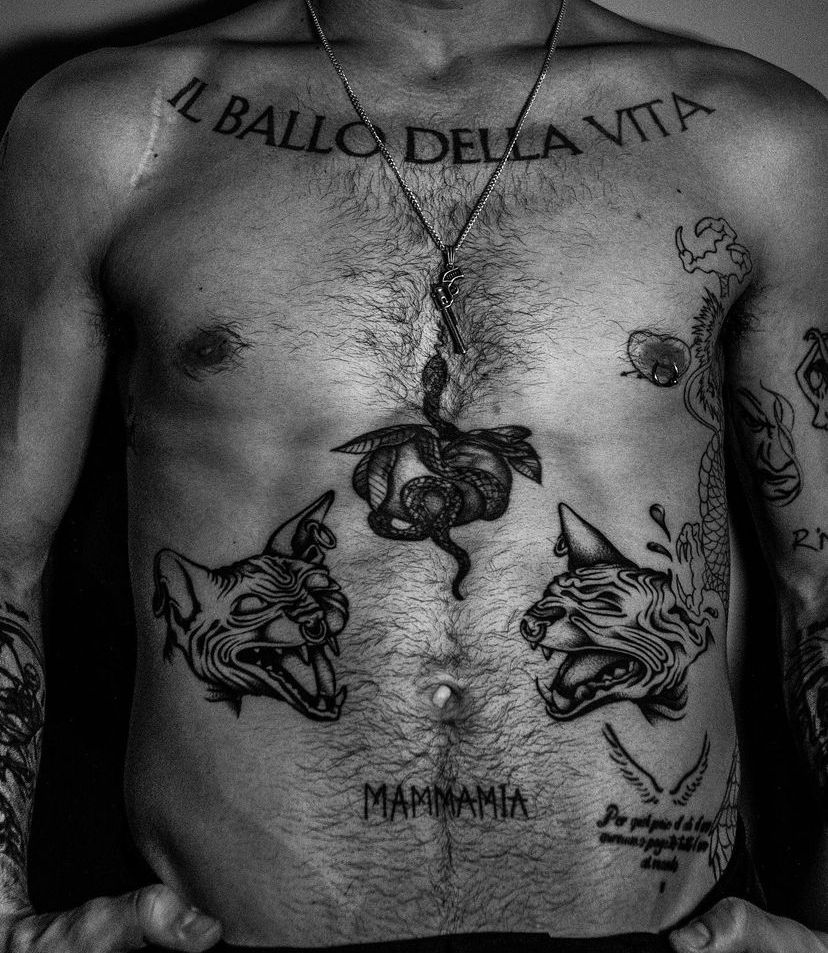
The rest of the torso is where the collection starts to feel more personal and less like a set of headline pieces. Photos show MAMMAMIA, a snake, feline or animal imagery and additional lines of text around the stomach and ribs. Some of the writing connects naturally with Måneskin’s music, while other designs are only securely described by what appears in the photograph.
Damiano has also talked about tattoos he did himself on his thighs. Those pieces matter because they do not have the polished look of a studio-centred chest statement. They preserve an earlier, more impulsive side of his relationship with ink. A self-done tattoo can be technically uneven and still be important because of when it was made and what the person wanted to remember.
The little heart around the nipple belongs in this section too, even though it has become one of the most repeated stories about his tattoos. Damiano says he got it with the other Måneskin members and laughs about the crooked result. That quote is useful because it gives the design a real voice. The heart does not need a grand meaning added to it. The band session and his acceptance of the imperfect line are enough.
The childhood school theme on his calf works differently. It preserves a piece of writing about wanting to become a rockstar. That tattoo links the child he was with the career he eventually built. It is one of the clearer examples of a design carrying a timeline rather than just a picture. The words matter because they existed before the international success.
His ribs are reportedly among the more painful areas he has had tattooed. That detail explains why the torso pieces should not be treated as random decoration. They involve difficult placements, long sessions and designs that are sometimes only visible when he chooses to show them. A concert photo can prove that ink is present, but it rarely captures the full lettering or the edge of a design.
There are also smaller marks whose meanings remain open. A guide can name the visible subject, locate it and attach the strongest available evidence without pretending that every symbol has a confirmed backstory. That approach is especially important with a heavily tattooed musician because new pieces, cover-ups and partial photographs can change the map quickly.
Put together, Damiano David’s tattoos move between public and private. Il ballo della vita announces the band. The back turns Icarus into a large dark image. Eren Jaeger brings anime into the collection, while the heart, childhood writing and self-done thigh work keep the whole thing loose and human. The photographs show the designs. His interviews explain the pieces he has actually chosen to explain. The rest is best left as careful visual description.