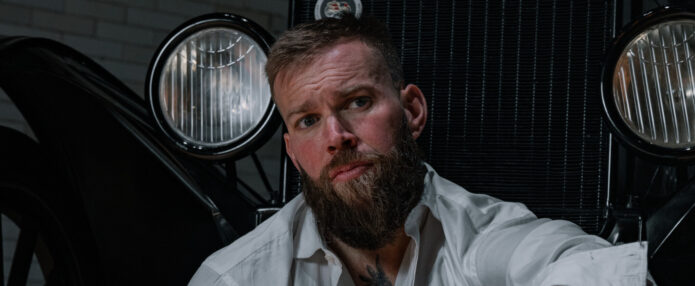
Jordan Shallow’s tattoos are presented in the current Inked profile as a collection built through travel, long sessions and a serious interest in tattoo history. Shallow is known publicly as a chiropractor, sports performance coach and entrepreneur, but the profile focuses on the way his skin has become a record of artists, places and visual traditions. His collection is not described as one finished sleeve. It is a changing group of pieces that move across the face, neck, arms, chest and legs.
The published photographs show several different visual languages at once. There is a detailed skull on the inner forearm, a large chest piece completed in a 15-hour session, a fighting tiger on the right leg, Japanese-inspired imagery, eagle forms and smaller marks across the hands and arms. Shallow’s own comments keep returning to the same idea: each tattoo is connected to the artist and the setting in which it was made. The result is a body of work that reads as an interconnected collection rather than a list of unrelated symbols.
Jordan Shallow’s face-visible portrait and hand ink
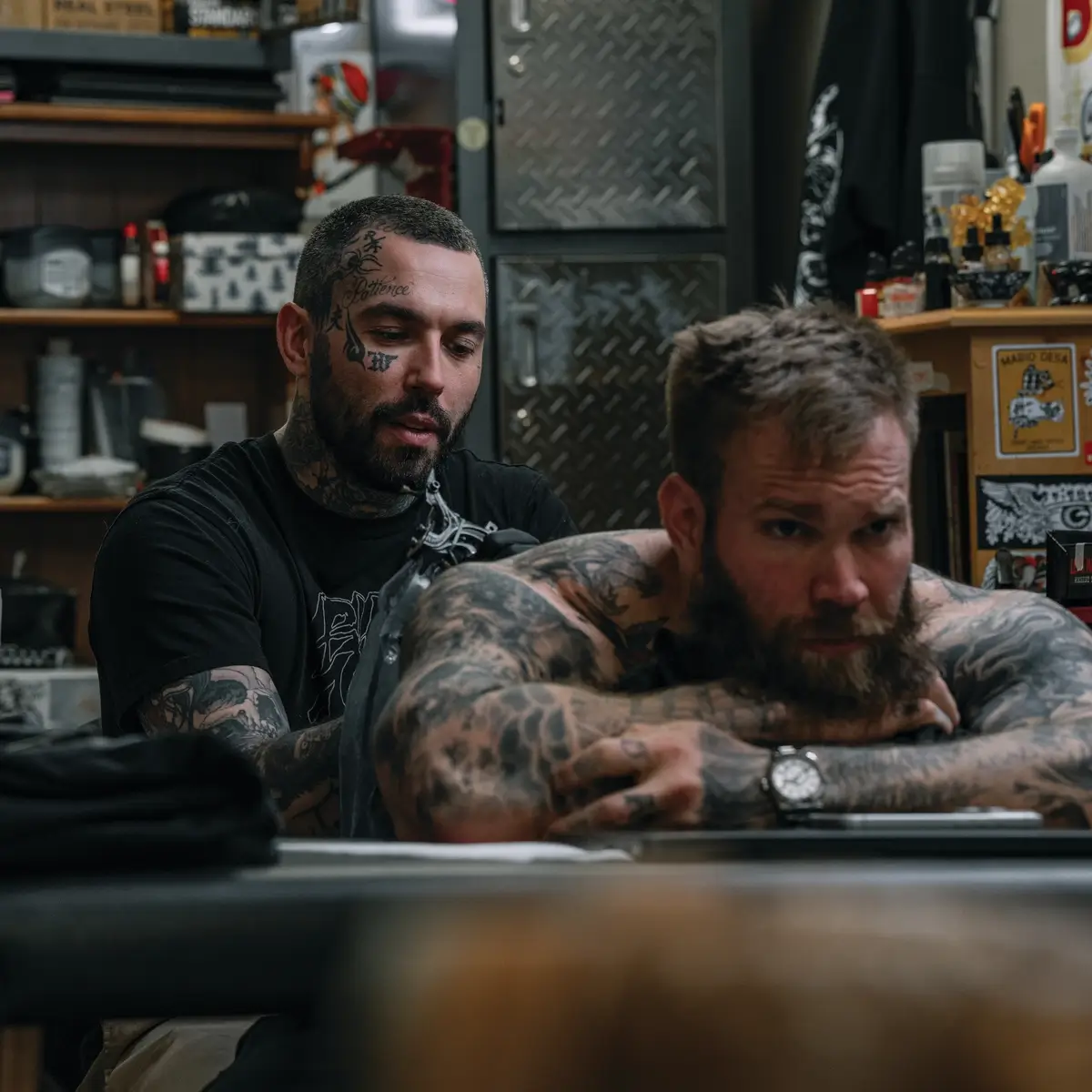
The Inked photographs establish Jordan Shallow as a heavily tattooed subject before the individual designs are discussed. In the face-visible session portrait, dark marks rise along the side of his head and continue through the neck, while the forearms and hands carry additional linework. The ink is visible in the same frame as his expression, beard and close-cropped hair, so the portrait records the tattoos as part of his recognizable appearance rather than as isolated details.
Small hand tattoos appear beside the larger coverage on the arms. Their scale is easy to miss when the camera is pulled back, but they become part of the visual rhythm around the wrists and fingers. The marks do not form one uniform block. Some are compact symbols or letters, while other areas are filled with heavier black and grey work. That mixture gives the hands a layered look consistent with the rest of Shallow’s collection.
The profile does not assign a private meaning to every mark visible in the portrait. It does identify the broader direction of his collection: Shallow chooses artists for their craft and the history behind their work. The face-visible photograph therefore works as a reliable overview of placement and density, while the more specific tattoos are explained through the profile’s descriptions of individual sessions.
The chest piece from a long session
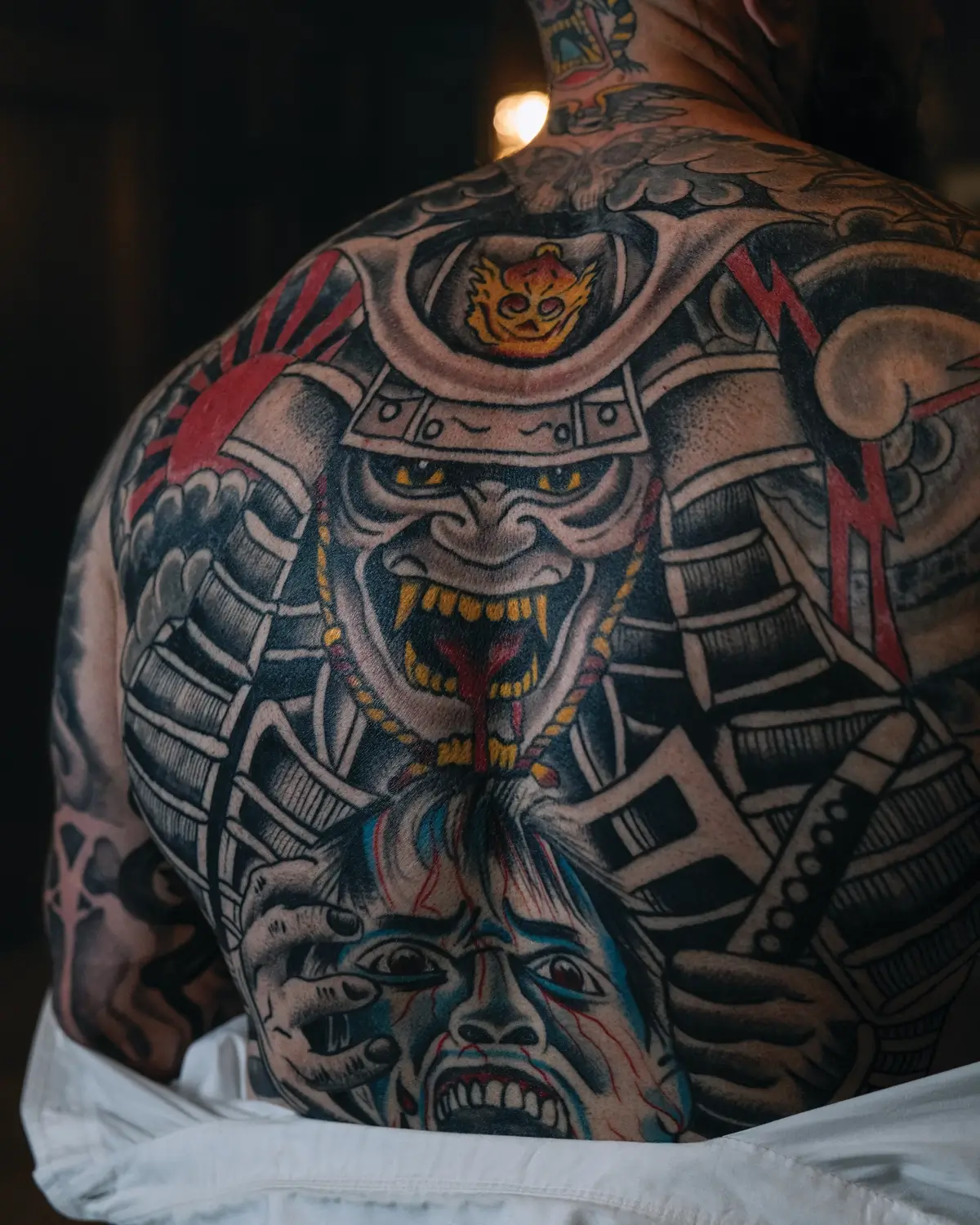
One of the most dramatic images in the profile is a close view of the chest and upper torso. The composition is dominated by a large illustrative figure with an armored, mask-like face, heavy black outlines and patches of red, yellow and blue. Smaller figures and decorative forms sit around it, creating a dense arrangement rather than a single small emblem. The piece is presented as work completed by Hector Salas during a session that lasted 15 hours.
That duration matters to the description because the chest tattoo is not treated as a quick addition to a growing list. It is a major section of the body, with multiple faces, ornamental shapes and strong color accents held together by a shared illustrative style. The central figure looks forward from the chest while the surrounding elements create a border of darker shapes and curved lines.
Shallow describes the chest work in the context of the relationship between collector and artist. His remarks emphasize the intensity of the process and the value of allowing an experienced tattooer’s point of view to shape the result. The published record supports that connection without inventing a symbolic explanation for each figure. What is clear is the placement, scale, color contrast and the unusually long session attached to the piece.
Jordan Shallow’s right-leg tiger tattoo
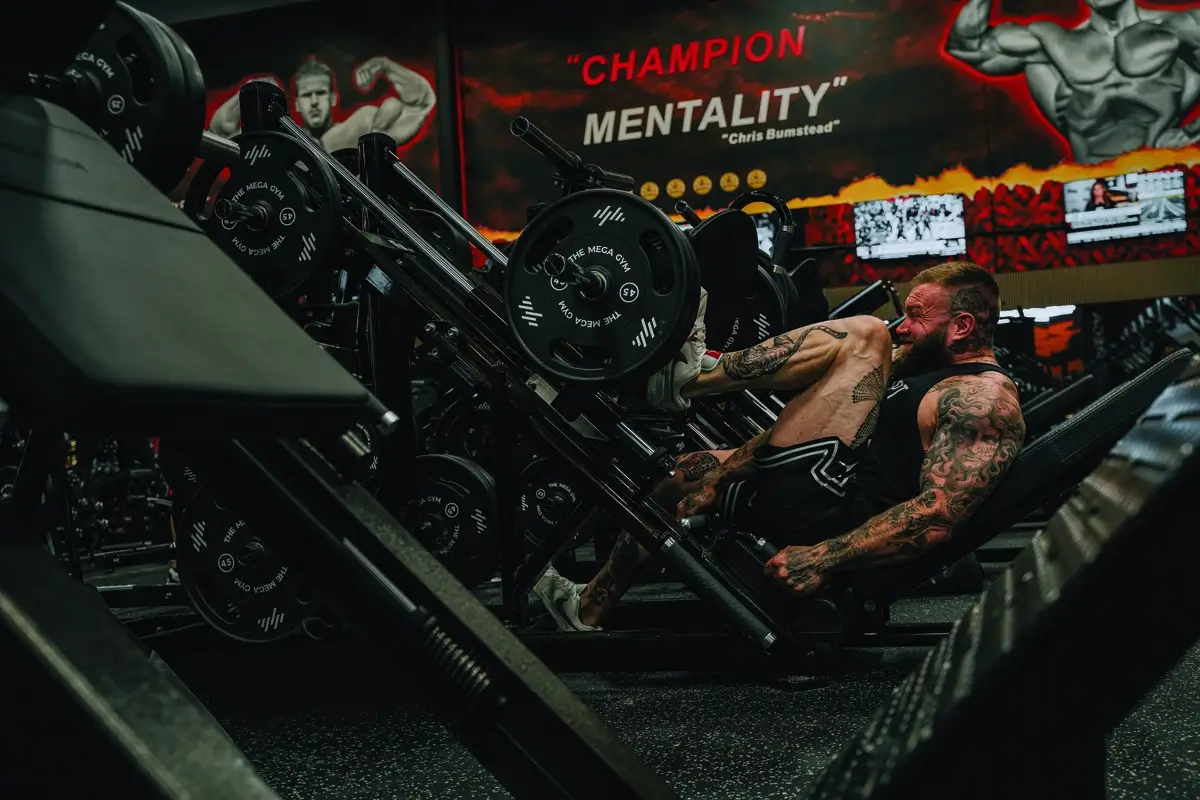
Shallow’s right-leg tattoo history includes a Bob Shaw fighting tiger that he received from Brett Masse. The profile places that tattoo at the point when his approach to collecting changed. Masse showed him a black-and-white flash sheet, and Shallow describes the encounter as opening his eyes to the history, nuance and craft of American electric tattooing. The tiger is therefore documented as both a body placement and a turning point in the way he understood his collection.
The gym photograph shows the right leg among the wider network of lower-body tattoos. Dark linework and shaded designs continue around the thigh and lower leg, while the seated pose reveals how the pieces sit beside the arms and torso coverage. The leg is not presented as an empty space waiting for one final image. It already carries multiple designs that read as parts of a long-running archive.
The tiger also explains why Shallow’s tattoos are described through their artists as much as through their subjects. The profile names Brett Masse and Bob Shaw while discussing the visual lesson Shallow took from the work. His tattoo history is consequently tied to individual makers, flash traditions and the places he visits, not only to the images visible on his skin.
Japanese and illustrative layers across the arms
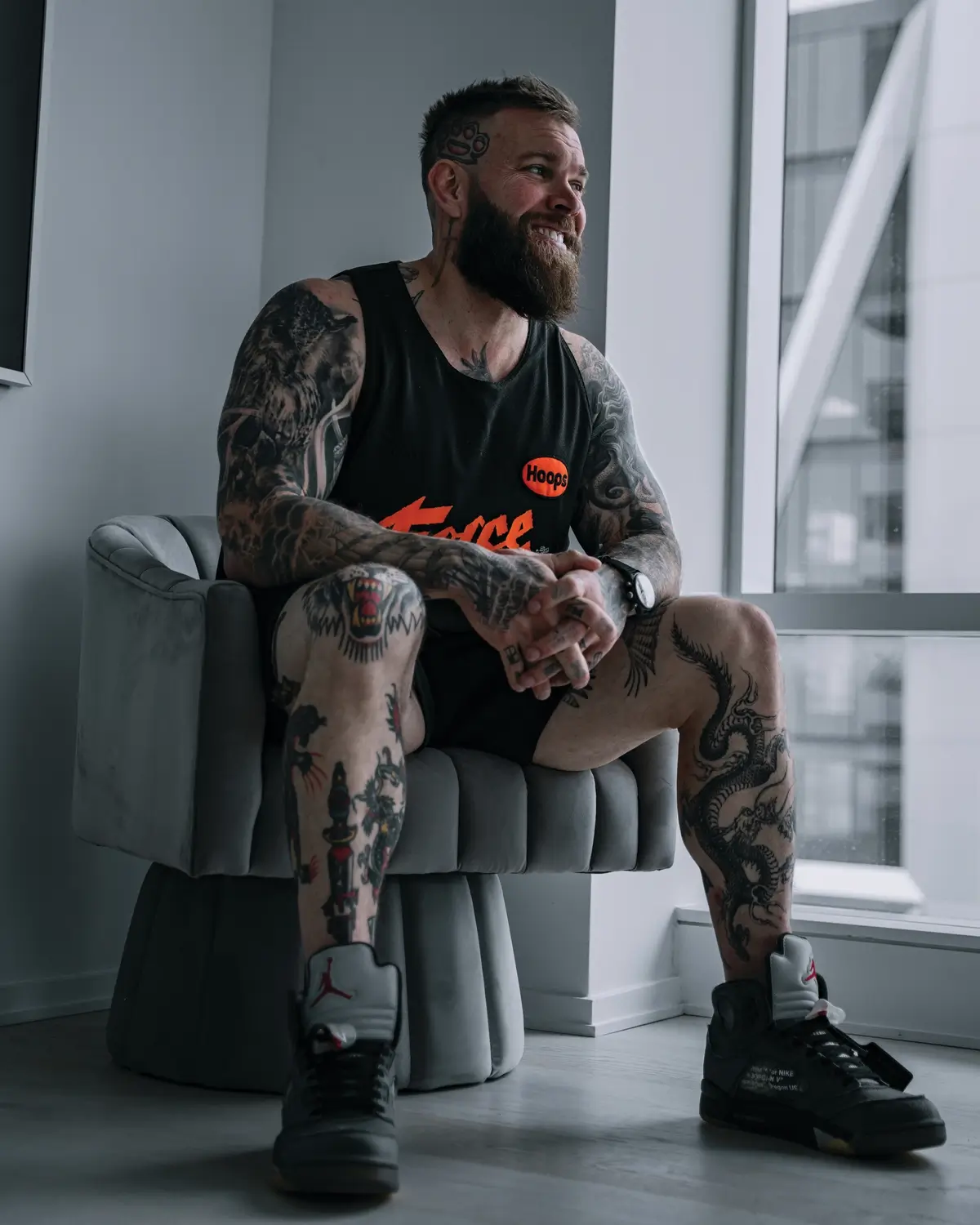
The full seated portrait shows the density of Shallow’s arm coverage. His shoulders, upper arms and forearms carry overlapping black-and-grey imagery, with different pieces meeting around the elbows and wrists. A portrait-style figure is visible on one upper arm, while the opposite arm contains darker ornamental work. The tattoos vary in scale, but the repeated use of line, shading and strong silhouettes keeps the collection visually connected.
Shallow tells Inked that he has travelled through Europe and Asia for tattoo sessions when his work takes him there. That travel history helps explain the range visible in the photographs. The collection includes American electric tattooing, large illustrative figures and Japanese-inspired ideas, but it is not reduced to a single style label. The profile presents the differences between the pieces as part of the appeal.
The arm tattoos also show why the same design can look different in a close crop and a full portrait. At close range, a figure or shaded section becomes a study in line weight and color. At a distance, the individual tattoos overlap into a continuous field that frames the torso. Shallow’s photographs preserve both views, allowing the collection to be read as separate designs and as one connected surface.
Eagle and lower-body tattoos in Jordan Shallow’s collection
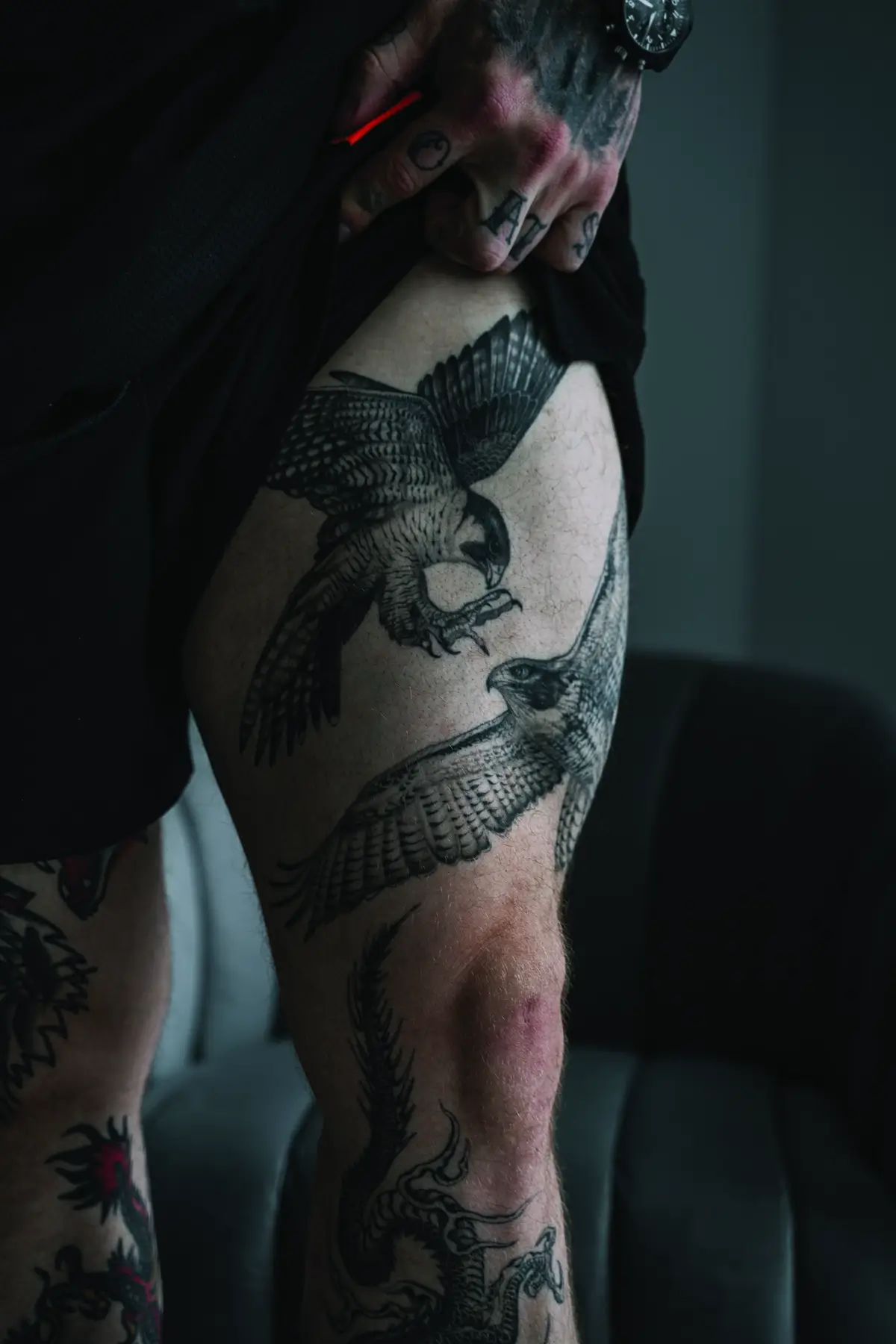
A separate close photograph focuses on an eagle tattoo across the upper leg. The bird is rendered in dark linework, with extended wings, a curved beak and layered feather texture. Additional imagery continues below it, including a dragon-like form on the lower leg. The arrangement shows how Shallow’s tattoos combine recognizable animals with larger compositions that follow the shape of the limb.
The eagle is visually different from the bright chest piece and from the compact marks on the hands. Its palette is almost entirely black and grey, and its strongest effect comes from the direction of the wings and the repeated feather lines. The photograph also includes part of the hand and other leg work, making the eagle one element within a much wider record rather than a standalone emblem.
Across the full set of images, the legs receive the same level of attention as the arms and chest. Shallow’s collection extends over multiple body areas, and the lower-body photographs make that scale clear. The documented pieces are connected by their placement within the broader collection, while their styles remain distinct enough for the profile to identify individual artists and sessions.
How the collection became a connected story
Shallow describes tattoos as a way to preserve contact with artists and with the history of the form. His first serious collecting period is linked to Brett Masse’s black-and-white flash, which changed the way he looked at tattooing. Later sessions expanded that interest through work by artists in different countries and traditions. The profile repeatedly places the designs inside those encounters.
That history is visible in the images. The chest piece has the density of a long session, the right-leg tiger carries the memory of a particular artist’s flash, and the arms contain overlapping work gathered over time. The skull on the inner forearm is tied to Benjamin Laukis and a trip to Greece. Each named piece adds another location and another maker to the collection.
Shallow’s body art is therefore best understood as a sequence of documented relationships. The visible designs matter, but the profile also preserves the names of the artists, the places connected to the sessions and the aesthetic discoveries that shaped later choices. That combination gives the photographs a stronger narrative than a simple inventory of motifs.
What the profile establishes
The published profile establishes that Jordan Shallow has extensive tattoos across his head, neck, arms, chest and legs. It specifically documents the inner-forearm skull by Benjamin Laukis, the chest piece by Hector Salas, the Bob Shaw fighting tiger associated with Brett Masse, Japanese-inspired work and the eagle and lower-body imagery shown in the Inked photographs. It also establishes that the collection remains unfinished.
Shallow has spoken about keeping some areas, including his neck, outside the current collection because of his mother’s wishes. He has also described a future word tattoo, “replaceable,” as a possible final piece near the hairline. Those comments are part of the documented tattoo history, but they are not present tattoos. The distinction matters: the current photographs show existing ink, while the interview records ideas that may or may not become future work.
Jordan Shallow’s tattoos form a changing archive of skulls, animals, figures, lettering and large illustrative compositions. The designs occupy nearly every visible part of the body in the published photographs, yet the collection remains readable through the artists and sessions attached to each major piece. The Inked profile’s strongest contribution is that it keeps the images connected to those documented stories without pretending that every mark has a public explanation.