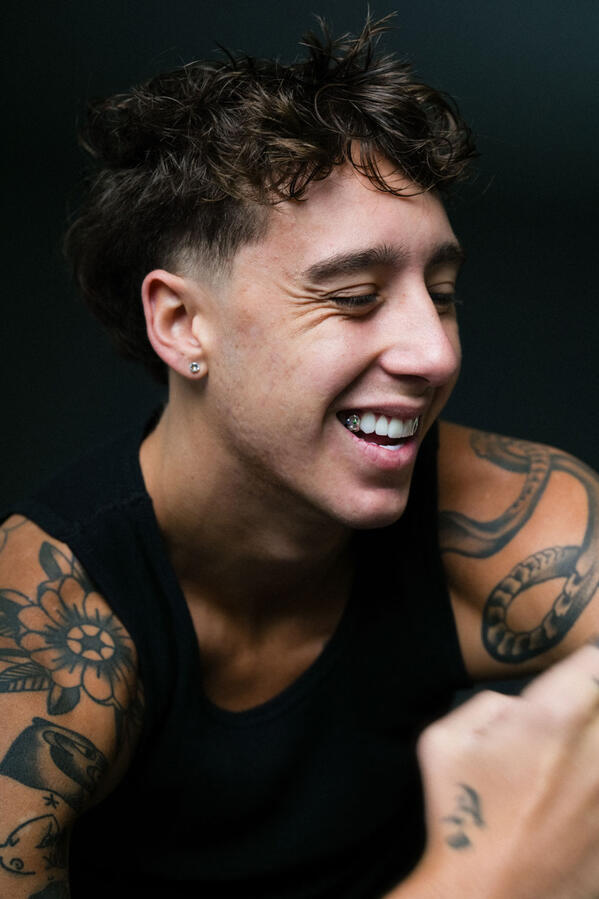
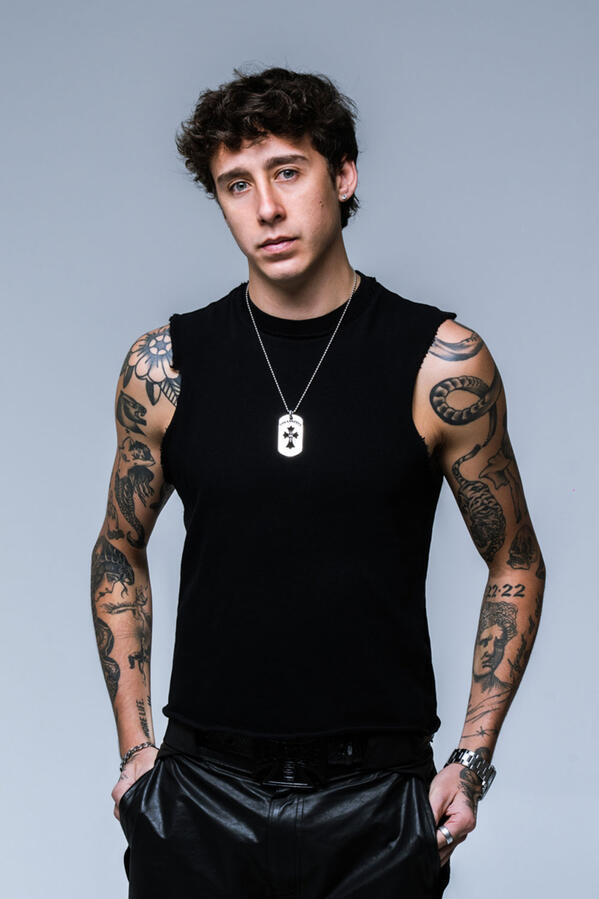
ZUEZEU’s tattoos are part of the visual identity of a rising electronic artist whose photographs rarely leave the arms, hands or torso out of frame. His collection is dense but not visually anonymous. Large flowers, serpents, figures, lettering and smaller symbols sit together in black-and-grey work that changes scale from shoulder pieces to fine marks across the fingers. The result is a body map that feels connected to the same restless energy as his music while remaining grounded in specific, visible designs.
In interviews, ZUEZEU describes his tattoos as milestones attached to different chapters of his life. He identifies the large back piece as his favourite because it is based on the cover art for his debut album, More Life. He has also said that the private meaning of that design is not something he wants to explain in full. That boundary is useful when reading the photographs: the images document the shapes, placements and visual language, while the artist’s comments identify only the meanings he has chosen to share.
The clearest pattern is the contrast between illustrative arm work and personal lettering. The arms carry most of the immediately recognisable imagery, including a broad floral tattoo, a snake, a standing figure and darker animal or ornamental forms. The torso adds large lettering and additional symbols, while the hands and fingers bring the collection into close-up portraits.
The shoulder tattoos set the visual tone of ZUEZEU’s collection
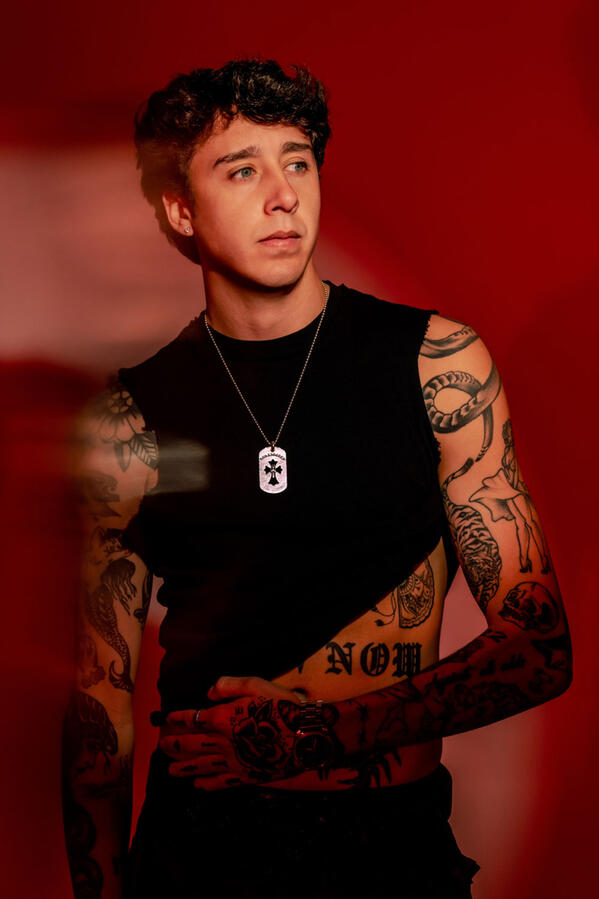
The shoulder line is where the collection first becomes easy to read in the official portraits. On one side, a large flower spreads across the upper arm with rounded petals and a dark centre. On the other, a thick curved band and adjacent linework create a heavier, more graphic shape. The pieces do not match, but they balance one another across the top of the body.
Below the flower, additional black-and-grey imagery continues down the upper arm. The lines are bold enough to remain visible in a full-length photograph, yet the designs contain smaller interior marks that become clearer when the camera moves closer. That mix of scale gives the shoulder work a layered appearance instead of making it read as one uninterrupted block of ink.
The photographs also show how clothing changes the emphasis. A sleeveless black top exposes the shoulder edges and leaves the chest mostly covered, making the upper-arm designs function as the portrait’s main graphic elements. In a closer image, the same placement becomes part of a larger story that includes the forearms and hands.
A serpent and standing figure occupy the most readable arm spaces
A long serpent is one of the most legible designs in the collection. It curves along the upper arm in a rounded silhouette, with the body outlined heavily and broken into sections by interior lines. The placement follows the arm rather than sitting as a small emblem, so its shape remains visible when the arm is relaxed or turned toward the camera.
On the opposite arm, a standing female figure appears in fine linework. The figure’s outline is lighter than the serpent’s, and the open skin around it keeps the design distinct from the denser pieces nearby. The difference in treatment is part of what makes the collection visually varied. ZUEZEU’s tattoos include both thick, almost emblematic black shapes and delicate illustrative outlines.
Other arm photographs show additional figures, animals and ornamental marks arranged around these focal designs. The images do not establish a single narrative for every tattoo, and ZUEZEU has not publicly assigned a meaning to each one. What they do show is a collection built through accumulation, with newer and older-looking marks sharing the same arms without being forced into one repeated style. The serpent remains the clearest arm-length silhouette.
The forearms carry lettering, portraits and compact blackwork
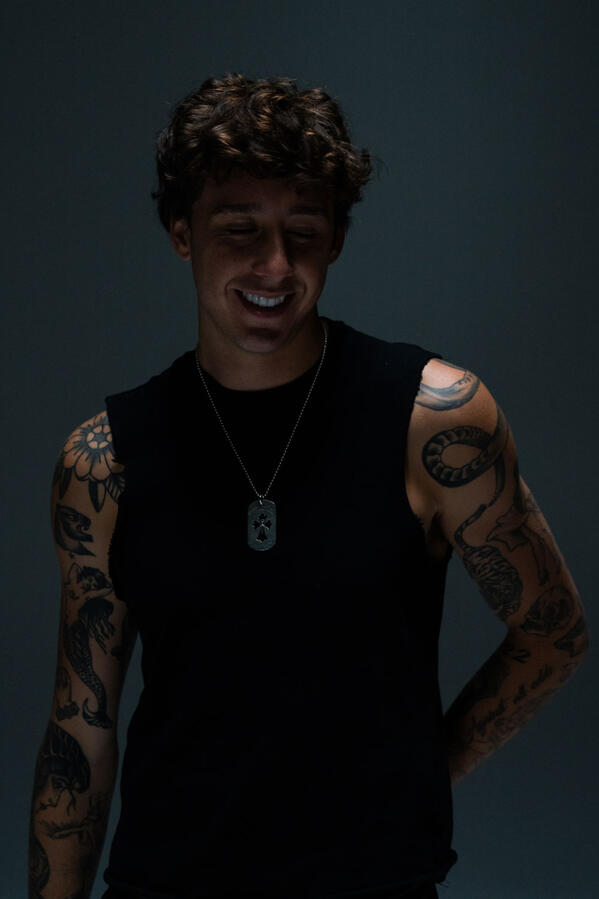
The forearms provide the densest close-up view of ZUEZEU’s tattoo language. Script runs along one forearm, while the other shows smaller drawings, dark outlines and compact symbols grouped around the wrist. A portrait-like face is visible among the lower-arm work in the official gallery, and the surrounding linework gives it enough space to remain identifiable.
Lettering appears in several forms. Some words are large enough to read across the stomach or lower torso, while other marks sit close to the wrist and hand. The different scales prevent the typography from becoming a single visual wall. Large letters act as anchors, and the smaller writing behaves more like detail around the illustrations.
The forearm tattoos are also where the passage of the collection becomes most apparent. Some lines are crisp and open, while other sections are darker and more crowded. The photographs do not provide dates for each design, but they do show how the arm has become a working surface for several kinds of tattoo: text, portraiture, ornamental shapes and figures.
The hands and fingers bring the tattoos into portrait close-up
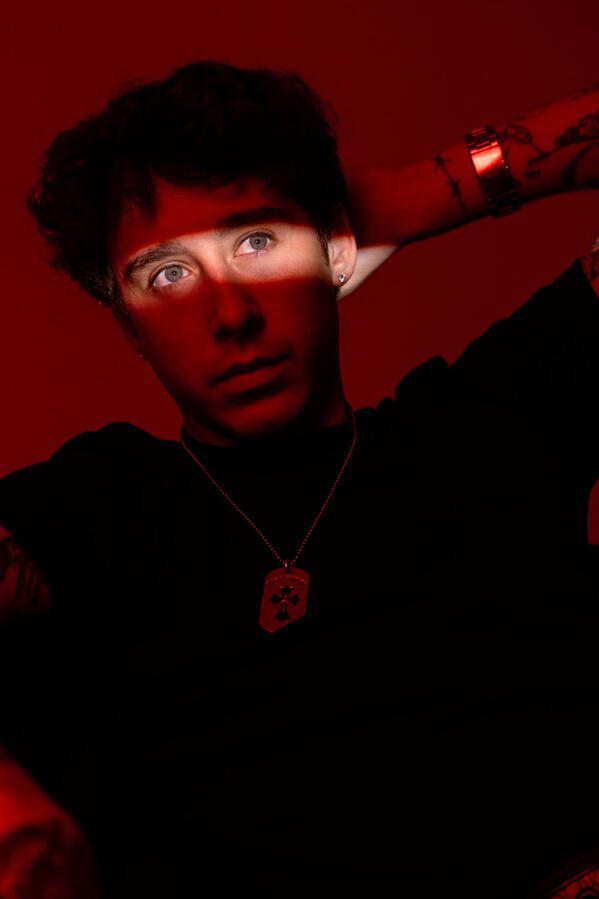
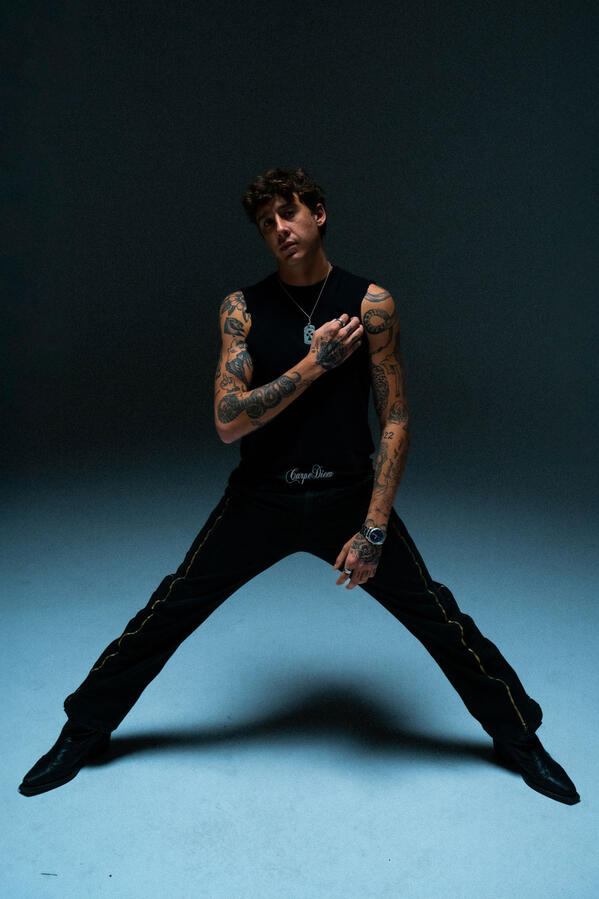
Hand tattoos become visible whenever ZUEZEU rests his fingers across his chest or face. The marks are smaller than the arm pieces, but they change the character of the portraits because they remain close to the camera. Dark symbols sit across the fingers, and additional linework appears around the back of the hand and wrist.
These designs make the collection readable even in photographs where the torso is mostly hidden by clothing. A hand placed over the chest reveals a compact blackwork map, while a close portrait brings the finger marks into the same frame as the shoulder tattoos. The result is a visual link between the largest pieces and the smallest details. The hand marks are small, but they remain among the most immediate details in a close portrait.
The hands also show that ZUEZEU’s tattoo history is not limited to the most dramatic illustrations. Small marks can be just as important to the overall identity because they are repeated across photographs and remain visible during ordinary gestures. The collection therefore reads at several distances, from the full sleeve-like effect of the arms down to the symbols that appear only when the hands move into view.
The More Life back piece connects the tattoos to his music
ZUEZEU has identified the back piece as his favourite tattoo and connected it directly to the debut album More Life. He describes the album as a defining early chapter, and the back design turns that chapter into a large permanent image. He has deliberately kept the exact private meaning of the artwork to himself, so the reliable description is its connection to the album and its role in his personal timeline.
The back piece is also important because it expands the collection beyond the highly visible arm tattoos. In front-facing portraits, the shoulder, forearm and hand work dominate. A rear-facing or turned photograph shows that the body art continues across another broad surface, giving the collection more depth than a pair of sleeves alone would suggest.
Its scale changes the way the other tattoos are understood. The arms can be read as a series of separate images, while the back functions as a single large statement tied to an album. That difference in scale is one of the strongest features of ZUEZEU’s tattoo history: individual memories and visual experiments sit beside one design that represents an entire period of his work.
How the official gallery changes the mood of the story
The official gallery presents ZUEZEU in several poses, from a close portrait to a seated image and a full standing frame. Across those changes, the same tattoo map remains visible. The arms are consistently the most information-rich area, but the torso lettering, hand marks and shoulder shapes keep returning as the pose changes.
Movement is part of the visual identity. ZUEZEU’s public image is built around high-energy performances, and the tattoos are often photographed while he is leaning, reaching or turning. That movement changes which designs sit in light and which disappear into shadow, but it also demonstrates how the pieces follow the body rather than functioning as flat front-facing graphics.
The photographs show a collection that can look delicate in one frame and heavy in the next. A close-up isolates the flower and face, while a wider shot reveals the full density of the arms. Both views are accurate because the tattoos combine open linework with darker fields and place different subjects at different distances from the camera.
The artist’s own account of the work
ZUEZEU has said that his tattoos are connected to moments and chapters in his life, and he has singled out the More Life back piece as the strongest example. He has not turned the collection into a catalogue of public explanations. Some designs are described visually in photographs, while others remain personal or have not been discussed in a reliable interview.
That distinction matters when looking at the snake, flowers, figures, lettering and smaller marks. Their placements and forms are visible evidence. Their private symbolism is not automatically known. The documented story is that the collection has grown alongside his music and that the back piece preserves the memory of his first album.
The collection is defined by contrast rather than one repeated motif
ZUEZEU’s tattoos do not follow a single subject. Floral work sits beside serpentine forms; fine-line figures share space with heavy outlines; lettering crosses the torso while compact symbols occupy the hands. What connects the pieces is the way they accumulate across the body and appear together in the artist’s portraits.
That combination gives the collection a distinctive visual identity. The tattoos are not background decoration in the available photographs. They shape the silhouette of the arms, interrupt the open space of the torso and add close-up detail to the hands. The More Life back piece adds a separate musical chapter, while the arm work records the changing visual language of the artist himself. The collection is recognisable because these contrasts remain visible together.
ZUEZEU’s documented tattoos form a dense black-and-grey collection built from flowers, serpents, figures, lettering and small hand marks. The official photographs make the placements clear, while his interviews provide a limited but meaningful history: the tattoos mark different life chapters, and the large More Life back piece preserves the beginning of his album-era identity. The most reliable picture is therefore both visual and personal, with the designs fully visible even where their private meanings remain his own.