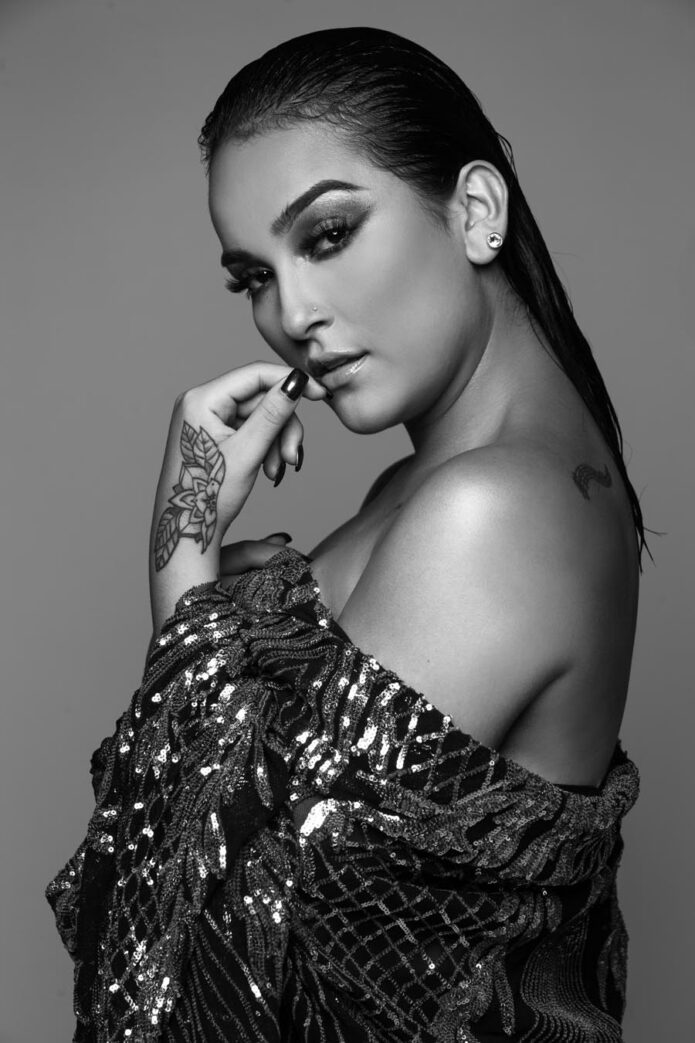
Daniela Darcourt has a line on her back that makes a lot more sense once you know who else wears it. Her sisters have it too. The phrase is Ensemble quoi qu’il arrive, a promise to stay together whatever happens. It’s a small piece of lettering, easy to miss beside the larger work on her arms, but it gives you a good place to start with her tattoos.
The Peruvian singer’s collection mixes writing with bolder decorative work. You can spot some of it straight away in studio photographs; other pieces need a closer view. The useful distinction is between what a photograph lets you see and what Daniela has actually explained. A flower can look beautiful without giving a stranger permission to decide what it means to her.
The matching back lettering she shares with her sisters
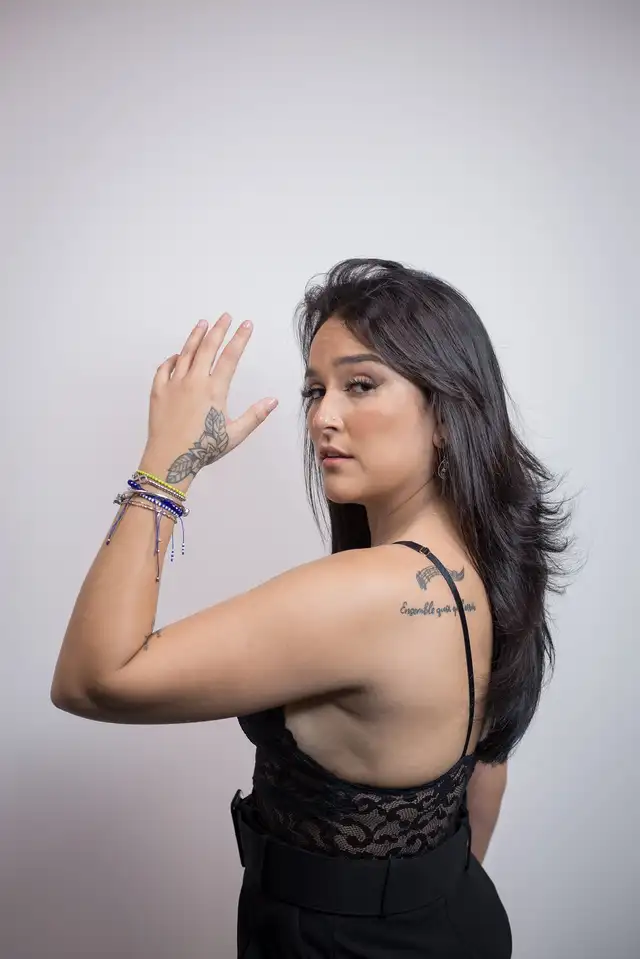
In her December 2021 interview with La República, Daniela identified the French phrase on her back and said that she and her five sisters all had the same tattoo. The six of them had it done at her apartment. The shared phrase is a family connection, and that meaning comes directly from her explanation.
It translates naturally as Together, whatever happens. In the accompanying photograph, the lettering sits across the upper back near the shoulder blade. It’s a compact horizontal line, with plenty of bare skin around it. A clothing strap passes through the area in this particular view, so the photograph isn’t a perfect lettering reference. It does establish the placement and the small scale of the piece.
That scale is part of its appeal. You don’t need to read a paragraph across someone’s back to get the idea of a shared promise. The line has room to sit quietly beside the other work above it, and it doesn’t turn the entire upper back into one continuous block of ink. The sisters’ decision to repeat the phrase also gives it a connection beyond Daniela’s own body.
She told the interviewer that she liked French and connected that interest to her family name. There’s no need to attach a more elaborate explanation to the language choice. The wording, the people who share it and her own account already give the tattoo a clear reason to exist.
A collection built around people she knows
Family comes up in her earlier explanations too. Speaking with El Comercio in 2020, she described a tattoo made from her grandfather’s signature and three little stars representing her mother, her sister and herself. She also mentioned a piece on her left arm that she felt summed up her life, without giving a detailed explanation of its imagery.
Those are separate accounts of separate pieces. It’s tempting to look at a photograph, notice a patch of writing and announce that you’ve found the signature. Unless the actual inscription is clear, that’s a leap. A reported meaning and a visible mark aren’t automatically a match. The same care applies to the stars, which shouldn’t be confused with every tiny shape visible in a distant photograph.
What does come through is her interest in keeping reminders close. That’s a practical way to think about a personal collection: a small mark can carry a very specific association for its owner without explaining itself to everyone else. You might recognize the object immediately and still know nothing about the person behind it.
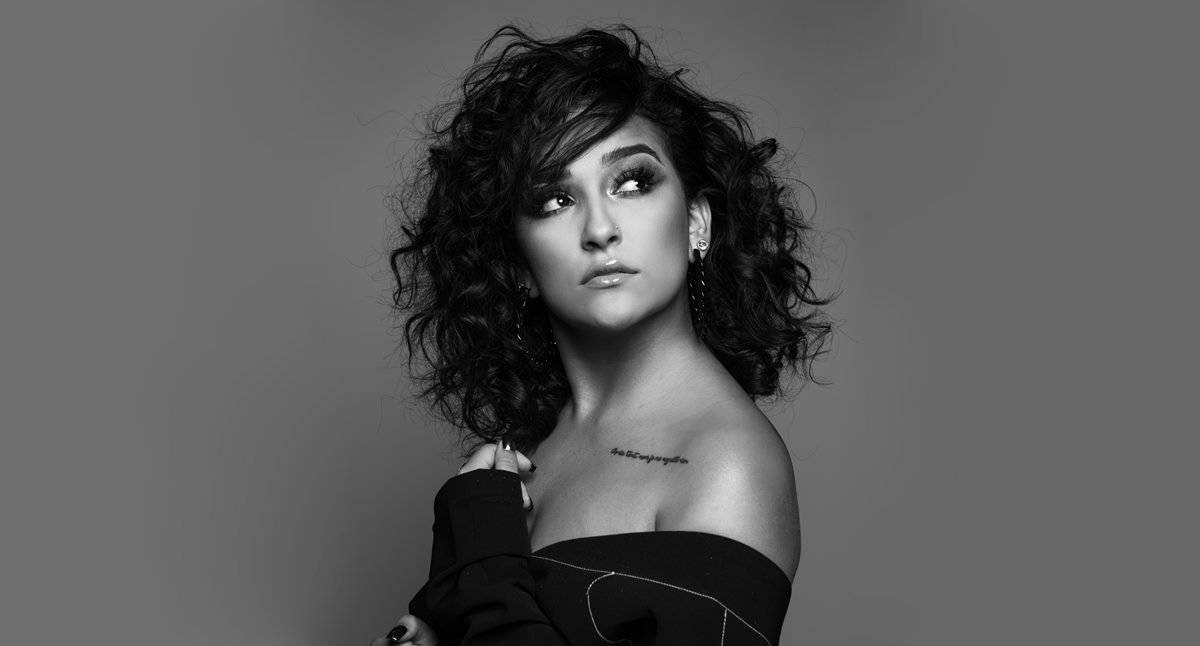
The studio photograph here is useful for seeing Daniela’s overall presentation. It isn’t offered as a close-up of those family pieces. Her expression, short curls and simple background keep the picture focused on her, while the small writing at the collarbone stays one part of a much larger image.
Small details beside bigger pieces
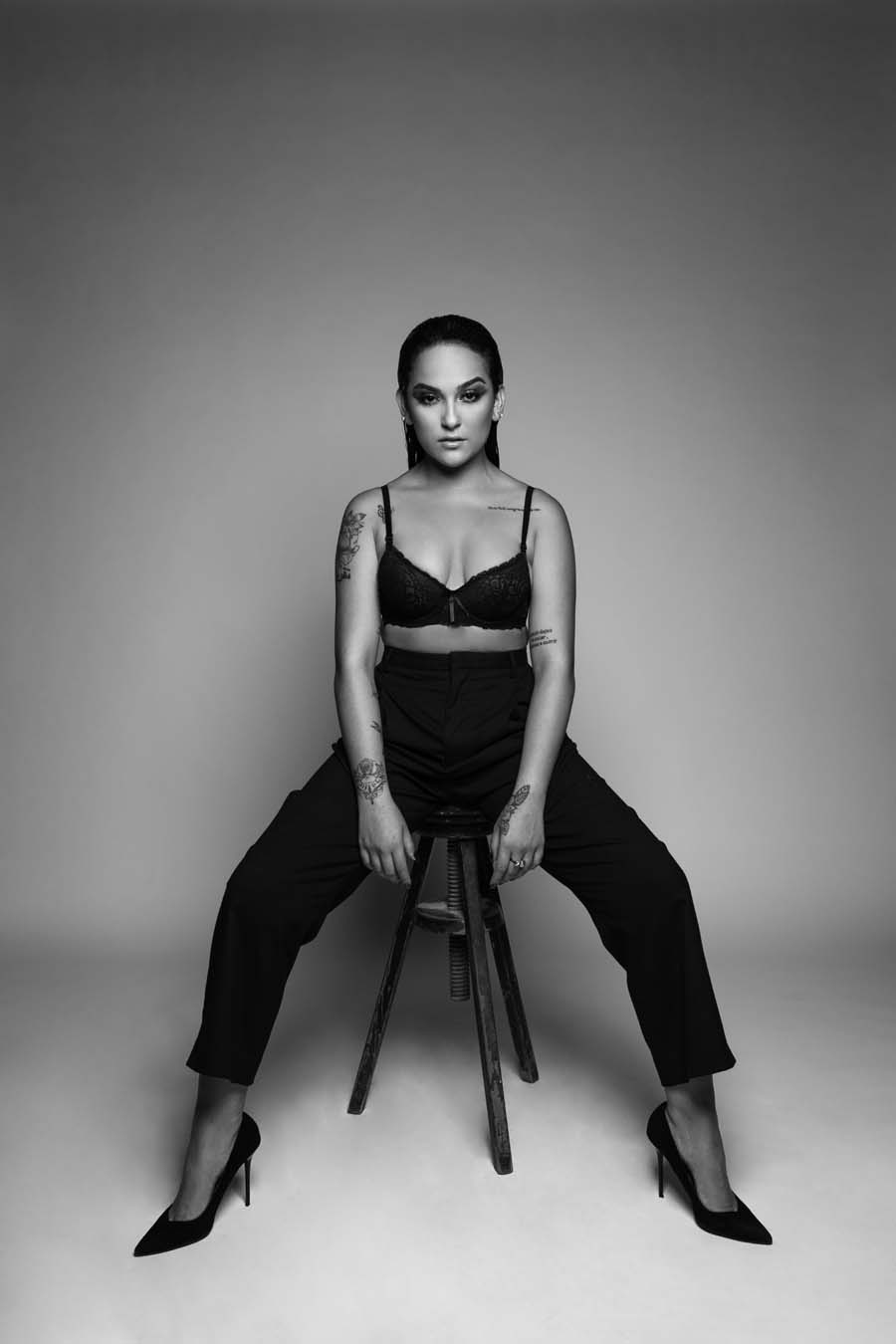
The full-length studio view makes the spacing easier to appreciate. Larger dark areas sit around the upper arm, while smaller marks appear closer to the wrists and chest. Her clothes cover some areas and leave others open. Even with several visible pieces, there’s still a lot of space between them.
That space matters visually. Separate tattoos don’t have to be joined with filler just because they occupy the same limb. Each can retain its own edge and size. In this photograph, the gaps let your eye move between the larger upper-arm work and the smaller details lower down without everything merging into one shape.
This is also why counting tattoos from a full-length picture rarely works. A small inscription may be hidden by a strap, a wrist may turn away, and several marks can overlap in perspective. The visible collection gives you a sense of distribution, not a reliable total. Zooming in until the pixels fall apart doesn’t fix those limits.
If you’re drawn to the balance of her collection, pay attention to that distribution before focusing on any individual motif. Placement changes the way a collection reads. A small design surrounded by open skin has a different presence from an equally small one packed between several larger pieces. Neither approach needs to be declared better; they simply do different things.
How she looks on camera
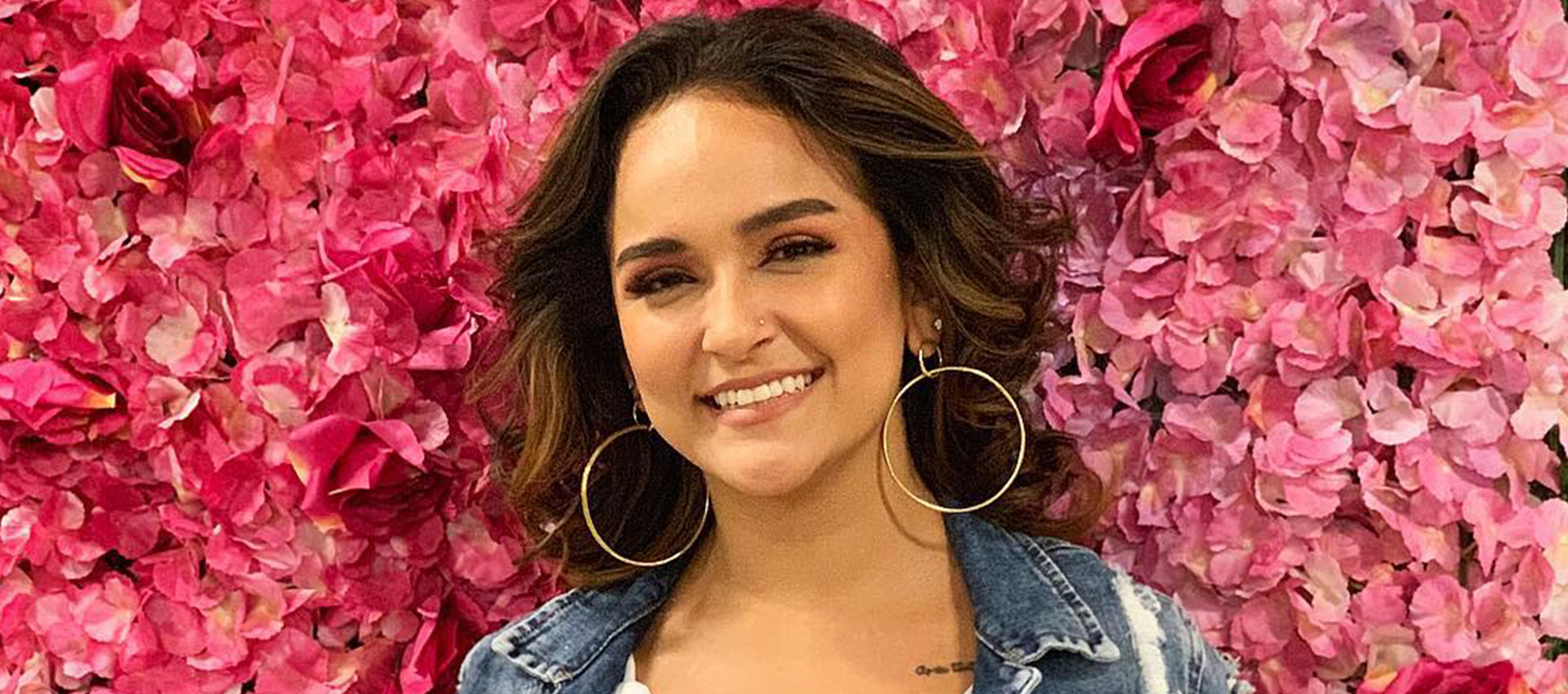
Daniela doesn’t have one fixed photographic style. The flower-wall portrait has a warm, casual feel, with a denim jacket and a broad smile. The black-and-white studio pictures feel more formal. Her face is clearly recognizable in both, even though the hair, clothes and lighting change the mood quite a bit.
That’s helpful when looking through celebrity tattoo pictures. A polished studio photograph can make dark linework stand out strongly, while a bright background or patterned outfit pulls attention elsewhere. Those differences don’t establish that a piece was added, removed or altered. Sometimes the same person is simply being photographed in a very different way.
The flower-wall image is included for that wider context, rather than to identify a particular tattoo. It shows how little of a collection may be visible in an ordinary upper-body portrait. You can know that someone has several pieces and still see almost none of them in a picture where a jacket does most of the covering.
For anyone collecting visual references, keeping the entire photograph is useful. A tiny crop can make an inscription look like the main event when it was barely visible in the original composition. Seeing the whole frame helps you understand its actual prominence, especially beside clothing, jewelry and the natural position of the body.
El Porvenir and the wider picture
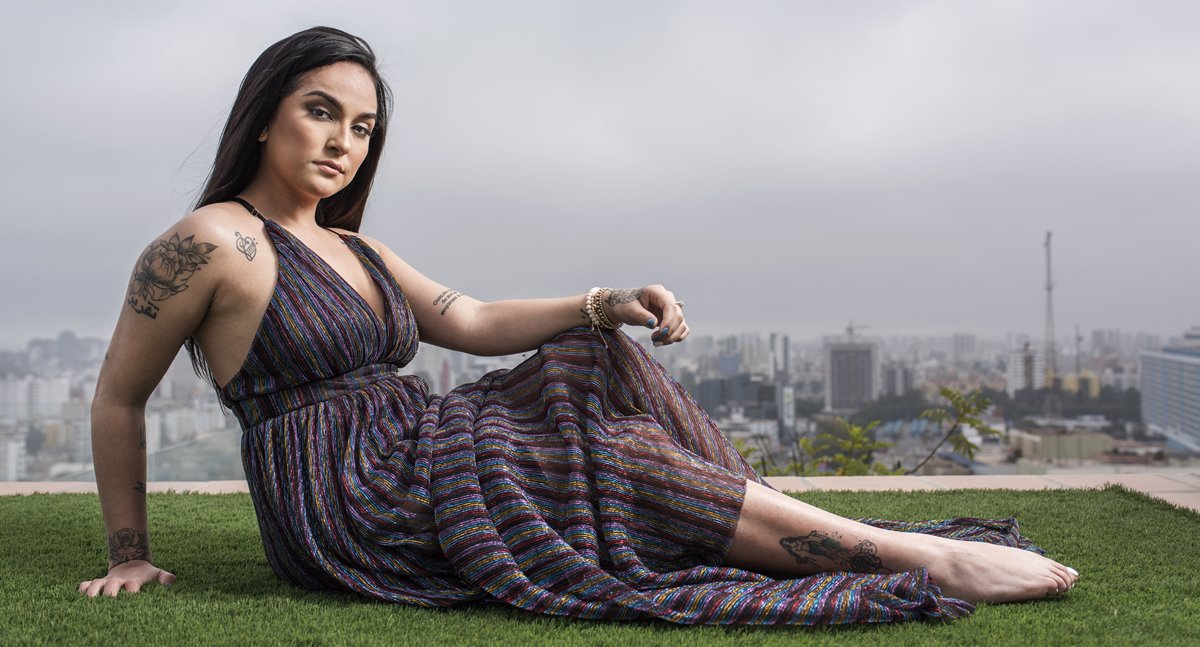
The home portrait published with her 2020 Somos interview gives a different view again. Daniela is seated outdoors in a long patterned dress, with the city behind her. Several areas of ink are visible, but this is an environmental portrait, not a catalogue of individual designs. It lets you see how the pieces sit together when she isn’t posed against a plain studio backdrop.
That interview spent time on El Porvenir, the Lima neighborhood where she grew up, and on the family routines she still associated with it. Her memories included going out for food with her mother and sisters. This adds some everyday context to a collection in which family already has a documented place, without proving that every design refers to her childhood.
There’s a difference between noticing a connection and inventing one. The shared French phrase has an explanation from Daniela. The signature and stars have her explanation too. An unrelated shape visible on her leg doesn’t become a tribute to the neighborhood just because it appears in a photograph taken at home.
Her own explanations are enough. They leave room for the collection to include decoration, private references and pieces she hasn’t discussed in detail. A tattoo doesn’t become less interesting because its owner hasn’t supplied a public backstory, and an article doesn’t need to fill that space with a guess.
Keeping the count in perspective
Daniela said she had 19 tattoos in the 2020 El Comercio interview. La República described 24 in December 2021. Those figures belong to those interviews. They shouldn’t be repeated as a current count, and they don’t provide a complete timeline of every addition.
Even a straightforward number can become misleading when it gets detached from the moment someone said it. A singer can keep getting tattooed after an interview, while an old profile continues circulating with its original total. The sensible way to handle the figures is to keep the dates attached and avoid pretending a few photographs settle the question.
She also spoke in 2020 about becoming interested in tattoos at 15. That’s an account of when her curiosity started, not confirmation of the date of her first appointment. It’s a small distinction, but a useful one. Interest, a first design and a later collection are different stages, and they shouldn’t be compressed into a single invented milestone.
For a reader considering a first piece, the more useful idea is her reason for collecting reminders. You can begin with a person, a phrase or a particular memory and decide how much space it needs. You don’t have to plan an entire body of work before choosing something small and specific.
Taking inspiration without repeating her promise
The sisters’ phrase works because it belongs to an actual relationship. Copying the exact sentence and placement would reproduce the appearance, but it wouldn’t reproduce that relationship. If a shared tattoo appeals to you, the better starting point is a phrase everyone involved already recognizes and would choose freely.
Think about how it sounds when you say it aloud. Does it feel like something your family would really say? Does everyone want the same wording, or just a small detail in common? Matching doesn’t have to mean identical placement, and a short phrase doesn’t need extra decoration simply to make it look more substantial.
For lettering in another language, make sure you understand the wording before treating a photograph as a spelling guide. Daniela’s back photo is partly interrupted by a strap, and the text is small within the frame. That’s enough to appreciate the piece, but it’s a poor substitute for a properly prepared reference of your own.
The other useful lesson in her photographs is patience with the whole composition. Look at the spaces around a piece, how it sits beside an outfit and how much of it is visible when the body is relaxed. Those details will matter long after the excitement of picking a motif has worn off.
Hear Daniela in her own setting
Photos only give you a still version of a performer. Daniela’s live performance of Si Tu Te Atreves in Lima brings the focus back to her voice and the stage. You don’t need to turn the video into a hunt for tiny details. It’s a chance to hear the singer whose family connections have become part of her collection.