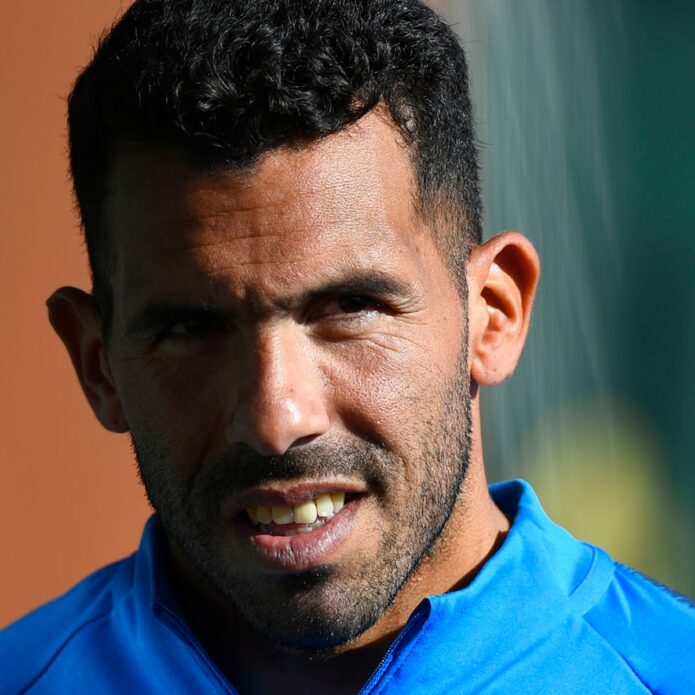
Carlos Tevez’s tattoos are hard to miss, but the large back piece draws the eye first. The former Argentina and Juventus striker has a black-and-grey scene across most of his back, inspired by Michelangelo’s Resurrection of the Dead. It reaches from his shoulders toward his waist and joins the ink on his right arm.
Tevez has shown it in match photos, interviews and social posts. The images below give a few different views; one close crop can’t show how the whole design sits across his back and shoulder.
The huge back tattoo
Reports about the tattoo say Tevez became interested in the image after seeing Michelangelo’s work in the Sistine Chapel during a visit to the Vatican. He bought a book about it and later took the idea to Polish tattoo artist Piotrek Taton.
The finished piece packs figures, shadows and architectural details into one scene. Near the neck is a brighter, sun-like area; below it, bodies and other shapes fill the back. From a distance it reads as one dark mural. Closer up, the separate figures and lines come into view.

The wide pitch-side view shows the tattoo filling Tevez’s back rather than sitting in a small panel.
Why the Sistine Chapel connection matters
The Sistine Chapel reference gives the tattoo a clear starting point. The scene is associated with resurrection, judgment and a crowd of figures in motion; Tevez’s back piece has that same busy, upward movement. It isn’t a set of unrelated angels or symbols.
The scale matters too. Tevez’s back has room for a full composition, closer to a mural than a group of small flash designs. A full-back photograph makes the layout easier to read than a tight crop.

This close view shows the scale: the artist stands beside a piece that covers almost all of Tevez’s back and reaches toward his arm.
The arm sleeve and the sun near his neck
The ink continues past the spine. Dark shading and tribal-style lines run over Tevez’s right shoulder and onto his arm, so the back doesn’t end at a neat edge or read as an isolated panel.
A large sun-like shape sits near the base of his neck. In the photos it catches the eye first, before the crowded figures below it.

This view shows the bright area near the neck and the shading through the centre.
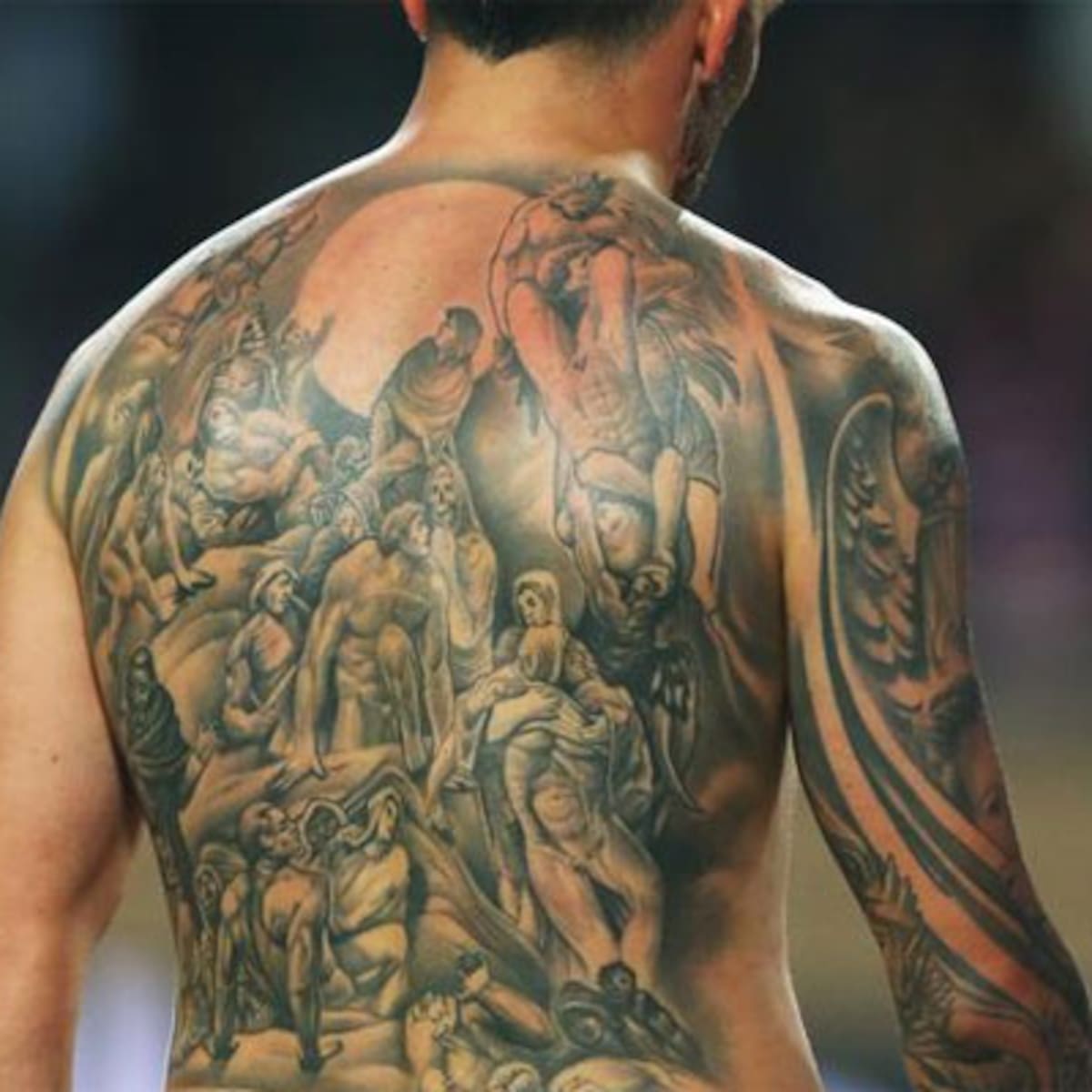
The side angle shows the ink wrapping over his shoulder instead of stopping at the edge of his back.
Close views of the arm tattoo
The arm carries dense lines and dark shading of its own, in the same bold style as the back. It can be easy to miss in match photos, where his arm is moving or partly covered by a sleeve.
The forearm has its own detail. Its darker shapes carry the larger design down toward the elbow.
This second crop shows the linework and shading more closely. It is another view of the documented tattoo work, not evidence of a separate design.
What makes Carlos Tevez’s ink stand out
The back piece follows one large visual idea, with a clear reference and a named artist. The right arm continues the dark shading, tying the work together rather than competing with it.
It looks different from the small names and dates common in celebrity tattoo galleries. This is large black-and-grey body art built around classical figures and strong contrast. The size gives the artist room to arrange a full scene around the shape of the back.
For another footballer’s collection, see David Beckham’s tattoos. Beckham’s ink is spread across many smaller pieces; Tevez’s is darker and closer to a single mural.
See the tattoo story
This video focuses on the large tattoo across Tevez’s back.
The full-back tattoo is the main event
The scene covers nearly all of Tevez’s back, from high across the shoulders toward the waist. Figures, clouds, drapery and heavy shading make it read as a scene rather than one emblem. At a glance it looks dense; closer up, the figures begin to separate.
The width of his back gave Taton room to build around the shoulders and spine. Darker areas set off lighter faces and bodies, and the composition shifts as Tevez moves. That’s why natural photos can show the layout better than a stiff, flattened pose.
Where the Sistine Chapel idea comes in
The design is commonly linked to Michelangelo’s Resurrection of the Dead in the Sistine Chapel. Tevez has spoken about finding the inspiration after a Vatican visit. The crowded figures and upward movement give the tattoo its classical, religious feel, though the finished work is adapted to his back rather than copied as a small section of the original.
A back tattoo bends with the wearer. The artist had to work around the shoulder blades and the curve of the lower back while keeping the figures readable. Photos where Tevez stands naturally show how the design follows that shape.
The right arm is part of the same picture
Photos of the back show darker work continuing over the right shoulder and onto the arm. That connection keeps the design from ending abruptly at the back’s edge. The shading carries the composition across the upper body.
Match and training photos also catch the forearm, but the angle and light don’t always show each mark clearly. The full-back scene is well documented; smaller details are better described by how they look and where they sit unless Tevez or a reliable source has explained them.
Why the tattoo works so well in football photos
In a match photo, the kit and the movement usually take over. When Tevez turns, raises his arms or lifts his shirt, the back piece becomes another large shape in the frame: black and grey against a bright jersey or the green pitch.
The classical figures make the scene easy to recognise, and the size gives them room. It draws attention because of its scale, but the reference and layout keep it from feeling like a patchwork of unrelated logos.
What to look for in the best reference photos
Full-back photos with good light show the figures across the back and how the ink reaches the right arm. A tight match crop may catch a shoulder or forearm, but it won’t explain the whole layout. Look for the sun-like shape near the neck, the group of figures through the centre and the way the shading continues across the shoulder.
For this article, the useful images are the ones that show the tattoo clearly, keep Tevez recognisable and give enough room to see its scale. A generic football photo can’t do that on its own.
One thought on “Carlos Tevez Tattoos: The Sistine Chapel Back Piece and More”